
CRM Implementation Services
Looking for CRM Implementation Services That Get Your Team Actually Using the CRM?
Six months after buying a CRM, too many sales teams are still working out of spreadsheets. We build yours around the way your business sells, markets, and supports customers, so your people open it every morning because it makes their day easier.
Salesforce · HubSpot · Dynamics 365 · Custom builds
Looking for CRM Implementation Services That Get Your Team Actually Using the CRM?
Plenty of companies buy a CRM and find, six months later, that the sales team still works out of spreadsheets. The software is rarely blamed. The setup is. CRM implementation services fix that by building the platform around the way your business sells, markets, and supports customers.
We provide CRM implementation services for growing businesses and enterprise teams, from the first strategy workshop through data migration, integration, training, go-live, and ongoing support. Whether you're on Salesforce, HubSpot, Odoo, Dynamics 365, or a custom build, the goal doesn't change. You want a system where your people open every morning because it makes their day easier.
What is CRM implementation?
CRM implementation is the work of planning, configuring, customizing, integrating, migrating, testing, deploying, and then improving a CRM, so it fits your processes and the people who use it. It's a project with a budget, milestones and risks, not a one-afternoon install.
What do CRM implementation services include?
A CRM stores your customer data as linked records. An account holds its contacts and opportunities. A lead converts into a contact and an account once it qualifies. An opportunity carries products, turns into a quote, and later an order. Customers open cases, log activities, and respond to campaigns. Set those links up correctly, and sales, marketing and service all see one version of each customer.
Our CRM implementation services cover everything needed to get there. We capture your business requirements, design the CRM architecture, then build, test, and launch. After launching the work shifts toward user adoption and optimization, since a CRM earns nothing until people use it.
What goes wrong when a CRM is implemented without a proper plan?
Most CRM projects don't collapse on day one. They fade out over a few months, and the causes are usually the same.
All of this can be fixed. Most of it can be avoided with a proper plan.
Data comes first. Legacy records get imported with duplicates, empty fields and old formats, and once a manager spots one wrong number in a report, nobody trusts the reports again. Then sales and marketing drift apart. Without shared lifecycle stages and a proper lead source field, marketing reports one lead count and sales report another.
Disconnected systems do a lot of quiet damage, too. If the CRM can't talk to your ERP, accounting software or website, someone ends up retyping orders and invoices by hand. And when reps are never trained on their own workflows, they drift back to email and sticky notes. By then, pipeline value, win rate, and sales cycle length are either missing or wrong.
What CRM implementation services do we provide?
We provide CRM implementation services across the full lifecycle, in roughly the order a project runs: strategy, build, data, integration, deployment, optimization and support. Take the whole package, or just the pieces you're missing. CRM consulting services
01
Strategy
How does our CRM strategy and road mapping set your project up?
The CRM strategy starts with your business goals, not the software. Maybe you want faster follow-up on inbound leads, or a forecast the board actually believes. We turn goals like those into a CRM roadmap with phases, milestones and dependencies, so everyone knows what launches first and what waits. A roadmap also keeps scope from quietly doubling halfway through.
How does our CRM consulting and requirements analysis work?
Our CRM implementation consultants run discovery workshops with sales, marketing, service and IT. Those sessions feed a requirements analysis covering functional, technical, reporting, security, integration and compliance needs. Each requirement gets a priority, an owner and acceptance criteria. That document is the blueprint we build and test against.
How do we help with CRM platform selection?
If you haven't picked up a platform yet, we'll compare Salesforce, HubSpot, Dynamics 365, Odoo and custom options against your requirements. We look at modules, editions, licensing, API access, customization limits, and the security model. You get one recommendation and the reasons behind it.
02
Build
How do we handle CRM setup and configuration?
People often ask how to configure a CRM. Mostly it means using the platform's built-in tools before anyone writes code. CRM setup and configuration covers objects, fields, pipeline stages, page layouts, user roles, teams, territories, and permission sets. We configure first and customize second, because configuration is far cheaper to maintain.
When does your CRM need customization?
You need customization when the standard setup can't match how you work. A manufacturer might need a custom object to track equipment. A SaaS company might need subscription fields on every account. CRM customization can add custom objects, fields, forms, views, dashboards, reports, components and full custom applications, but we only build what your requirements justify.
Why does CRM architecture matter before anything gets built?
CRM architecture is the plan underneath the system. It covers the data model, object model, user and permission models, and how integrations, automation and reporting fit together. Get it right early and the CRM absorbs more users, records and integrations without a rebuild two years from now.
How do our workflow development and automation services save your team time?
Every workflow we build has a trigger, a condition and an action, tied to a business rule you've signed off on. Typical examples include lead assignment and routing, follow-up emails, task creation, opportunity updates, approvals, case routing, and notifications. The point of workflow development and automation is simple. Reps should spend their time selling, not updating fields.
03
Data
How do we manage CRM data migration?
Data migration runs in a fixed order: assessment, data mapping, cleansing, transformation, validation, migration, and reconciliation. We map each field in the source system to its CRM equivalent, convert formats, and run test migrations. Afterwards we reconcile record counts so nothing from your legacy data goes missing.
How do data cleansing, deduplication and validation improve data hygiene?
Bad data in, bad reports out. Data cleansing and deduplication remove duplicate records, fix invalid emails and phone numbers, and standardize company names and addresses. Validation rules then stop new junk from getting in. Good data hygiene is what lets a sales manager trust a dashboard.
04
Integration
How do our CRM integration and API integration services connect to your systems?
CRM integration connects your CRM to email, calendar, your website, support tools, payment gateways, data warehouses, and BI platforms. When there's no ready-made connector, we build the API integration or third-party integration ourselves and define authentication, sync direction, sync frequency and error handling.
How do ERP, marketing, and accounting integrations help your teams?
ERP integration puts live product, stock, and order data in front of sales. Marketing integration moves leads and campaign results between your marketing automation platform and the CRM, which is where sales and marketing alignment actually happen. Accounting integration syncs quotes, orders and invoices, so finance and sales stop arguing over whose numbers are right.
05
Launch
How do testing and user acceptance testing protect your launch?
We test against written test cases at every level, including unit, system, integration, performance, security, and regression testing. Then your own team runs user acceptance testing (UAT) against the original business requirements. Defects are logged, fixed, and retested before anything goes live.
How does our CRM training fit for each department?
A sales rep and a service agent use the CRM in very different ways, so we train by department. Each role gets its own sessions, training materials, and documentation. Your CRM administrator also gets a proper knowledge transfer, so everyday changes don't depend on us.
What happens during deployment, go-live, and hypercare?
Deployment runs to a cutover plan. We also keep a rollback plan on hand, so if something breaks, we can return to the old setup without losing data. On go-live day we switch the new system on and confirm that your data came across correctly and your integrations are talking to each other. Then we stayed close. The weeks after launch are called hypercare. Your team is still learning the system, so we track how people use it and fix problems the day they show up. When someone gets stuck, they get an answer fast, before a workaround turns into a bad habit.
06
Optimize & support
How do we optimize your CRM after launch?
After a few months of real use, you can see what's working and what isn't. That's when optimization pays off. We speed up slow pages and heavy reports. We cut workflow and automation steps your team doesn't need. We also rebuild dashboards around the KPIs your leadership actually reviews, so the numbers on screen are the ones that drive decisions.
How do we improve CRM user adoption?
A CRM nobody uses is an expensive address book. Our user adoption work combines change management with adoption metrics such as logins, updated records and logged activities, plus regular feedback from users. When one team falls behind, we find out why. Usually it's something small, like a clunky layout or a missing report.
What does our ongoing CRM support and maintenance cover?
After hypercare, our job shifts to keeping the CRM healthy for the long run. When your team reports a problem, we troubleshoot it. We also watch the platform for failed syncs and errors, and we usually spot them before your users do. Platform updates are on us as well. And when the business changes, whether that's a new product line, a new team or a reworked sales process, we update the CRM, so it keeps up.
How do we implement a CRM system in stages?
The safest way to implement a CRM without disrupting the business is one stage at a time. Here's the order our CRM implementation services follow:
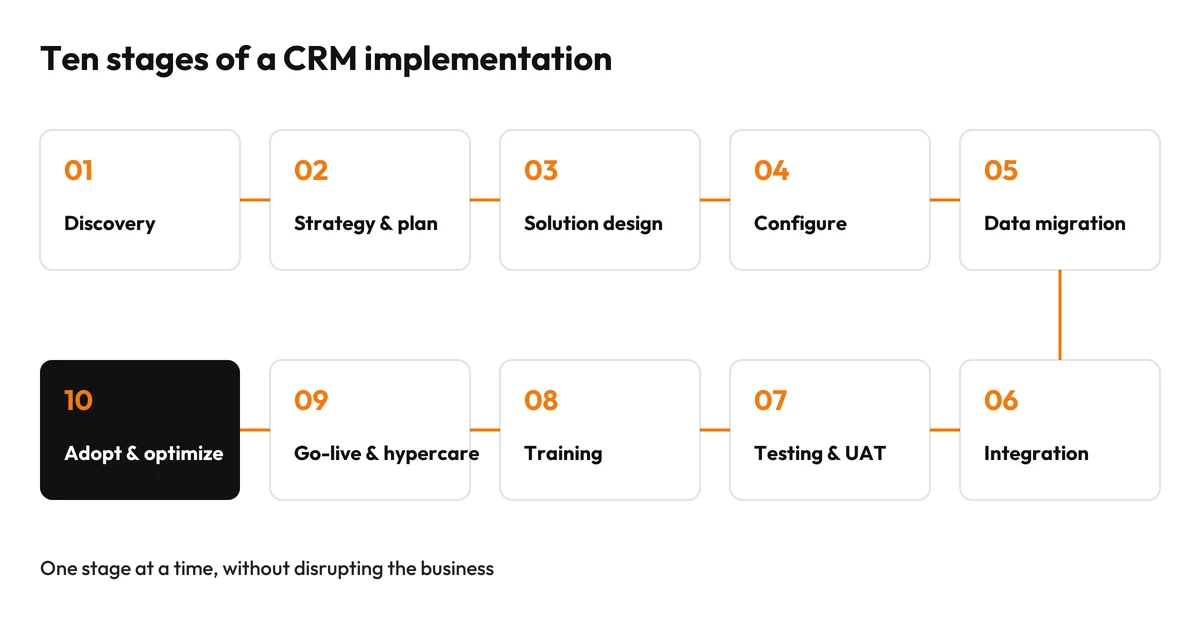
- 01
Discovery, where we learn your goals, processes and pain points.
- 02
Strategy and planning, which sets scope, budget, timeline, milestones and risks.
- 03
Solution design, covering the CRM architecture and data model.
- 04
Configuration and customization when the system gets built.
- 05
Data migration, clean and move your legacy data.
- 06
Integration with your other business systems.
- 07
Testing, finishing with UAT.
- 08
Training for every user group.
- 09
Deployment and go-live, followed by hypercare.
- 10
Adoption and optimization, where we measure usage and keep improving.
Bigger organizations often go a step further and roll out one team or region at a time. It lowers the risk, and the first team's results make the case for the next.
How does a well-implemented CRM connect to your customer journey?
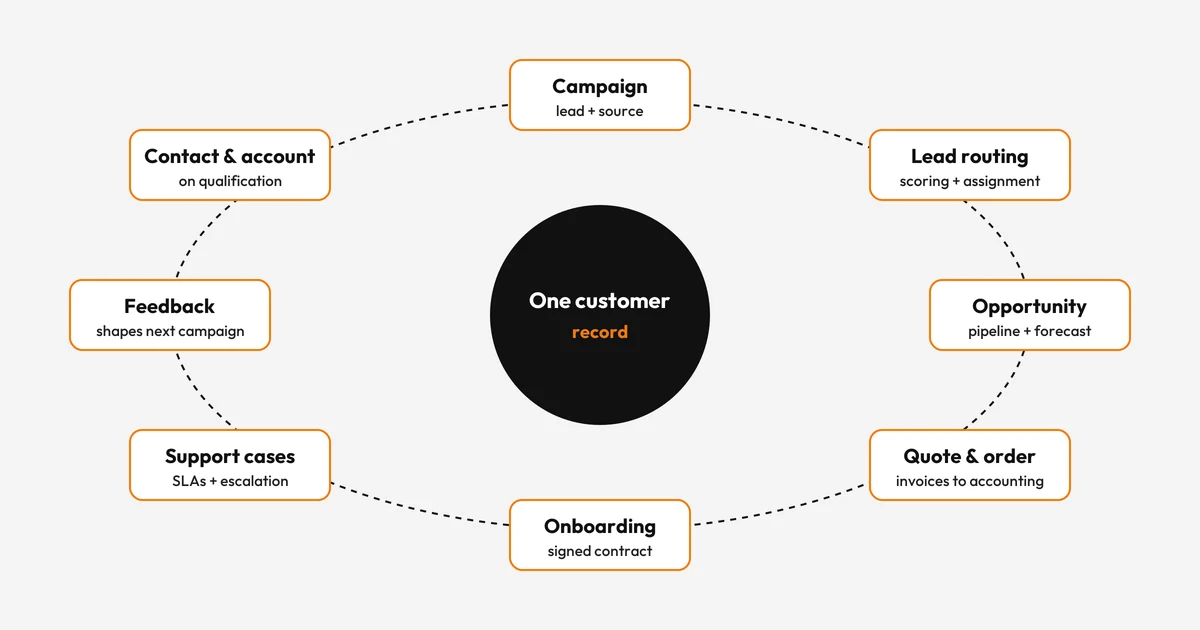
Once everything is connected, a customer's whole history sits in one system. A campaign produces a lead, tagged with its source. Lead scoring and routing send it to the right sales rep. When it qualifies, it becomes a contact and an account, and an opportunity enters the sales pipeline.
From there, the opportunity moves through your sales stages, produces a quote, and then an order, and feeds the sales forecast. A signed contract kicks off customer onboarding while invoices sync to accounting. Later, support cases and tickets are tracked against SLAs, urgent ones escalate automatically, and service history and feedback shape the next campaign.
That's the customer lifecycle visibility most teams don't have today. Marketing, sales, and service all work from the same record.
Which CRM platforms do we implement?
We deliver CRM implementation services on the major platforms, as well as custom builds:
Salesforce
Salesforce CRM implementation services for teams with complex B2B sales cycles.
HubSpot
HubSpot CRM implementation services for high-growth teams that want sales and marketing on one platform.
Microsoft Dynamics 365
Dynamics 365 CRM implementation services for businesses already working in the Microsoft ecosystem.
Odoo CRM
practical choices for growing and mid-sized businesses.
Which industries benefit most from CRM implementation services?
Every industry asks something different about its CRM. Banks, credit unions and other financial services firms need compliance controls and audit trails alongside relationship management, because regulators will want to see who changed what. Manufacturers and distributors usually need the CRM tied into their ERP, so sales can see products, stock levels and orders without switching systems. SaaS companies focus on subscriptions and the full customer lifecycle. Professional services firms want one place to manage both their clients and the projects they're running for them.
Healthcare teams need patient and contact management with strict access controls. Real estate runs property and deal management, and nonprofits lean on membership management and marketing automation. We also work with retail, e-commerce, education, legal, accounting, construction, automotive, and insurance businesses.
Financial services
Manufacturing & distribution
SaaS
Professional services
Healthcare
Real estate
Nonprofits
Retail & e-commerce
Education
What results can you expect from CRM implementation services?
A well-implemented CRM changes what you can measure. Lead conversion rate tends to rise because no lead sits waiting for a follow-up. Sales cycles get shorter when automation handles the admin, and pipeline stages are clear. Forecasts get more accurate once pipeline value and win rates come from clean data.
On the service side, case routing and a knowledge base cut resolution time. Retention and customer lifetime value improve when every team can see the full customer history. None of it happens without user adoption, so we track that too.
How far each number moves depends on where you start. That's why we set baseline KPIs during discovery and report against them after go-live.
Why should you choose us as your CRM implementation partner?
We start with your process and pick up the software second. One team handles the whole lifecycle from strategy to support, so nothing gets lost between vendors. We also stay after launch, because department-level training and post-launch optimization do more for adoption than go-live day ever does.
We'll be straight with you about scope, too. If configuration does the job, we won't sell you customization.
[add years of experience, number of implementations and client testimonials]
What do businesses usually ask about CRM implementation?
When should a startup implement a CRM system?
Sooner than most founders expect. Once more than one person is handling leads, or nobody can say where a deal stands without digging through email, it's time. Starting early is easier because there's fewer legacy data to migrate and fewer bad habits to undo. A lean setup with clear pipeline stages and lead sources can grow as you add teams and integrations.
What is Salesforce implementation, and how do you handle it?
Salesforce implementation means setting Salesforce up to match your business. That covers configuring objects and pipelines, customizing where needed, migrating data, integrating other systems, and training users. We do implement Salesforce, using the same staged approach as every other CRM project.
How do consulting services help a CRM implementation succeed?
Good consultants catch the problems that sink CRM projects before they get expensive, such as vague requirements, dirty data, unrealistic timelines or no adoption plan at all. Ours define the requirements, design the architecture and keep business and technical teams talking, so what gets built is what you need.
How long does a CRM implementation take?
It depends mostly on four things: scope, how much data you're moving, how many systems the CRM must connect to, and how far you need it customized. A straightforward setup can be ready in [add typical timeline]. Enterprise projects take longer, especially with several integrations and a phased rollout. You won't have to guess, though. At the end of discovery, you'll get a timeline with clear milestones.
What are the best practices for CRM implementation in financial services?
Begin with compliance and security requirements, before features. Set up role-based access control, field-level and record-level security, and audit trails. Clean and validate client data before migrating it, integrate core systems carefully, and train advisers on workflows that fit how they work. We build all of this into our financial services projects.
Do you offer ongoing support after go-live?
Yes. After hypercare we offer CRM support and maintenance, including troubleshooting, system monitoring, platform updates and continuous improvement as the business grows. [add support plan details]
Ready to get started with our CRM implementation services?
Maybe this is your first CRM. Or maybe you already have one that never quite did what you needed. Either way, we can help. We implement CRMs for businesses of every size, and we handle the whole job, from strategy and data migration through integration, training and support after launch. Tell us where things stand today, and we'll map out a plan to get you where you want to be.