
Ending Post-Acquisition CRM Sprawl With a Controlled Salesforce Migration
Unboxx designed a controlled path to move HubSpot and Jira Service Management data into the parent company's Salesforce org.

Consolidation Overview
Client
An enterprise B2B software company folding an acquired business into its parent Salesforce environment.
Challenge
Customer, pipeline, and support data sat in HubSpot and Jira, apart from a highly customized Salesforce org.
Solution
Unboxx designed a staged migration into Sales Cloud and Service Cloud with mapping, deduplication, and reconciliation controls.
Outcomes
Fewer duplicates, cleaner ownership, protected history, and a documented cutover plan with rollback controls.
An Acquired Business Running on Its Own Tools
The client is an enterprise B2B software company that grew through acquisition. Its parent business already ran on Salesforce, with Sales Cloud, Service Cloud, and CPQ shaped by years of custom processes and data structures.
The acquired business worked differently. Its sales team kept customers and pipeline in HubSpot. Product support lived in Jira Service Management. Each system had its own records, its own workflows, and its own history.
Why Folding Two Systems Into Salesforce Was Not Simple
The goal was simple to state: one Salesforce environment for customer, sales, and support data. The hard part was the org itself. It was already heavily customized, and the parent business relied on it.
Records that overlapped
The same customers could exist in HubSpot and in Salesforce. Account ownership and hierarchy rules had to decide which record survived and who owned it.
History that had to survive
Activities, notes, emails, and attachments carried years of context. Jira tickets came with comments, statuses, and history that needed a new home in Service Cloud.
Dependencies on every side
CPQ products, pricing, contracts, and quotes were tied into the move. Downstream integrations, entitlements, and SLAs also had to keep working after the switch.
Six Steps From Separate Systems to One Org
Unboxx ran the work as two streams under one plan: HubSpot to Sales Cloud, and Jira Service Management to Service Cloud.
Assess both sides
Reviewed data models, workflows, and migration limits in all three platforms first.
Map every object
Mapped objects, fields, and relationships from leads and accounts to cases.
Set survivor rules
Set matching and survivorship rules so each customer kept one owned record.
Carry the history
Planned how activities, notes, emails, and attachments move with their records.
Rebuild service work
Mapped Jira tickets, workflows, SLAs, and entitlements into Service Cloud.
Stage the cutover
Ran sandbox loads and reconciliation, then set UAT, rollback, and cutover steps.
The Controls Built Into the Migration Design
HubSpot workflows were mapped to their Salesforce equivalents, and custom objects were part of the field mappings. Duplicate management ran on defined matching rules, with survivorship deciding which values stayed when two records described the same customer.
Every load ran in a sandbox first. The team compared source and target data, worked through the exceptions, and ran it again before moving on. By the time anything touched production, it followed a tested path with staged loads, rollback controls, and written cutover procedures.
Integration planning ran alongside the data work. Unboxx listed the downstream dependencies on the Salesforce org and noted where the migration could affect them, so those risks were known before cutover.
What Changed Once the Data Came Together
The payoff came in two places: data quality and launch readiness. The charts below track where risk and rework dropped, and where visibility and readiness improved.
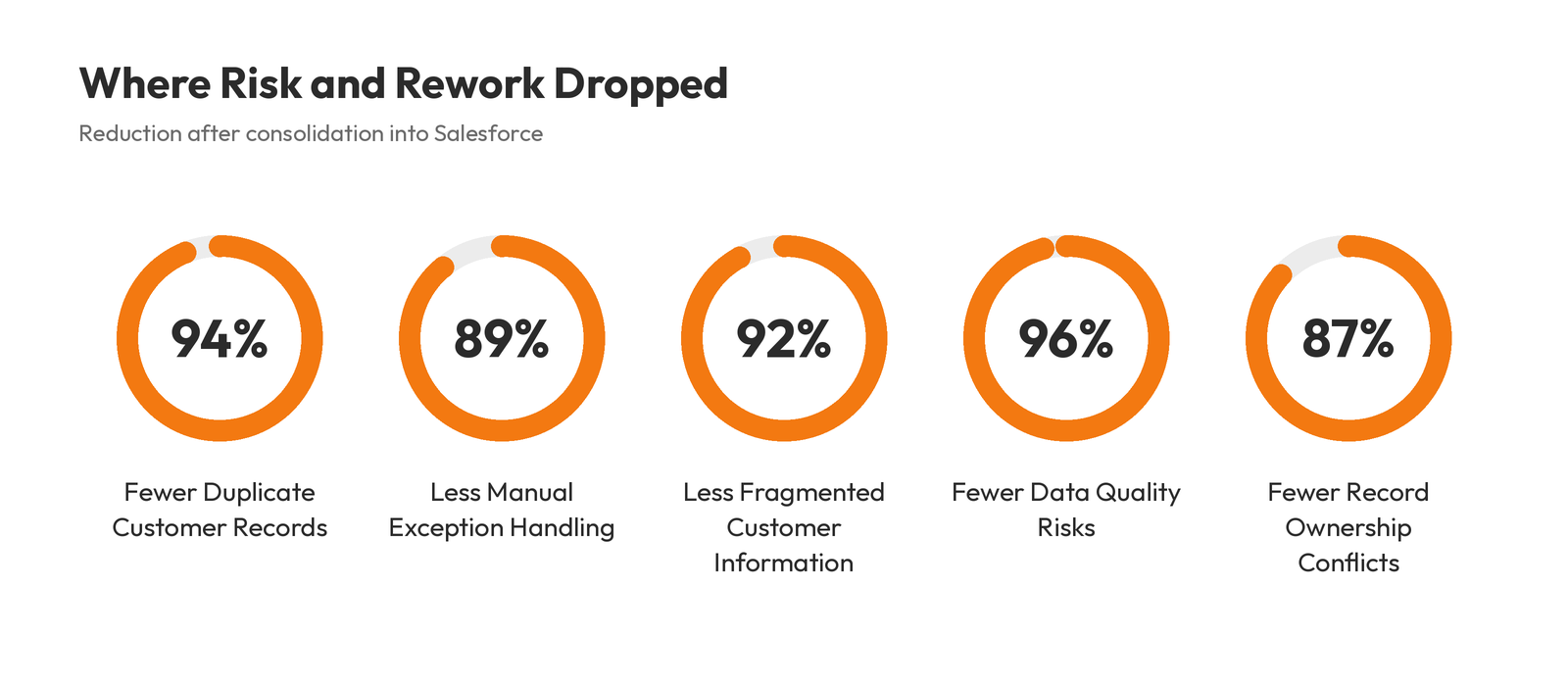

In practice, sales and support teams now work from one customer record instead of separate systems. Leadership gets something just as useful: a documented, tested route into production.
Lessons for Teams Consolidating After an Acquisition
- Decide survivorship and ownership rules before the first load, not after duplicates appear.
- Treat service history as seriously as sales data, because tickets, comments, and SLAs carry customer context.
- Run every load in a sandbox and reconcile it before production sees a single record.