
A sales director approves an Agentforce pilot in spring. By autumn, finance asks about a new metered line on the Salesforce invoice. Nobody budgeted for it.
A Salesforce press release (2025) cites Gartner survey data on the problem. It found that 90% of CIOs say managing AI costs limits the value they get.
Agentforce cost is hard to forecast because Salesforce sells the same agents four ways. You can pay per action, per conversation, per user or through an edition bundle. This guide prices each model from the list rates and works out first-year totals for 25, 50 and 150 seats.
Key Takeaways
- Agentforce cost depends on the billing model, and per-action Flex Credits are cheapest below 1,200 actions per user each month.
- The new Core, Advanced and Max editions bundle 500,000 to 2.75 million Flex Credits per org each year.
- Data 360 credits, metered API calls and partner build work sit outside the headline Agentforce price.
How Much Does Agentforce Cost in 2026?
Agentforce cost starts at $0 for the build tools and $0.10 for each action an agent takes. A licensed user adds $5 a month on the metered plan or $125 a month on the flat add-on. Edition bundles start at $195 per user per month.
The figures come from the public Salesforce Agentforce pricing page, which Salesforce marks as subject to change. Your account executive quotes the final number, and discounts vary by contract.
Salesforce Foundations is the free entry point. It includes Agentforce Builder, Prompt Builder and Agent Script, so teams can design and test agents before buying usage. Customers on Enterprise Edition or above could also claim 100,000 free Flex Credits through Foundations, per the 2025 press release.
The table below lists each Agentforce pricing model with its unit and list rate in US dollars.
| Pricing model | Unit | List price (USD) | Best fit |
|---|---|---|---|
| Salesforce Foundations | Per org | $0 | Building and testing agents |
| Flex Credits | 100,000 credits | $500 | Metered agent actions |
| Conversations | Per conversation | $2 | Customer-facing chat agents |
| Agentforce User License | Per user per month | $5 plus Flex Credits | Light employee use |
| Agentforce add-on | Per user per month | $125 | Heavy employee use |
| Industries add-on | Per user per month | $150 | Industries Clouds |
| Max Edition | Per user per month | From $550 | Full AI suite |
Which row is cheapest depends on how often your agents act. The sections below work that out with arithmetic you can check.
How Do Flex Credits Price Each Agentforce Action?
Flex Credits price Agentforce by the action, at 20 credits or $0.10 for each standard action. A voice action uses 30 credits, which is $0.15. Credits are sold in blocks of 100,000 for $500, so one credit costs half a cent.
An action is one task the agent completes. Examples are looking up an order, updating a case or drafting an email. A single customer request often triggers two to five actions. The agent may read a record, check a policy and then write a reply.
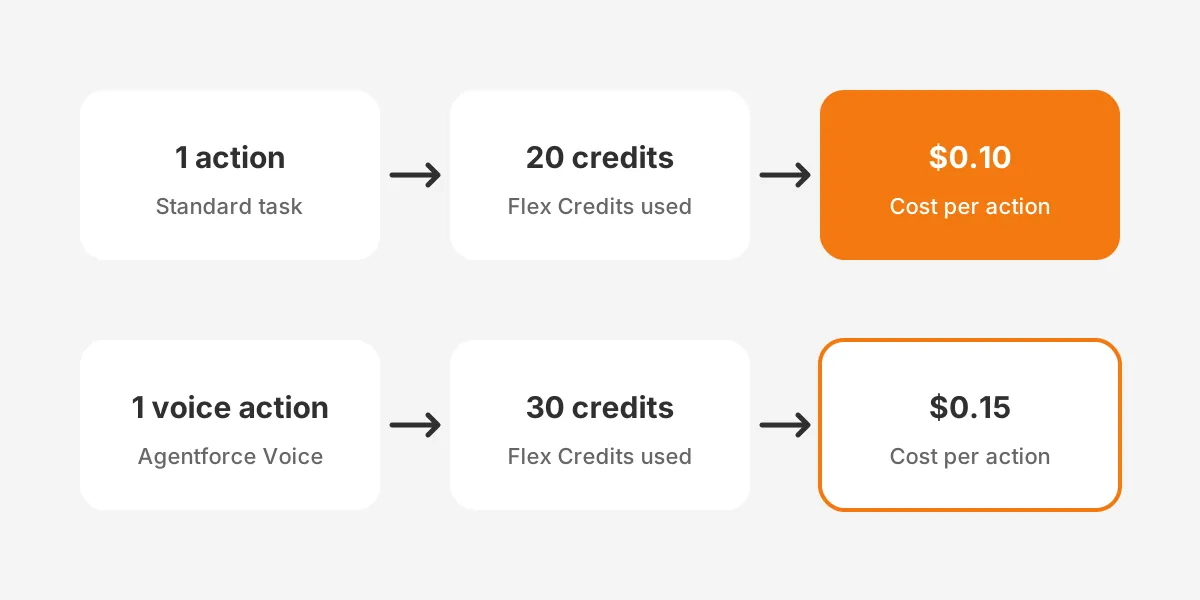
Flex Credits are fungible. The same balance pays for actions, prompts, translations and voice actions, so one budget covers every agent in the org. Salesforce tracks the balance in the Digital Wallet, which shows consumption by agent and by day.
The Agentforce pricing page gives a worked example for service teams. A case-management agent uses 3 actions, or 60 credits, per case. At 360,000 credits a month, the bill is $1,800.
Agentforce flex credits suit work that varies week to week, because the Agentforce cost follows real activity. A seasonal spike in service volume raises the bill for that month only. A quiet month costs less, which per-user pricing cannot match.
Salesforce's other examples show how wide the range is. An IT onboarding agent with one action uses 2,000 credits a month, which costs $10. A voice reservations agent uses 4 voice actions, or 120 credits, per call. At 36,000 credits a month, it costs $180.
Those examples share one rule. The bill equals tasks per month times actions per task times credits per action. Change any of the three and the total moves in proportion.
The weak point is forecasting. Nobody knows the action count of a new agent before it runs in production. Run a pilot for four weeks, count actions per task, then multiply by expected volume.
When Does the $2 Conversation Price Make Sense?
Agentforce per conversation pricing makes sense when each conversation triggers more than 20 actions. Below that point, Flex Credits cost less. The break-even is simple division: $2 divided by $0.10 per action equals 20 actions.
Few service conversations reach 20 actions, so the Agentforce cost of chat is usually lower on credits. A typical order-status or password-reset chat uses 2 to 5. At 3 actions, the metered cost is $0.30 per conversation against $2 under conversation pricing.
Take an example with assumed figures. A service team runs 5,000 customer chats a month, each using 3 actions. Flex Credits cost 15,000 actions times $0.10, or $1,500 a month. Conversation pricing costs 5,000 times $2, or $10,000.
The conversation model still has a use. Some buyers want a fixed unit price for procurement, even if it costs more. Long, complex conversations in claims or technical support can also pass 20 actions.
Two rules limit the choice. Flex Credits and Conversations cannot run in the same org. Switching from Conversations to Flex Credits means replacing every existing Conversation SKU on the contract.
Salesforce also lists an Agentforce Help Agent resolution price of $2 per resolved case. It charges only when the agent closes the case without a human, so escalated cases cost nothing.
Resolution pricing shifts the risk to Salesforce. You pay only for outcomes, yet the unit price matches a full conversation. At a 60% resolution rate on 5,000 chats, the example team would pay $6,000 a month. That assumed rate is for illustration only.
For most service teams, Agentforce cost per conversation is lowest on Flex Credits. Conversation and resolution pricing trade a higher unit price for a predictable one.
What Do Per-User Add-Ons and Editions Cost?
Per-user add-ons cost $125 per user per month for Sales, Service, Field Service and Operations. Industries add-ons cost $150. Both give licensed users unmetered use of employee-facing agents, so the Agentforce cost per user stays fixed.
The Agentforce User License is the metered option at $5 per user per month. It gives a user access to agents, while every action draws on Flex Credits. Salesforce also sells an Agentforce Coworker User License at $50 per user per month.
On 3 September 2026, Salesforce replaced its edition lineup for new buyers with three tiers. Salesforce Ben (2026) reports that each tier includes Agentforce, Slack and Slackbot. The prices below come from the Sales Cloud pricing page.
| Edition | Price per user per month | Flex Credits per org per year | Agentforce for Sales |
|---|---|---|---|
| Core | $195 | 500,000 | Available for purchase |
| Advanced | $395 | 1,000,000 | Available for purchase |
| Max | $550 | 2,750,000 | Included |
All three editions are billed annually. The Max edition keeps the $550 price of the old Agentforce 1 Edition. It adds the full AI suite, including Agentforce Coworker.
Existing customers are not forced to move. Salesforce Ben reports that legacy edition pricing stays unchanged. Agentforce 1 customers can upgrade to Max at no extra charge. Still check Sales Cloud and Service Cloud renewals against the new tiers.
The bundled credits lower the Agentforce cost of each seat, but they are a pool per org, not per user. A 50-seat Core org gets 500,000 credits a year, which covers 25,000 actions. That is 500 actions per user for the whole year.
Which Agentforce Cost Model Fits a Sales Team?
The Agentforce cost model that fits a sales team depends on actions per rep each month. Below 1,200 actions per user, the $5 licence plus Flex Credits costs less than the $125 add-on. Above it, the flat add-on wins.
The Agentforce break-even comes from the list prices. The add-on costs $120 more per user than the $5 licence. At $0.10 per action, $120 buys 1,200 actions a month, or about 55 actions per working day.
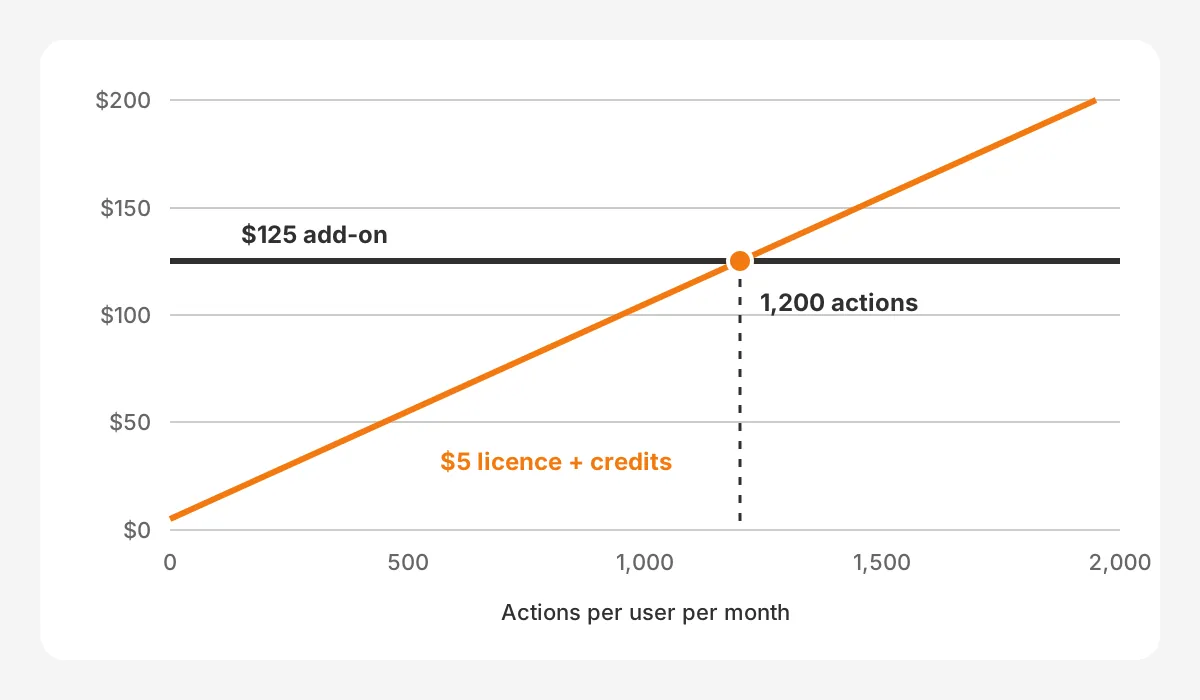
Most sales reps sit well below that line. Picture an agent that drafts follow-up emails, summarises calls and updates opportunities. It might run 10 to 20 actions per rep each day. That is 220 to 440 actions a month.
Heavy users push the Agentforce cost math the other way. A sales development team that runs an AI prospecting agent on every lead can pass 1,200 actions per rep. For that team, the add-on gives a fixed bill and removes the forecasting work.
A split licence plan is worth testing. Give the add-on to the 10 heaviest users and the $5 licence to everyone else. Review the action counts each quarter and move users between the two.
Editions make sense when the team also needs what they bundle. Max at $550 includes the add-on, Slack and 2.75 million credits. Judge it on the whole bundle, since the Agentforce price is only one part.
What Does a First-Year Agentforce Cost Look Like?
A first-year Agentforce cost for a 50-seat sales org is about $21,000 on Flex Credits at 300 actions per user. The same org pays $75,000 on the $125 add-on. The figures below use one assumed usage rate to show the method.
The assumption is 300 actions per user each month, which is an example and not a benchmark. Replace it with your own pilot count. The formula stays the same.
- Multiply users by monthly actions by 12 to get yearly actions.
- Multiply yearly actions by 20 to get Flex Credits.
- Multiply credits by $0.005 to get the credit bill.
- Add $60 per user per year for the Agentforce User License.
- Compare the total with $1,500 per user per year for the add-on.
| Seats | Actions per year | Flex Credits | Credits plus licences | $125 add-on |
|---|---|---|---|---|
| 25 | 90,000 | 1.8 million | $10,500 | $37,500 |
| 50 | 180,000 | 3.6 million | $21,000 | $75,000 |
| 150 | 540,000 | 10.8 million | $63,000 | $225,000 |
The metered route is cheaper at every size in this example because 300 actions sits far below 1,200. Quadruple the usage and the add-on becomes the better deal.

Bundled credits lower the metered total. A 50-seat org on Core already holds 500,000 credits, which covers $2,500 of the 3.6 million needed. The credit bill drops to $15,500.
These totals cover licences and usage only. A full Agentforce cost estimate also needs the lines in the next section.
Which Hidden Lines Raise the Total Bill?
The hidden lines in an Agentforce budget are Data 360, metered API calls, implementation and ongoing administration. None of them appears in the headline Agentforce price. Each needs its own budget line before the Agentforce cost is final.
Data 360 credits
Agents that ground answers in unified customer data use Data 360, formerly Data Cloud. Salesforce states that its Agentforce usage examples exclude Data 360 credits. Data 360 also bills Flex Credits for querying and processing unstructured data. Its per-profile plans start at $240 per 1,000 profiles a year.
Headless Platform Interaction
A Salesforce Help article (2026) describes a new meter. Every successful call a registered agent makes into Salesforce will count as a Headless Platform Interaction. That covers calls over MCP and the API. The rate is still listed as TBA, with 30 days' notice before metering starts.
Only active production orgs are metered. Sandboxes, scratch orgs and Developer Edition orgs are not. Teams running outside agents against Salesforce should add a placeholder line for this meter now.
Implementation and administration
Agents need clean data, permission sets, topics, actions and testing before they go live. That work is the Agentforce implementation cost, and your partner quotes it rather than Salesforce. Ask for it as a fixed scope with named deliverables.
Ask the partner to price four items on separate lines: data preparation, agent configuration, testing and user training. Separate lines show where the money goes. They also make it easier to cut scope if the quote runs over budget.
After launch, someone has to tune prompts, review failed actions and watch the credit balance. Budget admin hours for this, either in-house or through Salesforce managed services.
How Has Agentforce Pricing Changed Since 2025?
Agentforce pricing has changed three times since launch, which is why older guides quote the wrong Agentforce cost. Each change added a model rather than removing one. Check the date on any figure before you put it in a budget.
The first model was $2 per conversation. In May 2025, Salesforce added Flex Credits at $0.10 per action, according to its press release. The same release promised per-user licences and editions for summer 2025.
The per-user layer followed. The $125 add-on and the $550 Agentforce 1 Edition gave buyers a flat Agentforce cost per user for employee-facing agents. Both prices now sit on the public pricing page, with the edition renamed Max.
The third change came on 3 September 2026. Core, Advanced and Max replaced the old editions for new buyers and folded Flex Credits into the seat price. Salesforce Ben quotes Salesforce COO Miguel Milano on the reason.
He said only 5% of knowledge workers on Sales and Service Cloud had upgraded to higher-end editions.
A fourth change is pending. The Headless Platform Interaction meter will price calls from outside agents once Salesforce publishes a rate. Under Agentforce pricing 2026 rules, outside agents get their own Salesforce meter.
The pattern matters for AI agent pricing across vendors. Metered units let a vendor reprice usage without touching the seat price. Read renewal terms for any right to change credit multipliers.
How Should You Buy Flex Credits?
Buy Flex Credits on PayGo while usage is unknown. Move to Pre-Commit or Pre-Purchase once you have three months of data. Salesforce offers all three buying models for Salesforce Flex Credits.
- Pre-Purchase: pay upfront for a set amount and draw it down over the term.
- Pre-Commit: commit to a baseline, pay monthly in arrears and settle a true-up at term end.
- PayGo: pay as you go, billed monthly in arrears for actual use, with no commitment.
Two terms matter for budgeting. Unused Flex Credits do not roll over into the next subscription term. So what happens if you use more Flex Credits than you bought? Nothing punitive: the extra use is billed at the contracted rate, with no overage penalty.
The no-rollover rule makes Pre-Purchase risky for a new agent. It locks in an Agentforce cost before usage is known. A team that buys 3.6 million credits and uses 2 million loses the difference. PayGo costs nothing extra in that case.
Pre-Purchase suits stable, proven volume, where the yearly Agentforce cost is easy to predict. A service agent with a year of steady case data is a good candidate. Ask whether a larger commitment earns a lower rate per credit.
How Do You Keep Agentforce Cost Under Control?
Keep Agentforce cost under control by measuring actions per task, cutting wasted actions and reviewing the Digital Wallet each month. Most overspend comes from agents that take more steps than the task needs.
- Start with one agent and one use case, such as case summaries or lead follow-up.
- Run it in a sandbox, where testing does not touch production meters.
- Count actions per completed task during a four-week production pilot.
- Remove actions that fetch data the agent never uses in its answer.
- Set a monthly credit alert at 80% of the expected spend.
- Compare each heavy user against the 1,200-action break-even every quarter.
- Recheck the Flex Credits Rate Card before each renewal.
Review the Digital Wallet with the agent owner, not only with finance. The owner can explain a spike, such as a new topic or a looping action. Finance alone sees only the total.
Agent design drives Agentforce cost as much as list price does. An agent that reads five records to answer a question costs five times more than one that reads one. Good topic and action design is cost control.
The AI-native CRM services from Unboxx cover this design and tuning work on Salesforce. For a wider plan, the 90-day AI implementation roadmap sets owners and go/no-go gates for each agent.
Compare agents with rule-based automation before you buy credits. Some tasks run cheaper as a Flow, and the guide to AI agents versus traditional automation explains where each fits. The Salesforce and Anthropic partnership shows where the platform's models are heading.
Frequently Asked Questions
Is Agentforce included in Salesforce?
Agentforce is partly included in Salesforce. Salesforce Foundations gives every org free access to Agentforce Builder and Prompt Builder. Running agents in production costs extra through Flex Credits, conversations, add-ons or an edition. Core, Advanced and Max bundle credits, and Max includes the Agentforce add-on.
How are Flex Credits consumed?
Flex Credits are consumed each time an agent completes an action. A standard action uses 20 credits, and a voice action uses 30. The same balance also covers prompts and translations. The Digital Wallet shows which agents used credits, so admins can find costly agents.
Is Agentforce free?
Agentforce is free to build and test through Salesforce Foundations, but not free to run at scale. Production agents draw Flex Credits at $0.10 per action or bill $2 per conversation. Enterprise Edition customers could claim 100,000 free credits, which covers about 5,000 actions.
How much does Agentforce cost per month?
Agentforce cost per month ranges from under $100 to tens of thousands. A 50-seat team at 300 actions per user pays about $1,750 a month on metered pricing. The same team pays $6,250 on the $125 add-on. Your own action counts set the real figure.
Does Agentforce Voice cost more than chat?
Agentforce Voice costs more than chat for each action. A voice action uses 30 Flex Credits, or $0.15, against 20 credits for a standard action. A four-step phone booking therefore uses 120 credits, which is $0.60. Chat agents doing the same steps cost $0.40.
Is Agentforce Cost Worth It for Your Org?
Agentforce cost is worth it when an agent removes more paid work than it consumes in credits and setup. Price your pilot with real action counts and pick the cheapest model for each user group. Add Data 360 and admin lines before you sign.
Unboxx is a Salesforce partner that has built AI agents for faster team decisions. To model your own Agentforce budget and agent design, schedule a consultation with Unboxx.
Let's create something out of this world together.
Have a project in mind? Contact us for expert design and development solutions. Let's discuss how we can help grow your business.
Ready to Unboxx Your Potential?
Build smarter systems. Automate faster. Scale confidently.