
Most B2B teams now test AI tools, yet few turn those tests into lasting results. In McKinsey's State of AI 2026 survey, 37% of respondents attribute any EBIT impact to AI. That share has not moved in a year. Pilots run, but the profit line rarely shifts.
AI automation consulting closes that gap. It is paid, outside help to find the workflows worth automating and choose the tools. The consultant then builds the first automations and measures the return.
This guide covers what AI automation consulting includes and what it costs in 2026. It also compares consultants with agencies and in-house teams, and shows how to vet a firm.
Key Takeaways
- AI automation consulting starts with a process audit and ends with measured automations, not a slide deck.
- Published 2026 rate cards put an automation audit at $1,500 to $25,000, depending on scope.
- A good consultant names the workflow, the baseline metric and the human review step before any build starts.
What Is AI Automation Consulting?
AI automation consulting is a service that maps your business processes and finds the steps AI can handle. The consultant plans how to automate those steps safely. They then build or oversee the first automations and measure the result against a baseline.
In short, AI automation consulting turns scattered AI experiments into a managed backlog of workflows with owners and metrics.
The work combines three disciplines. Process analysis shows where time and errors pile up. Technical design picks the tools, such as Zapier, n8n, Microsoft Power Automate, Salesforce Flow or HubSpot workflows. AI design decides where a large language model adds value.
Typical model tasks include drafting a reply, classifying a ticket and extracting data from a PDF. Each task has a clear input and an output a person can check.
AI automation consulting differs from classic process automation consulting in one way. Rule-based automation follows fixed if-then logic. AI automation adds a model that reads unstructured input, such as emails, call notes and documents.
The model then makes a judgment, and that judgment needs guardrails. That is why the human review step is part of the design.
General AI strategy consulting is a different service. A strategy engagement answers which AI bets a company should make over three years. An automation engagement answers which five workflows to fix this quarter, and how.
For the difference between rule-based flows and agents, see this comparison of AI agents and traditional automation.
Typical buyers are operations, sales and finance leaders at companies with 20 to 2,000 staff. They already run a CRM such as Salesforce, HubSpot or Dynamics 365, plus an ERP, email and chat tools. Their problem is rarely a lack of software. It is manual work between those systems.
What Does an AI Automation Consultant Do?
An AI automation consultant finds automatable work, designs the automation, builds or supervises the build, and proves the result. The deliverables are a process map, a ranked backlog, working automations and a measurement report.
Most engagements follow four stages. Unboxx runs the same sequence in its AI business automation services, under the names Discover, Strategy, Implement and Optimize.
- Discover: interview the people who do the work, time each step and record the systems involved.
- Design: rank the candidate workflows, choose the platform and write the automation specification.
- Build: configure the automation, connect each API and add a human-in-the-loop checkpoint.
- Improve: compare results with the baseline, fix exceptions and add the next workflow.
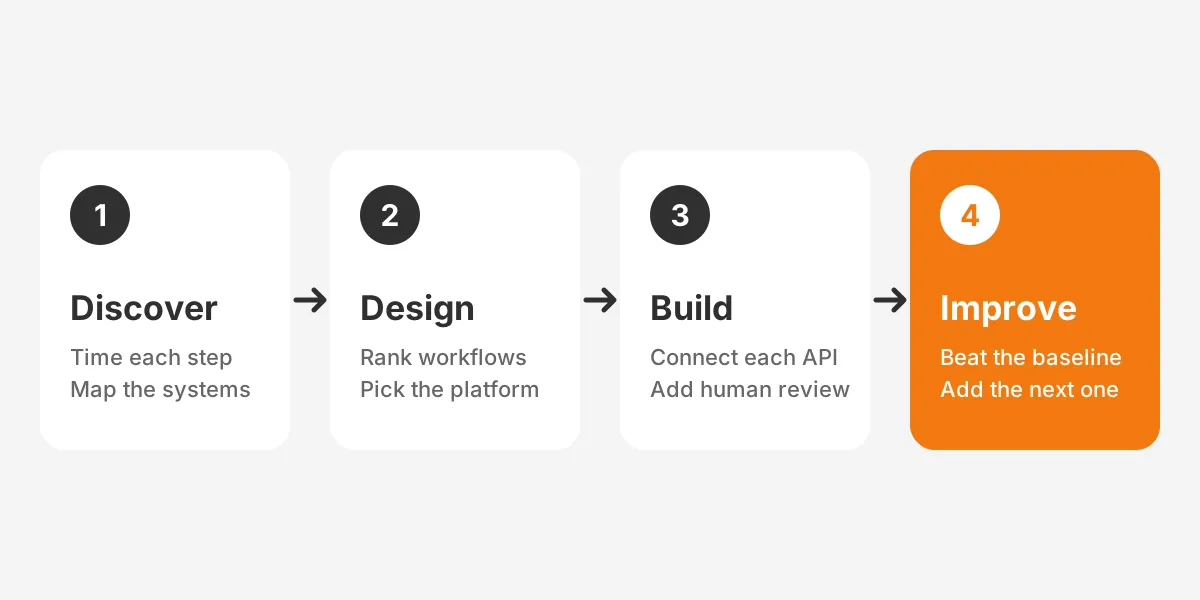
The discovery stage carries the most weight. A consultant who skips it tends to automate the loudest request instead of the costliest one. Plan on system access, sample records and two or three hours with the staff who run each process.
The build stage depends on the engagement model. Some consultants hand a specification to your team. Others build the automation themselves, which turns the work into a project with a fixed scope. Either way, the consultant should document each workflow so your team can run it later.
Change management belongs in any AI automation consulting scope. Staff need to know what the automation does, where it can fail and who fixes it. Without that, adoption stalls and people return to the old spreadsheet within a month.
When Do You Need AI Automation Consulting?
You need AI automation consulting when manual work between systems costs more than an outside review would. The case gets stronger when your team lacks the time or skills to fix that work. Five signs point that way.
- Staff copy data between the CRM, ERP and email by hand every day.
- Response times depend on who is in the office, as with quote follow-up or support tickets.
- An internal AI pilot worked in a demo but never reached production.
- Ten or more processes look automatable, and nobody can say which comes first.
- Leadership wants a business case with a cost and a payback period before approving budget.
AI automation consulting for small businesses usually starts with one workflow and a fixed-price audit. A 15-person firm rarely needs a roadmap across departments. It needs one quick win that proves the method and pays for the next step.
You may not need a consultant when the job is small and well defined. A single Zapier zap that posts new deals to Slack needs an afternoon, not an audit. The same is true when an internal admin already knows the platform and owns the process.
Timing matters too. McKinsey reports that 40% of large organizations now scale AI agents, up from 27% a year earlier. Smaller organizations stayed flat at 22%. Mid-sized firms that wait may end up running slower, costlier processes than larger rivals.
Hiring an AI automation consultant early is cheaper than unwinding a failed pilot later. A pilot built without a baseline gives leadership no evidence, so the next budget request starts from zero.
Which Processes Should You Automate First?
Automate first the processes with high volume, clear rules for success and low risk when the AI gets something wrong. A simple scoring method makes that choice repeatable.
- List every candidate process with its weekly volume and the hours it takes.
- Score business impact from 1 to 5, using hours saved, revenue at stake and error cost.
- Score effort from 1 to 5, using data quality, number of systems and approval steps.
- Plot each process on an impact and effort grid.
- Start with high-impact, low-effort work, and schedule high-impact, high-effort work as phase two.
- Do low-impact, low-effort fill-ins when time allows, and avoid low-impact, high-effort work for now.
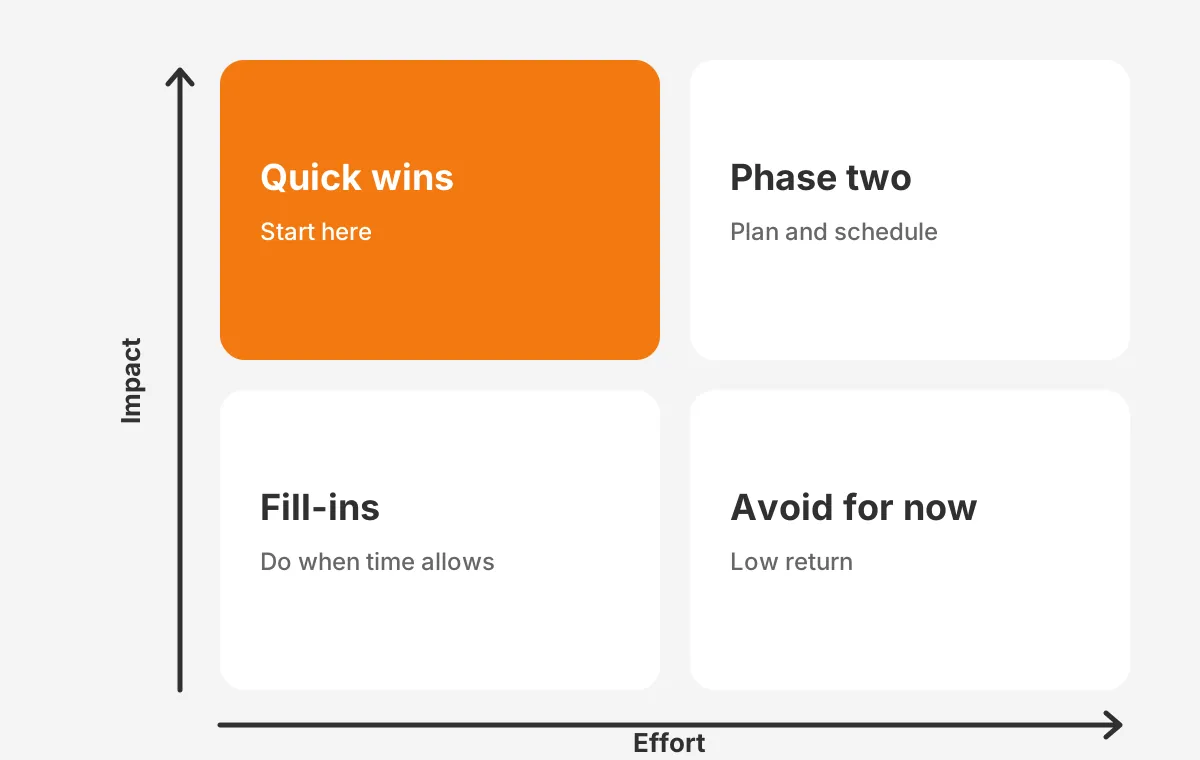
Common first candidates in B2B firms include lead routing, quote follow-up and ticket routing. Invoice data entry and meeting summaries logged to the CRM are also frequent picks. Each has a clear input, a clear output and a person who can check the result.
These workflow automation examples for sales, finance, HR and IT show more options by department. The ranked list becomes the automation roadmap for the next two or three quarters.
Avoid starting with processes that rely on poor data. If half the CRM records lack an owner or an industry field, an AI routing rule will misfire. Data quality work often belongs in the same engagement, before any model sees the records.
Also avoid processes where an error causes legal or financial harm, such as credit decisions. Wait until the team has run lower-risk automations for a quarter. Those workflows need a stricter review step and an audit trail.
What Tools Do AI Automation Consultants Use?
AI automation consultants use integration platforms, CRM-native automation and large language models, chosen to fit the systems you already run. The best tool is usually the one your team can maintain after handover.
Integration platforms connect apps through each API. Zapier suits simple, high-volume triggers between cloud apps. n8n suits teams that want to self-host or write custom code. Microsoft Power Automate fits companies that already run Microsoft 365 and Dynamics 365.
CRM-native tools keep logic inside the system of record. Salesforce Flow handles record updates, approvals and routing inside Salesforce. HubSpot workflows handle lead routing, nurture emails and task creation inside HubSpot. Odoo offers its own automated actions for ERP and CRM records.
The AI layer adds a model to the workflow. Options include OpenAI models, Google Gemini and AI agents built into CRM platforms. A model drafts, classifies or extracts. A person approves the output wherever an error would reach a customer.
A sound AI workflow automation design keeps the model step small and testable. It logs every prompt and response, so the team can review errors. It also sets a monthly cap on model usage, so a busy week does not produce a surprise invoice.
In AI automation consulting, tool choice follows the process map, never the reverse. A consultant who names a platform before discovery is selling a product, not giving advice.
How Much Does AI Automation Consulting Cost?
AI automation consulting costs $1,500 to $25,000 for an audit, based on rate cards published in 2026. Retainers run $1,000 to $5,000 a month.
The ranges below come from two published sources. Goodspeed's 2026 cost guide lists prices by engagement type. Krater's pricing table, checked in October 2026, adds builds and hourly rates of $100 to $300.
| Engagement type | Typical price | Typical length | Source |
|---|---|---|---|
| Automation audit | $1,500 to $5,000 | 1 to 2 weeks | Krater, 2026 |
| One-off assessment | $2,000 to $10,000 | 1 to 2 weeks | Goodspeed, 2026 |
| Audit plus 3 to 5 builds | $5,000 to $15,000 | Varies by build | Krater, 2026 |
| Full audit and roadmap | $10,000 to $25,000 | 4 to 8 weeks | Goodspeed, 2026 |
| Advisory retainer | $1,000 to $5,000 per month | Ongoing | Krater and Goodspeed, 2026 |
Hourly rates for AI consultants suit short advisory calls. They suit discovery work less well, because the hours are hard to predict before the audit starts.
Four factors move the price within those ranges. Each department in scope adds interviews and process maps. Every system that needs an API connection adds build hours, and poor data quality adds cleanup time.
Compliance is the fourth driver, because regulated data needs security review and audit logging. A mid-sized firm that scopes two departments often lands in the full audit and roadmap band. AI automation consulting at that size then moves to builds priced per workflow, plus a retainer for support.
The fee is only part of the total cost of ownership. Budget for platform licences, model usage and ongoing maintenance as well. McKinsey found that about 20% of respondents say AI operating costs, including token costs, constrained their AI use. A consultant should estimate monthly model spend before the build.
Ask for a fixed price on the audit and a capped estimate on each build. Open-ended hourly billing makes AI automation consulting cost hard to control. For a sense of wider project budgets, this 90-day AI implementation roadmap shows how spend spreads across phases.
Consultant, Agency or In-House: Which Fits?
A consultant fits when you need an independent plan. An agency fits when you want one firm to plan and build. An in-house team fits when you have the skills and want full control. Most mid-sized firms combine two of these.
| Factor | AI automation consultant | AI automation agency | In-house team |
|---|---|---|---|
| Main output | Audit, roadmap, specification | Working automations | Automations your staff own |
| Speed to first result | 2 to 8 weeks for the plan | 4 to 12 weeks for builds | Depends on staff time |
| Platform bias | Low, if independent | Often tied to one stack | Tied to current skills |
| Ongoing cost | Retainer or none | Retainer for support | Salaries and training |
| Best for | Unclear priorities, board approval | Clear scope, no build capacity | Mature IT and ops teams |
The line between consultant and agency is thin. Ranking AI automation consulting firms such as Goodspeed and Krater both advise and build. What matters is whether the advice comes before the build. It also matters whether the firm will recommend a tool it does not resell.
An in-house build works when you already employ a platform admin and a developer. They know the data and the politics. They often lack time, though, and AI work slips behind daily support tickets. A short consulting engagement can set the plan while your team owns delivery.
For AI automation consulting with a build phase, ask the firm to price the plan and the builds separately. That keeps the option to build in-house later.
What Should an AI Automation Consulting Brief Include?
An AI automation consulting brief should state the business problem, the processes in scope and the systems involved. Data constraints and success measures belong in it too. A clear brief cuts discovery time and makes quotes comparable.
- Problem statement: one paragraph on what costs time or money today.
- Processes in scope: names, owners, weekly volume and hours per week.
- Systems: CRM, ERP, email, chat, document storage and any custom databases.
- Data rules: where personal or regulated data sits and who may access it.
- Success metrics: hours saved, response time, error rate or revenue per rep.
- Budget range and decision date.
- Internal contacts: an executive sponsor, a process owner and an IT contact.
Attach sample records with personal data removed, plus screenshots of each current workflow. These show the consultant real edge cases on day one. Ask each firm to answer the same brief so you can compare scope, price and timeline line by line.
A one-page brief is enough for most AI automation consulting requests.
How Do You Vet an AI Automation Consulting Firm?
Vet an AI automation consulting firm by checking its delivered work and its method for measuring results. Then test its approach to AI risk. Ask for evidence, not frameworks.
- Ask for two case studies with a named workflow, the tools used and a measured result.
- Ask how they set the baseline before the build, and who signs it off.
- Ask where a human reviews AI output, and what happens when the model is unsure.
- Ask which platforms they would not recommend for your case, and why.
- Ask who owns the automations, prompts and documentation when the contract ends.
- Ask how they handle access, encryption and audit logging for your data.
A firm that works with regulated data should know the NIST AI Risk Management Framework. NIST released AI RMF 1.0 on 26 January 2023. Its four functions are Govern, Map, Measure and Manage. NIST added a Generative AI Profile, NIST-AI-600-1, on 26 July 2024.
Watch for warning signs. A firm that promises a fixed percentage saving before discovery is guessing. Some firms cannot explain AI limits, such as wrong answers stated with confidence. Those firms will not design a safe review step.
A firm that only resells one platform has a reason to recommend it. Request references from two clients whose AI automation consulting project is at least six months old. Older projects show whether the automations held up after handover.
Check the contract as well. It should name deliverables per stage and cap change requests. Full rights to the workflows built should pass to you. A short notice period on any retainer keeps the AI automation consulting partner accountable.
How Do You Measure AI Automation Results?
Measure AI automation results by comparing a baseline taken before the build with the same metric after launch. Check it at 30, 60 and 90 days. The metric must tie to time, money or customer experience.
Good AI automation consulting sets these metrics in the brief, not after launch. Agreeing them early stops debate about whether the project worked.
Unboxx built a quote follow-up workflow for an event catering company. It used Zapier, Gmail and Google Gemini, with each draft held in Gmail for a person to review. The catering quote follow-up case study reports a 96% reduction in manual follow-up effort and 81% more consistent follow-up.
A worked example shows the method. The figures here are assumptions for illustration, not survey data. A sales operations team spends 15 hours a week on quote follow-up at a loaded cost of $45 an hour. That is $675 a week, or about $35,100 a year.
Suppose the automation removes 80% of that effort. The saving is about $28,080 a year. Subtract $3,000 a year for platform and model usage. If the audit and build cost $12,000, payback arrives in roughly six months.
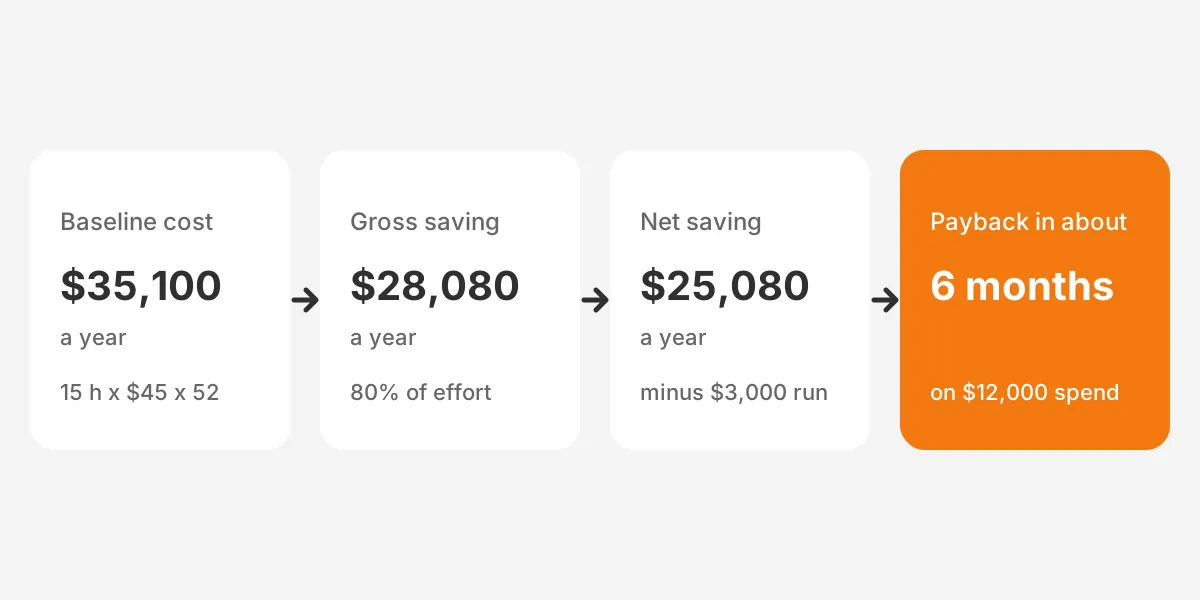
Track quality next to speed. Count how often staff edit or reject an AI draft. A rising edit rate signals drift in the data or the prompt. Your consultant should set an alert for that metric at launch.
Report results in business terms. A board approves the next phase when it sees hours returned, faster response and lower error rates. For the full delivery sequence, see this step-by-step AI business automation process.
Frequently Asked Questions
Is AI automation consulting worth it for small businesses?
It is worth it when manual work costs more than the audit fee within a year. A small business spending ten staff hours a week on data entry can recover a $3,000 audit within months. For one simple workflow, a no-code tool and an afternoon may be enough.
What deliverables should AI automation consulting produce?
Expect a process map, a ranked automation backlog, a platform recommendation, a written specification per workflow and a measurement plan. If the engagement includes builds, add working automations, documentation and a handover session. Each deliverable should be signed off before the next stage starts.
Do you need technical skills to hire a consultant?
No technical background is needed to hire an AI consultant. You do need a clear business problem and access to the people who run the process. The consultant handles platform choice and API design. Your team supplies process knowledge, sample data and a decision-maker who can approve changes.
How long does an AI automation project take?
An audit takes one to eight weeks, depending on scope. A first build of one workflow often goes live within four weeks after that. Larger programs that span departments run in phases over three to six months. Each phase ends with a review of results.
Who owns the automations after the engagement ends?
You should own every workflow, prompt, credential and document, and the contract should say so in writing. Ask for admin access to each platform from day one. Avoid setups where the consultant holds the only account, because that creates lock-in when support ends.
How Can Unboxx Help With AI Automation Consulting?
Unboxx provides AI automation consulting for B2B teams on Salesforce, HubSpot, Dynamics 365 and Odoo. The team audits your processes, ranks the work and builds automations with human review built in.
To scope your first workflow and its payback, schedule a consultation with Unboxx.
Let's create something out of this world together.
Have a project in mind? Contact us for expert design and development solutions. Let's discuss how we can help grow your business.
Ready to Unboxx Your Potential?
Build smarter systems. Automate faster. Scale confidently.