
A sales team sits through four polished vendor demos in two weeks. Every platform looks capable, every price looks negotiable, and the decision ends up resting on which presenter was most convincing. Twelve months later, reps still keep deals in spreadsheets because the chosen CRM never fit how they sell.
CRM selection is the structured process of choosing a customer relationship management platform. It tests each option against written requirements, demos, references and cost. Capterra's 2026 Tech Trends Survey found that 61% of successful software adopters tested three shortlisted vendors. Only 41% of disappointed buyers did the same.
The process below is built for B2B teams and runs in about nine weeks, from first meeting to signed contract.
Key Takeaways
- CRM selection works best as a fixed sequence: team, requirements, shortlist, scripted demos, references, cost and contract.
- Scripted demos and a sandbox trial expose fit problems that a vendor's standard presentation hides.
- Three-year total cost of ownership, not the license price, should decide between close finalists.
What Is CRM Selection?
CRM selection is the work of deciding which CRM system, edition and implementation approach fits your business. It starts with business goals and ends with a signed order form and an implementation plan. Some buyers call this stage CRM software selection.
The CRM selection decision covers three things: the software, the partner who will configure it and the commercial terms. All three are settled before anything is signed.
A CRM selection process is separate from CRM implementation. Selection decides which system and on what terms. Implementation covers how that system gets configured, loaded with data and adopted. Teams that choose a CRM before scoping the build sign without knowing what the build will cost.
For most B2B companies, the CRM selection shortlist comes from a small set of platforms. Common candidates include Salesforce Sales Cloud, HubSpot Sales Hub, Microsoft Dynamics 365 Sales, Zoho CRM, Pipedrive and Odoo CRM. Each suits a different mix of team size, process complexity, existing software and budget.
Why Does CRM Selection Go Wrong So Often?
CRM selection usually goes wrong because the buyer evaluates the vendor's story instead of the buyer's own process. A standard demo shows the product at its best, with clean sample data and tidy workflows. It rarely shows quote approval, territory rules or the ERP order sync your team depends on.
The stakes are high because the system sits at the center of daily selling. Capterra's 2026 Sales and Marketing Software Trends Survey covered 2,452 software buyers. Of the CRM users, 57% rated the software as critical to operations. A poor fit therefore slows every team that touches a customer record.
Four CRM selection mistakes appear again and again in failed projects:
- Choosing a CRM by its features before writing down the problems the CRM must solve.
- Letting each vendor run an unscripted demo, which makes comparison impossible.
- Comparing first-year license prices instead of three-year total cost of ownership.
- Skipping reference calls with customers of a similar size and industry.
Forrester's 2023 report Reduce Technical Debt By Understanding CRM Capabilities Before RFP makes a related point. It recommends a value-based gap analysis before selecting a CRM. The request for proposal then reflects real business needs, not vendor feature lists.
The choice also shows up in sales numbers. Pipedrive's 2026 research looked at sales and marketing professionals who are satisfied with their tools. Of that group, 82% are likely to hit quota at least some of the time. It shows a link between tool satisfaction and results, not cause.
Who Belongs on the CRM Selection Team?
The CRM selection team needs one decision owner and a small core team. A wider group of users tests the shortlisted systems. Keep the core team to five or six people, so meetings produce decisions. Everyone else joins the scripted demos and the trial.
| Role | Typical person | Responsibility in CRM selection |
|---|---|---|
| Executive sponsor | CEO, COO or CRO | Approves budget, breaks ties, signs the contract |
| Project lead | Sales operations or RevOps manager | Runs the timeline, scoring and vendor contact |
| Sales representative | Two frontline reps | Tests daily tasks during demos and the trial |
| Marketing lead | Marketing operations manager | Checks lead capture, campaigns and attribution |
| IT or systems lead | IT manager or architect | Reviews security, integrations and API limits |
| Finance reviewer | Controller or finance manager | Builds the three-year cost model and checks terms |
Name the executive sponsor in writing before the first vendor call. Without one, close scores tend to stall the decision for weeks. The project lead should also own a single shared folder where every score, note and quote is kept.
Some companies add an outside advisor at this stage. A partner such as the Unboxx CRM consulting team can run the scripted demos. An advisor also checks vendor claims against real projects and keeps the CRM selection criteria neutral.
Frontline reps matter more than their job titles suggest. They spend the most hours in the system, and their early involvement raises later user adoption. Give two reps a real vote on the demo scorecard, not only an observer seat. The final choice then reflects daily work.
What Are the 7 Steps of CRM Selection?
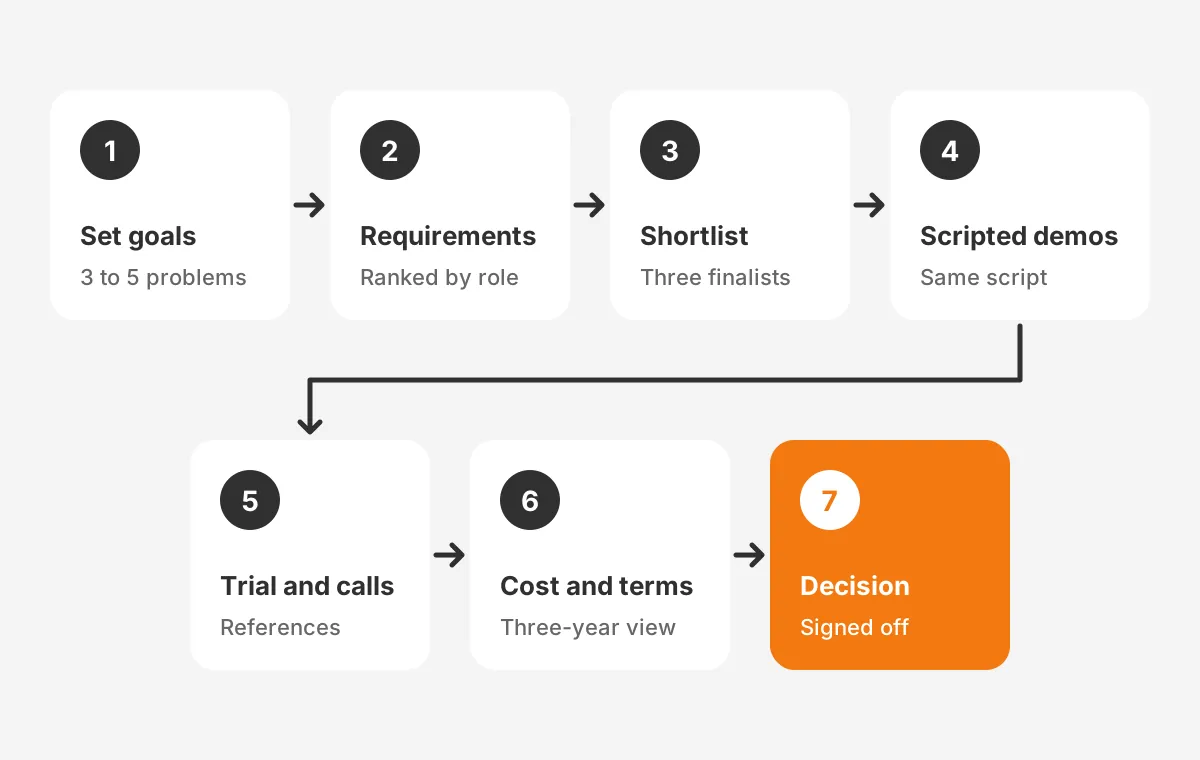
The CRM selection process has seven steps, and each one produces an output the next step needs. Taking them in order keeps the team from comparing vendors before it knows what it needs.
- Write the business goals and the three to five problems the CRM must fix.
- Document requirements by role and rank them as must-have, should-have or could-have.
- Build a longlist of six to eight vendors, then cut it to three finalists.
- Send each finalist a demo script based on your own sales process and data.
- Run a two-week sandbox trial and call at least two reference customers per vendor.
- Compare three-year total cost of ownership and negotiate contract terms.
- Make the decision, record the reasons and agree the implementation plan.
Step 2 deserves the most time. The guide to CRM requirements explains how to interview each role and write user stories. It also ranks them with the MoSCoW method. Those ranked requirements become the CRM selection criteria for every later step.
Which CRM Selection Criteria Should Carry Weight?
Seven CRM selection criteria usually decide a B2B choice. Agree their weights before the first demo and do not change them afterwards:
- Process fit: how closely standard features match your sales stages, quoting and approvals.
- Usability: the number of clicks routine tasks take on desktop and mobile.
- Integration: native connectors and API limits for your ERP, email and phone systems.
- Data and security: data residency, single sign-on, audit history and permission controls.
- Scalability: the cost and effort of adding users, teams and business units.
- Partner support: the depth of the implementation partner pool for that platform.
- Three-year cost: licenses, implementation, migration, integrations and administration.
Pipedrive's 2026 CRM selection guide estimates one to two weeks of selection work for small teams. Larger teams need three weeks or more. A mid-sized B2B company with integrations and two or more sales teams should plan for the longer end.
How Do You Build a CRM Shortlist?
You build a CRM shortlist by filtering a longlist against must-have requirements, integration needs and budget. Start with six to eight vendors from analyst reports, peer recommendations and review sites such as Capterra. Then send a short request for information (RFI) with ten to fifteen questions.
Good RFI questions are specific and verifiable. Ask each CRM vendor whether the platform supports your quoting model and which ERP connectors exist. Also ask about API limits per edition and where customer data is stored. A vendor that cannot answer in writing is unlikely to deliver in production.
The table below shows how common platforms tend to match B2B situations. Treat it as a starting filter, because editions and pricing change every year.
| Platform | Often shortlisted when | Check carefully |
|---|---|---|
| Salesforce Sales Cloud | Complex processes, two or more teams, deep customization | Edition limits, add-on costs, admin effort |
| HubSpot Sales Hub | Marketing and sales on one platform, fast adoption | Seat types, object limits, reporting depth |
| Microsoft Dynamics 365 Sales | Microsoft 365 and Dynamics ERP already in place | Licensing tiers, partner availability |
| Zoho CRM | Tight budgets and smaller sales teams | Integration depth with existing systems |
| Pipedrive | Small teams with a simple sales pipeline | Fit for multi-team or complex quoting |
| Odoo CRM | Companies running or planning Odoo ERP | Customization scope and partner quality |
Cut the longlist to three finalists. Two leaves no fallback if one vendor stumbles in the trial. Four or more stretches the team's time and blurs the scores. Capterra's survey result on three shortlisted vendors points to the same number.
Integration needs often decide the shortlist. A distributor that runs NetSuite or Dynamics 365 Business Central should rank CRM platforms by connector quality first. The CRM ERP integration guide lists the objects to sync and the integration patterns to ask each vendor about.
How Should You Run Scripted CRM Demos?
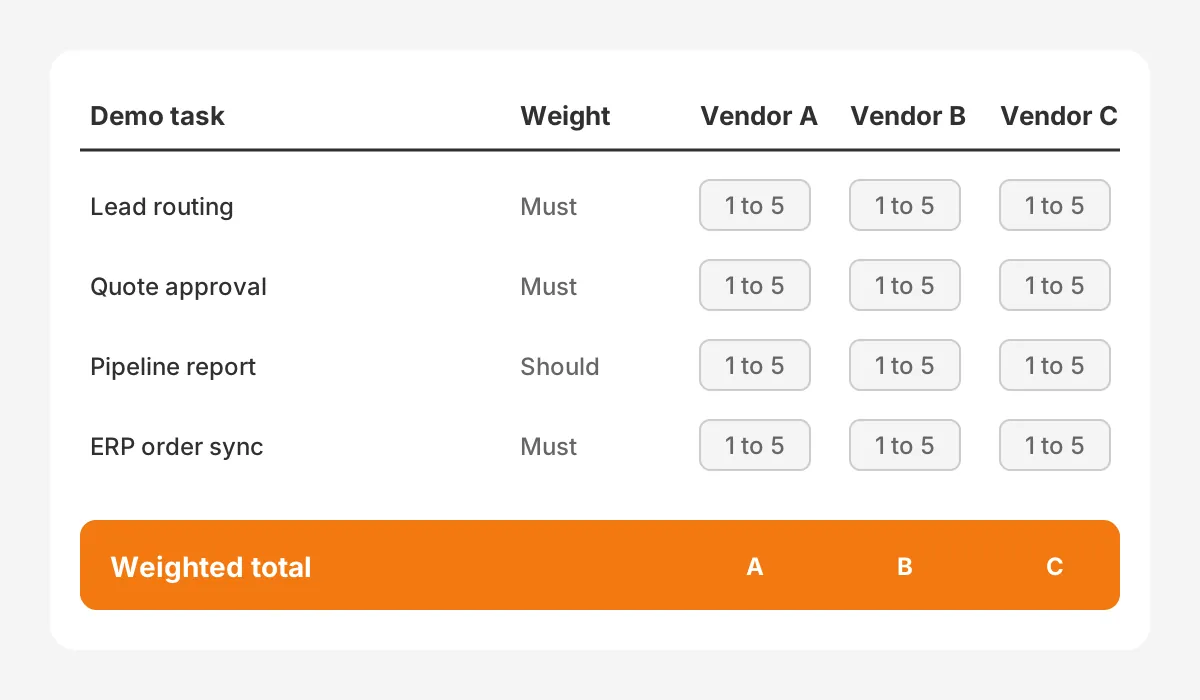
Run scripted CRM demos by giving every finalist one script, one set of sample data and one scorecard. Each vendor then shows your process, not its favorite features. Send the CRM demo script two weeks ahead, so the vendor has time to configure a realistic environment.
A strong demo script follows one deal from first touch to closed order. Write it as a sequence of tasks with clear pass criteria:
- Capture a web lead and route it to the right rep by territory.
- Convert the lead and log a call from a mobile phone.
- Build a quote with two discount tiers that need manager approval.
- Move the opportunity through your real pipeline stages.
- Show the pipeline report your sales director reviews every Monday.
- Show how a closed deal creates an order in the ERP.
Score each task from 1 to 5 during the session. Then weight the scores by the priority of the matching requirement. HubSpot's CRM selection guide also recommends a weighted scoring matrix for vendor comparison. The scorecard keeps the CRM evaluation tied to written criteria rather than to presentation style.
After the demos, ask the top two vendors for a two-week sandbox trial. Load around 500 real records, invite the frontline reps and ask them to work real deals in parallel. The trial shows page speed, mobile usability and the number of clicks routine tasks take.
What Should the Sandbox Trial Test?
The sandbox trial should test the tasks that cause friction today, not the features that already work. Give each tester a short checklist and a feedback form:
- Find a customer and see every open deal, quote and support case.
- Log a meeting from a phone between two site visits.
- Build a filtered report without help from an administrator.
- Import a spreadsheet of 200 contacts and fix the duplicates.
- Follow an automated task from lead assignment to reminder.
Collect the feedback forms on the last day and add the results to the scorecard. Weigh them heavily: reps working real deals reveal problems that a rehearsed demo never reaches.
What Should CRM Reference Checks Ask?
CRM reference checks should ask customers what went wrong, what it cost and what they would change. Ask each finalist for two references of a similar size, industry and integration setup. A reference that matches your situation is worth more than a famous logo.
Use the same questions on every call, so the answers can be compared:
- How long did implementation take compared with the original plan?
- Which costs appeared after signing that were not in the first quote?
- How did support respond to the most serious issue you raised?
- What share of the sales team uses the CRM every day?
- Which integration caused the most work, and how was it solved?
- Would you choose the same platform and partner again?
Ask the implementation partner for references too, not only the software vendor. The partner's delivery quality often matters as much as the platform. Unboxx publishes its CRM project success stories for this reason, so buyers can check comparable work before a reference call.
How Do You Compare CRM Total Cost of Ownership?
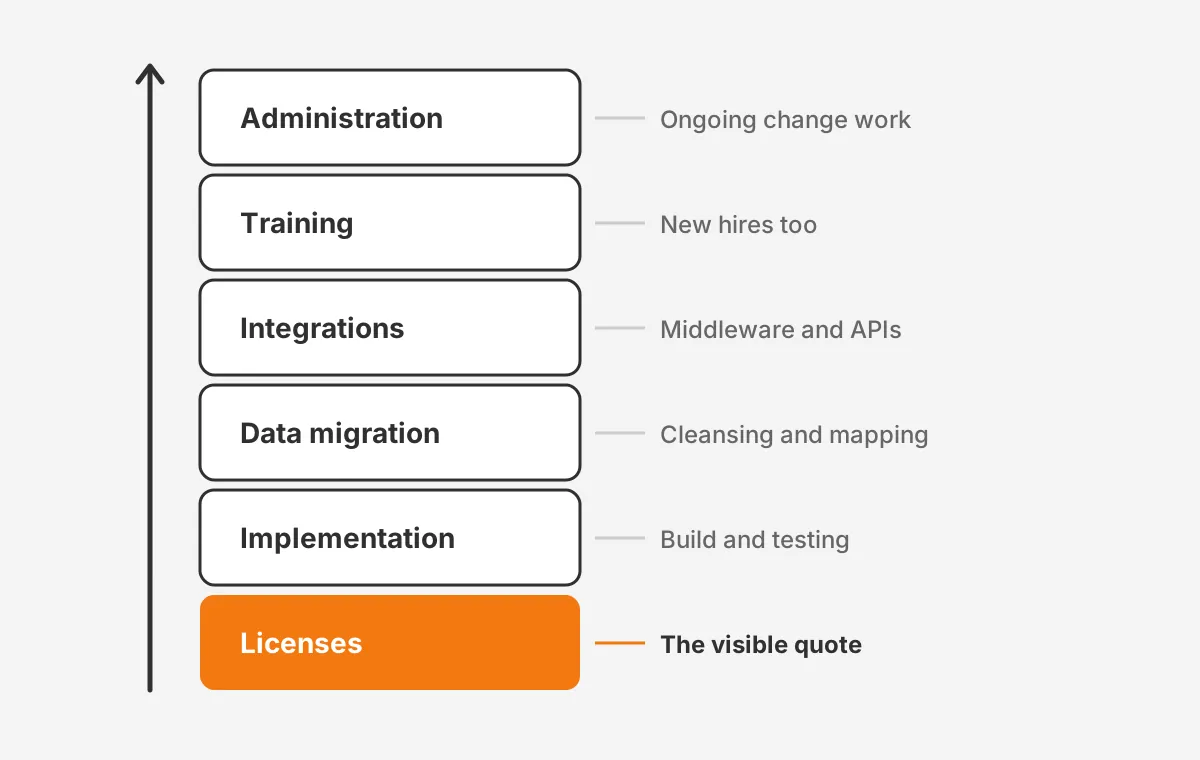
You compare CRM total cost of ownership by adding every cost over three years, not only the first-year license. Build one spreadsheet with the same rows for each finalist. Finance should review it before any price negotiation starts.
| Cost line | What to include | Common gap in vendor quotes |
|---|---|---|
| Licenses | All seat types, editions and add-ons for three years | Renewal increases after year one |
| Implementation | Configuration, automation, testing and project management | Change requests beyond the first scope |
| Data migration | Cleansing, mapping and loading historical records | Attachments, activities and custom objects |
| Integrations | ERP, email, telephony and marketing connectors | Middleware subscriptions and API overage |
| Training | Role-based sessions and documentation | Training for new hires after go-live |
| Administration | In-house admin time or a managed service | Ongoing release and change work |
Licenses rarely make up the whole cost. On a mid-sized project, implementation, migration and integration work can match or exceed the first-year subscription. The breakdown of CRM implementation cost shows how each of these lines is usually estimated.
A worked example makes the point. Assume a 60-user team where Vendor A costs less per seat but needs paid middleware for the ERP sync. Vendor B costs more per seat but includes a native connector. Over three years, the cheaper license can produce the higher total.
Here is how the sum works. Assume Vendor A charges $80 per user per month and Vendor B charges $100. Over 36 months for 60 users, licenses cost $172,800 and $216,000. If Vendor A needs $30,000 a year in middleware plus $40,000 of extra integration work, its total reaches $302,800.
These figures are illustrations, not market prices. Run the same sum with your own quotes.
Which CRM Contract Terms Should You Negotiate?
The CRM contract terms worth negotiating are renewal caps, seat flexibility, data rights and support levels. Vendors expect negotiation, and quarter-end timing can help because sales teams work to quarterly targets. Keep two finalists active until the terms are agreed.
Negotiation works best with facts in hand. Bring the three-year cost model, the competing quote and the list of add-ons the team does not need. Removing unused add-ons and committing to a longer term are common ways to lower the total without cutting scope.
- A cap on renewal price increases, written as a percentage per year.
- The right to reduce seats at renewal if headcount falls.
- Free sandbox environments for testing and training.
- A data export clause that covers all records, files and history.
- A service level agreement with response times and service credits.
- A data processing agreement that meets your privacy obligations.
- Proof of security controls, such as a current SOC 2 report.
Review the implementation partner's statement of work with the same care. It should list deliverables, acceptance criteria, assumptions and the rate for change requests. A vague statement of work leaves every change request open to dispute once the project starts.
How Long Should CRM Selection Take?
CRM selection for a mid-sized B2B company usually takes eight to ten weeks from kickoff to signature. Smaller teams with a simple pipeline can finish faster. Companies with ERP integrations, two or more business units or strict security reviews need the longer range.
Three factors decide how long CRM selection takes. They are integration scope, the number of teams involved and the speed of legal review.
| Week | Activity | Output |
|---|---|---|
| 1 to 2 | Form the team, set goals, gather requirements | Ranked requirements list |
| 3 | Build the longlist and send the RFI | RFI responses from six to eight vendors |
| 4 | Score RFI answers and pick finalists | Shortlist of three vendors |
| 5 to 6 | Run scripted demos | Weighted demo scores |
| 7 | Sandbox trial and reference calls | Trial feedback and reference notes |
| 8 | Total cost model and negotiation | Final quotes and contract drafts |
| 9 | Decision and sign-off | Signed contract and decision record |
This schedule is an example, not a benchmark. Write the CRM decision record in week 9 even if the choice feels obvious. It explains the reasons to future managers and gives the implementation team a clear brief. The CRM implementation plan guide covers what happens next.
If the new CRM replaces an existing one, start migration planning during selection. Data volume and quality affect cost and timeline. The CRM migration guide explains how to scope that work early.
Frequently Asked Questions
What is the difference between CRM selection and implementation?
CRM selection decides which platform, edition and partner to use and on what contract terms. Implementation follows the signature: configuring the system, migrating data, building integrations and training users. Selection usually takes weeks, while implementation for a mid-sized company often takes three to six months, depending on scope.
Should a company hire a consultant for CRM selection?
A consultant helps when the team lacks recent CRM buying experience or faces complex integrations. Before you select a CRM with outside help, check the advisor's independence. A good advisor writes demo scripts and models total cost of ownership. Ask any advisor to disclose vendor partnerships.
How many vendors should be on a CRM shortlist?
Three vendors is the usual target for a CRM shortlist. Two leaves no fallback if one fails the trial, and four or more stretches the team's time. Start with a longlist of six to eight, then cut it with a written request for information.
Why do CRM demos mislead buyers?
Standard CRM demos use clean sample data and the vendor's best workflows. They rarely show approvals, territory rules or integrations that match a buyer's process. A scripted demo built on your own sales steps gives a fair comparison. Score every vendor against the same weighted criteria.
When should a company replace its CRM?
A company should consider replacement when users keep data outside the CRM, reports need manual work, or integrations break often. Rising license costs for unused features are another sign. Run an audit first, because configuration fixes sometimes solve the problem without a new CRM selection project.
Where Should Your CRM Selection Start?
A sound CRM selection starts with written goals and ranked requirements. It then moves through scripted demos, reference calls, a three-year cost model and firm contract terms. Each step narrows the field with evidence. The board, finance and the reps can all see why one platform won.
Unboxx helps B2B teams run CRM selection across Salesforce, HubSpot, Microsoft Dynamics 365 and Odoo, from requirements to contract review. To plan your shortlist and demo scripts with an experienced team, schedule a CRM selection consultation.
Let's create something out of this world together.
Have a project in mind? Contact us for expert design and development solutions. Let's discuss how we can help grow your business.
Ready to Unboxx Your Potential?
Build smarter systems. Automate faster. Scale confidently.