
A nonprofit buys Salesforce, imports a donor spreadsheet, and six months later nobody trusts the reports. Gift totals disagree with the finance system. Program staff keep tracking outcomes in their own files. The software works. The setup does not.
A Salesforce nonprofit consultant designs, builds and hands over a Salesforce org shaped around fundraising, programs and grants. That design work pays off. In the Salesforce.org Nonprofit Trends Report (2020), 85% of digitally mature nonprofits met or exceeded fundraising goals. Only 66% of low-maturity peers did.
Key Takeaways
- A Salesforce nonprofit consultant turns the free Power of Us licenses into a working donor, program and grant system.
- The first decision is NPSP or Nonprofit Cloud, because moving between them later means building a new org.
- Vet consultants on nonprofit project references, current certifications and a written statement of work before signing.
What Does a Salesforce Nonprofit Consultant Do?
A Salesforce nonprofit consultant configures Salesforce for nonprofits so donor, program and grant data live in one system. The work starts before any setup. It begins with a discovery workshop that maps how money, people and services move through the organization.
From kickoff to handover, a Salesforce nonprofit consultant typically owns eight jobs.
- Run discovery and document requirements for fundraising, programs and finance.
- Recommend NPSP or Nonprofit Cloud and the right edition.
- Design the data model, including households, recurring donations and gift entry.
- Move donor data from spreadsheets or a legacy donor database.
- Build Flow automation for receipts, task routing and data checks.
- Set up integrations with accounting, email and payment tools.
- Build reporting and dashboards for the board and program leads.
- Deliver staff training and a plan for user adoption.
The discovery workshop decides how good the rest of the project will be. It should produce a process map, a list of reports leadership needs, and a record count for every data source. A consultant who skips this step is guessing.
The engagement rarely stops at launch. Most firms stay on for managed services, which means monthly admin hours, release reviews and fixes. Teams without a full-time Salesforce admin lean on that help the most.
AI work is now part of the role too. Nonprofit Cloud includes Flex Credits for AI and Agentforce, with 500,000 credits per org on the Core edition. A consultant decides which use cases deserve those credits first.
Sensible first candidates are narrow and measurable. Examples include drafting gift acknowledgment letters, summarizing case notes, or answering volunteer scheduling questions. Each one needs clean data underneath, which is why AI work usually follows the core build.
Who Needs a Salesforce Nonprofit Consultant?
Organizations with growing donor files, grant reporting duties or two or more programs need a Salesforce nonprofit consultant most. A five-person charity with one fundraiser can often run an out-of-the-box setup. A 40-person organization with three funding streams usually cannot.
Not every nonprofit needs a Salesforce consultant. Outside help pays back fastest in four situations.
- Teams with an accidental admin: a development officer who inherited Salesforce on top of a full job.
- Organizations moving off a legacy donor database such as DonorPerfect or Bloomerang.
- Nonprofits that must report outcomes to funders by program, cohort or grant.
- Groups that tried a self-build and now face duplicate records and broken reports.
Unboxx sees the same pattern in its CRM for nonprofits services: the trouble rarely sits in the software. It sits in unclear ownership of data and process. A Salesforce nonprofit consultant fixes that by assigning owners before building anything.
Consider a worked example with assumed details. A youth services nonprofit runs an after-school program, a summer camp and a mentoring scheme. Each program reports to a different funder, on a different schedule.
Without one data model, staff rebuild the same attendance numbers three times each quarter. A Salesforce nonprofit consultant would model programs, participants and services once. Each funder report then becomes a filtered view of the same records.
Board reports draw on those records as well, so the numbers match what funders see.
Smaller teams comparing platforms should read the nonprofit CRM software comparison first. A donor management tool can be the better fit when programs and grants are simple.
Which Roles Sit on a Nonprofit Salesforce Project?
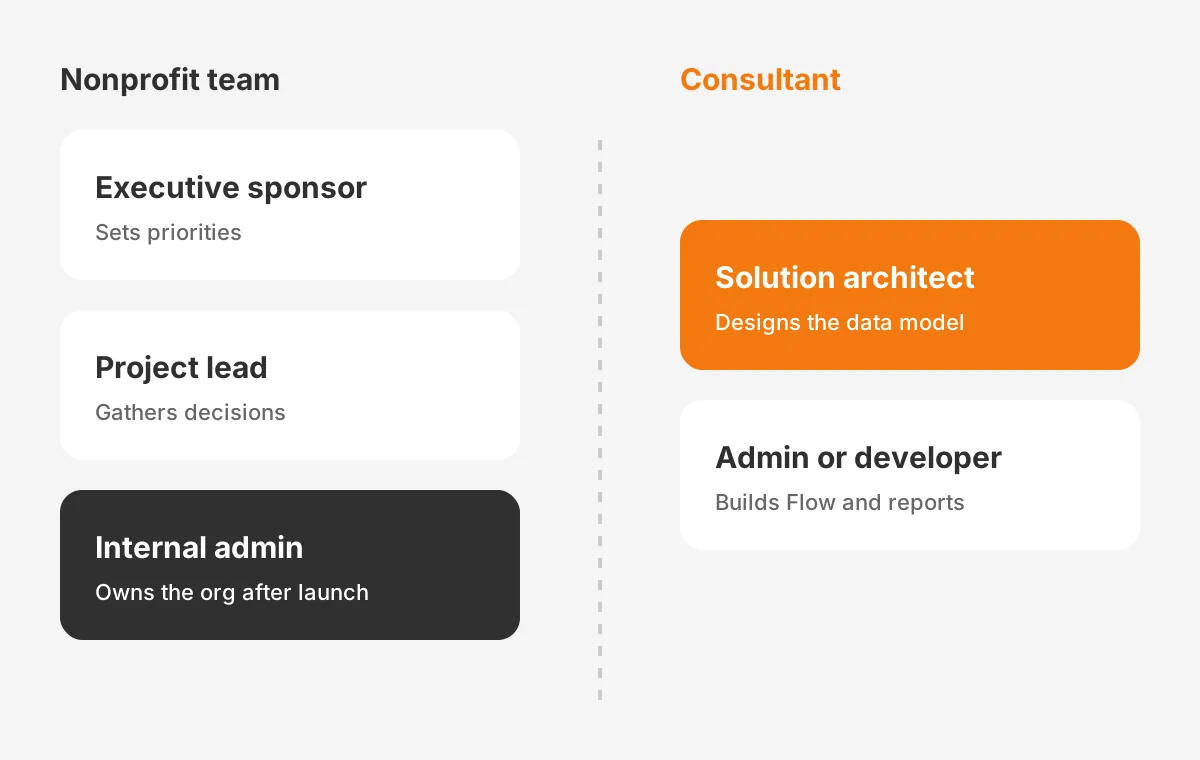
A typical project needs five roles, and a Salesforce nonprofit consultant fills two or three of them. The nonprofit must staff the rest. Gaps on the client side cause more delays than technical problems do.
| Role | Usually filled by | Main job |
|---|---|---|
| Executive sponsor | Nonprofit (CEO or COO) | Sets priorities and approves scope changes |
| Project lead | Nonprofit (development or operations) | Gathers decisions and keeps staff on schedule |
| Solution architect | Consultant | Designs the data model and integrations |
| Admin or developer | Consultant | Builds objects, Flow automation and reports |
| Internal admin | Nonprofit | Owns the org after go-live |
The internal admin role is the one nonprofits skip most often. Without it, the consultant becomes the only person who understands the system. That dependence raises managed services costs every year.
The project lead needs protected time. A rule of thumb from typical plans is one day a week during build, rising during testing. When that time is missing, decisions stall and the consultant waits on answers.
A Salesforce admin for nonprofits does not need to be a developer. The role needs someone who can add fields, fix reports, reset passwords and spot bad data. Trailhead offers free learning paths for exactly that work.
Should You Choose NPSP or Nonprofit Cloud First?
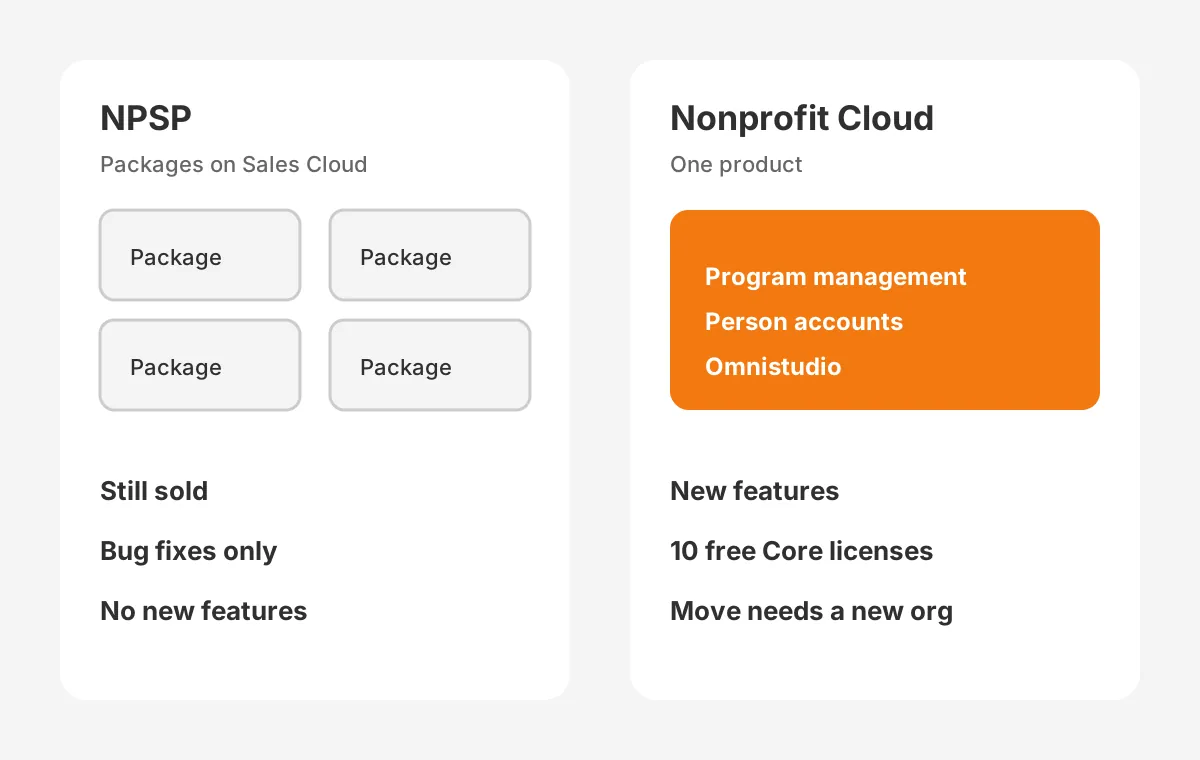
New implementations should usually start on Nonprofit Cloud, because NPSP now receives bug fixes only. Donorbox reviewed both products in 2025. Its NPSP and Nonprofit Cloud comparison notes that NPSP is still sold, with no end-of-life date announced.
The Nonprofit Success Pack is a set of installable packages built on Sales Cloud. Nonprofit Cloud is a single product with program management, person accounts and the Actionable Relationship Center. It also adds automation through Omnistudio and a Business Rules Engine.
The NPSP vs Nonprofit Cloud choice is hard to reverse. Nonprofit Cloud migration from NPSP requires a new Salesforce org, so data and automation are rebuilt. A Salesforce nonprofit consultant should explain that cost before recommending either path.
Two cases still favor NPSP. The first is an existing NPSP org that works well and has no budget for a rebuild. The second is a team that depends on an AppExchange app not yet available for Nonprofit Cloud.
A simple decision rule helps. Start fresh orgs on Nonprofit Cloud. Keep a healthy NPSP org until a major change, such as a new program model, justifies the rebuild. Plan that move as its own project, with its own budget.
Ask for a written estimate of the rebuild before the next license renewal.
When Should a Nonprofit Hire a Salesforce Consultant?
A nonprofit should hire a Salesforce consultant before the first record is imported, not after reports break. Early design decisions, such as household accounts or person accounts, are expensive to change later.
After the initial build, these events are the usual signals that it is time to bring a consultant back.
- A new grant requires outcome reporting the current org cannot produce.
- Gift totals in Salesforce differ from the general ledger each month.
- The organization plans a move from NPSP to Nonprofit Cloud.
- The accidental admin leaves and nobody knows how the automation works.
- Leadership wants to test Agentforce for donor service or volunteer questions.
Of these, data migration carries the highest risk. A consultant can migrate donor data without losing giving history. That depends on mapping every field, cleaning duplicates first and testing a sample load. The Salesforce data migration checklist lists each stage.
Timing within the year matters too. Avoid a go-live during year-end giving season, when gift volume peaks and staff have no time for training. Spring and early summer launches leave room to fix problems before the busy months.
Fiscal year-end deserves the same caution. Finance teams close the books then, and gift reconciliation needs their attention. A Salesforce nonprofit consultant should schedule the final data load at least six weeks away from that close.
What Does a Typical Project Timeline Look Like?
A focused build moves through six phases, and each phase ends with a sign-off. The durations below are an assumed example for a 25-user organization. Larger data volumes or extra programs stretch every phase.
- Discovery, weeks 1 to 3: workshops, process maps and the requirements list.
- Design, weeks 3 to 5: data model, integration plan and report list.
- Build, weeks 5 to 10: objects, Flow automation, page layouts and dashboards.
- Migration, weeks 8 to 12: field mapping, cleanup, test loads and the final load.
- Testing and training, weeks 11 to 14: user testing and role-based sessions.
- Go-live and support, weeks 14 to 16: launch, fixes and handover documents.
The phases overlap on purpose. Migration starts during build so test loads can expose data problems early. Training runs on real migrated records, so staff recognize their own donors and programs.
A Salesforce nonprofit consultant should share this plan as a dated schedule, not a slide. Every phase needs a named owner on each side. The nonprofit project lead signs each phase before the next one starts.
Digital maturity grows after go-live, not on launch day. Plan a review at 30, 60 and 90 days. Each review checks login rates, open data issues and whether leadership trusts the dashboards.
How Do You Vet a Salesforce Nonprofit Consultant?
Vet a Salesforce nonprofit consultant on three things: nonprofit references, current certifications and a written delivery plan. A strong sales call proves little. Evidence from finished projects proves more.
Knowing how to choose a Salesforce consultant is mostly a matter of order. Work through these steps before any pricing talk.
- List the three outcomes the project must deliver, such as faster gift entry.
- Shortlist three firms that show nonprofit projects on their site or AppExchange listing.
- Check certifications on Trailhead, including the nonprofit credential.
- Ask each firm for two references from organizations of similar size.
- Request a draft statement of work with deliverables, owners and exclusions.
- Compare proposals on scope first and price second.
The credential to look for is the Salesforce Certified Agentforce Nonprofit Consultant. Trailhead lists the Salesforce Certified Platform Administrator certification as its prerequisite. A certified Salesforce consultant without nonprofit project history is still a risk.

Good questions to ask a Salesforce consultant are specific. Who will build the org day to day? Which nonprofit implementations has that person delivered? What happens to scope if a grant requirement changes mid-project?
Watch for Salesforce consultant red flags. These include a fixed price before discovery, no named team members and no plan for staff training. Another warning sign is a proposal that ignores the NPSP vs Nonprofit Cloud decision.
A scoring sheet keeps the comparison fair. Score each Salesforce nonprofit consultant from 1 to 5 on five criteria. The weights below are a suggested starting point, not an industry standard.
| Criterion | Suggested weight | Evidence to request |
|---|---|---|
| Nonprofit project history | 30% | Two references of similar size |
| Statement of work quality | 25% | Draft scope with exclusions |
| Certified team | 15% | Trailhead profile links |
| Training and handover plan | 15% | Sample training agenda |
| Total cost for the same scope | 15% | Itemized proposal |
What Should a Statement of Work Include?
A statement of work should name every deliverable, its owner and what the project excludes. It protects both sides. Vague scope is where most budget overruns on nonprofit projects begin.
A sound statement of work from a Salesforce nonprofit consultant covers six areas.
- Objects and processes in scope, such as donations, programs and volunteer management.
- Data sources, record counts and the cut-off date for donor data.
- Named integrations, for example QuickBooks for finance and Mailchimp for email.
- Reports and dashboards, listed by audience.
- Training sessions, user adoption checks and handover documents.
- Acceptance criteria and a support window after go-live.
Data governance belongs in the statement too. Someone must own duplicate rules, required fields and who may edit gift records. Without that owner, data quality drops within months of launch.
Grant management and program management need clear boundaries. Some organizations track grants in Salesforce, others in the finance system. The statement should say which system is the record of truth for each.
Change requests need a written process as well. The statement should say who can request a change, how it is priced and who signs it off. That rule stops small additions from quietly doubling the budget.
Handover documents deserve their own line in the statement. Ask for a data dictionary, a list of every automation with its trigger, and an admin runbook. A Salesforce nonprofit consultant who writes these makes the nonprofit less dependent on future support.
How Much Does a Salesforce Nonprofit Consultant Cost?
Cost depends on scope, data volume and the pricing model, so there is no single market rate. Ask for a fixed fee for defined phases and time and materials for open-ended work. Licenses are a separate line.
Is Salesforce free for nonprofits? Partly. The Salesforce Nonprofit Cloud pricing page lists 10 free Core licenses through the Power of Us program. Additional licenses are discounted for eligible nonprofits.
Salesforce nonprofit pricing on that page sets the Sales and Service Core edition at $70 per user per month. The Advanced edition is $125 and both Max editions are $285. All require an annual contract.
The worked example below uses assumed figures to show how a budget forms. The consultant hours and the hourly rate are illustrations, not market data.
| Budget line | Assumption | Year-one cost |
|---|---|---|
| Core licenses | 25 users: 10 free, 15 paid at $70 | $12,600 |
| Implementation | 240 hours at an assumed $150 | $36,000 |
| Managed services | 10 hours a month at an assumed $150 | $18,000 |
| Total | Before any license discount | $66,600 |
Ask how much the Salesforce consultant will cost for the whole scope, not per hour. Each Salesforce consultant hourly rate varies by region, seniority and firm size. Two firms at different rates can land on similar totals.
The pricing model shifts risk. A fixed fee puts overrun risk on the consultant, so the scope must be tight. Time and materials keeps flexibility, but the nonprofit carries the overrun risk.
The Salesforce nonprofit consultant cost should also include a contingency line. Holding 10 to 15% of the build budget in reserve is a common planning habit. It covers data surprises found during migration.
The Salesforce managed services guide compares ongoing support against an in-house admin. For a 25-user org, that choice often decides the year-two budget.
What Mistakes Do Nonprofits Make With Consultants?
The costliest mistake is buying a build without planning who runs the system afterward. A Salesforce nonprofit consultant can deliver a clean org that decays in a year without an internal owner.
The build itself goes wrong in predictable ways.
- Migrating every legacy field instead of only the fields reports use.
- Skipping change management, so staff keep using spreadsheets.
- Customizing gift entry heavily before testing the standard process.
- Treating fundraising and marketing as separate systems with no sync.
Ownership of the org is another blind spot. The nonprofit, not the Salesforce nonprofit consultant, should hold the main system administrator login. The same applies to integration accounts, domain settings and the Power of Us license contract.
A clean exit clause protects the organization if the relationship ends. It should require the consultant to hand over credentials, documentation and open tickets within a set number of days. Good partners accept this clause without argument.
Reference calls surface these problems before a contract is signed. Ask past clients whether the Salesforce nonprofit consultant met the go-live date, stayed within budget and trained staff well. Ask, too, whether they would hire the same team again.
Disconnected fundraising and marketing systems hurt donor communication most. The marketing automation for nonprofits guide shows how email journeys depend on clean CRM data. Organizations weighing a different platform can compare costs in HubSpot for nonprofits.
A nonprofit technology consultant who works across platforms can also judge whether Salesforce fits at all. Microsoft Dynamics 365 suits teams already deep in Microsoft tools. A good Salesforce nonprofit consulting partner says so when it applies.
Frequently Asked Questions
Is a Salesforce partner the same as a consultant?
Not always. A Salesforce partner is a firm registered in the Salesforce partner program, often listed on AppExchange. A consultant may be an individual freelancer. For a Salesforce implementation for nonprofits, a partner firm usually supplies an architect, a builder and cover during staff leave.
How long does a Salesforce implementation take?
A focused fundraising build often takes 8 to 16 weeks, based on typical project plans. Programs, grants and integrations extend the timeline. Data migration and staff training take longer than configuration. Ask the consultant for a phase plan with dates, owners and review points before signing anything.
Can an NPSP consultant build on Nonprofit Cloud?
Only with retraining. An NPSP consultant knows the package model, while Nonprofit Cloud runs on a different data model with person accounts. Ask which Nonprofit Cloud implementation projects the person has delivered. Then check their Trailhead profile for the Agentforce Nonprofit Consultant credential.
Does a nonprofit still need an internal admin?
Yes. A consultant builds the org, but someone must handle daily user requests, data fixes and new reports. Smaller teams can train an internal admin for part of each week. Larger teams often pair an internal admin with monthly managed services hours from the consultant.
Should you hire a CRM generalist or Salesforce specialist?
A nonprofit CRM consultant compares platforms such as Salesforce, Dynamics 365, Bloomerang and DonorPerfect before recommending one. A Salesforce specialist assumes Salesforce from the start. Organizations still choosing should start with the broader advisor. Then they can hire a Salesforce nonprofit implementation partner for the build.
How Can Unboxx Help as Your Salesforce Nonprofit Consultant?
Unboxx works as a Salesforce nonprofit consultant and Salesforce Crest Partner, covering discovery, data migration, Flow automation and training. Projects such as this automated Salesforce CRM success story show the same method applied to reporting problems.
To scope a project, schedule a consultation with Unboxx. Bring a list of programs, funding sources and current tools. A Salesforce nonprofit consultant can then recommend NPSP or Nonprofit Cloud and a phased plan.
Let's create something out of this world together.
Have a project in mind? Contact us for expert design and development solutions. Let's discuss how we can help grow your business.
Ready to Unboxx Your Potential?
Build smarter systems. Automate faster. Scale confidently.