
Finance teams now ask one question before every agent pilot: what will it cost once live? McKinsey's State of AI 2026 survey found 40 percent of large organizations now scale AI agents. About 20 percent said AI operating costs, token costs included, held back their AI use.
AI agent cost is the total of three budgets: building the agent, running it every month, and keeping it accurate. Most quotes cover only the first one. This guide breaks each budget into cost lines, shows real 2026 list prices, and walks through a worked year-one example.
Key Takeaways
- AI agent cost has three parts: a one-time build, a monthly run cost and ongoing maintenance.
- Pricing models differ by platform, so the same workload can cost $24 or $12,000 a month.
- Model routing, prompt caching and tight scope cut run costs without lowering answer quality.
What Does AI Agent Cost Include?
AI agent cost is everything a company pays to design, deploy, run and maintain an agent. An agent is software that works on its own. It reads a request, plans steps, calls tools such as a CRM or ERP, and acts. Each of those steps uses compute, licenses and people.
The cost of AI agents falls into three budgets. Each one behaves differently over time, so each needs its own owner.
- Build cost: discovery, design, integration work, testing and launch, paid once.
- Run cost: model tokens, platform fees, hosting and data storage, paid every month.
- Maintenance cost: prompt updates, integration fixes, monitoring and human review, paid every month.
Maintenance is the line most budgets forget. Prompts drift as products change, and APIs change versions. In most plans, maintenance turns a one-time AI agent cost into a recurring one.
The run cost scales with volume. The build cost scales with the number of systems the agent touches. Maintenance scales with how often your processes, products and policies change.
Cost per task is the clearest way to frame the question. Divide the monthly AI agent cost by the number of tasks the agent completes. That single figure lets you compare an agent with a person, an older automation or a vendor's per-outcome price.
Free tiers do not change the answer: AI agents cost money even there. Usage is capped, and integration, security and review still take paid staff time.
Why Do AI Agents Cost More Than Chatbots?
AI agents cost more than chatbots because they call the model over and over for one task. A chatbot answers one question with one model call. An agent plans, checks a record, calls a tool, reads the result and calls the model again.
Anthropic measured this gap in its own systems. Its 2025 engineering report on a multi-agent research system gives the figures. Agents use about 4 times more tokens than chat interactions. Multi-agent systems use about 15 times more tokens than chats.
That multiplier is why an AI chatbot cost estimate is a poor guide to AI agent cost. An FAQ bot sends one short prompt per question. An agent that checks the CRM and the ERP, then drafts a refund, sends 8 or more.
Three design choices push the token count up:
- Long context: the agent sends full account histories or long policy documents with every call.
- Deep loops: the agent takes 10 or more steps before it finishes one task.
- Multi-agent designs: a lead agent hands work to subagents, and each subagent calls the model again.
None of these choices is wrong. Each one should earn its token cost with better answers. That trade-off is the core of AI agent cost control.
How Do AI Agent Pricing Models Work?
AI agent pricing models charge by token, by action, by conversation, by user or by outcome. The model your platform uses decides how your bill grows with volume. Agentic AI pricing is still settling, so vendors change these models often.
The table sets out the main AI pricing models for agents in 2026, with list prices where vendors publish them.
| Pricing model | How it bills | Published example | Best fit |
|---|---|---|---|
| Per token | Input and output tokens sent to the model API | Claude Sonnet 5.5: $2 input, $10 output per million tokens | Custom agents built on a model API |
| Per action | Credits consumed by each agent action | Agentforce Flex Credits: 20 credits, or $0.10, per action | Agents inside a CRM with clear action counts |
| Per conversation | A flat fee for each customer conversation | Agentforce: $2 per conversation | Service agents with long, unpredictable chats |
| Per user | A monthly seat fee for employees who use agents | Agentforce add-ons: $125 per user per month | Internal sales and service teams |
| Per outcome | A fee only when the agent resolves a task | Varies by vendor and contract | Support teams with a clear resolution metric |
Token pricing comes straight from the model provider. Anthropic's Claude pricing page lists Claude Opus 5.5 at $4 per million input tokens. Output costs $20 per million tokens. Claude Haiku 5.5 lists at $0.10 input and $0.50 output for prompts up to 100,000 tokens.
Claude API pricing also includes a 50 percent discount for batch processing. That discount suits agents that run overnight jobs, such as data cleanup, rather than live chats. Other LLM API pricing follows the same input and output split.
Platform pricing wraps the model inside a product. Salesforce's Agentforce pricing page lists Flex Credits at $500 per 100,000 credits. It also lists a $2 per conversation option, and Agentforce 1 Editions from $550 per user per month. Those editions include 2.5 million Flex Credits per org each year.
Agentforce pricing has one rule buyers miss: Flex Credits and Conversations cannot run in the same org. Pick the model that matches your volume before you sign. Microsoft Copilot Studio pricing uses its own Copilot Credits, sold in monthly capacity packs. Compare all three on the same monthly workload.
Ask partners for AI agent development pricing in the same units. A fixed build fee and a monthly run estimate per 1,000 tasks make quotes comparable. Without that, AI agent cost comparisons mix one-time and recurring spend.
Outcome based pricing sounds safest, since you pay only for results. The catch is the definition of an outcome. Agree in writing what counts as resolved, and how disputed outcomes get reviewed.
What Does It Cost to Build an AI Agent?
How much it costs to build an AI agent depends on scope, integrations and the platform. A configured agent inside an existing CRM can take weeks. A custom agent spanning four systems can take months.
AI agent development cost is mostly people's time, not software. An AI agent development cost breakdown usually has four phases:
- Discovery: map the process, the data the agent needs and the decisions it may make alone.
- Build and integration: write prompts, connect APIs, set permissions and design the guardrails.
- Testing: run real cases, score answers, and fix failure patterns before launch.
- Launch and handover: train staff, set up monitoring and document how the agent works.
Integration is usually the largest line. Each system the agent reads or writes needs authentication, field mapping and error handling. A CRM, an ERP and a ticketing tool make three separate integration projects.
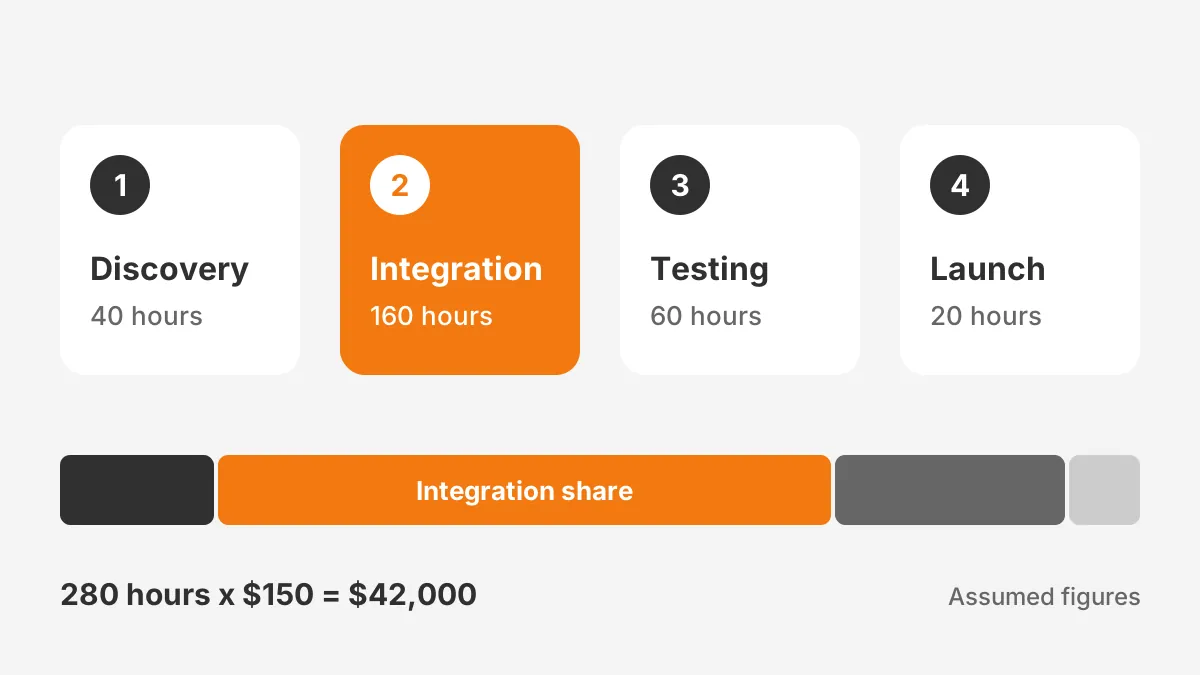
Here is a worked example with assumed figures, not a quote. A mid-sized company builds a service agent that reads its CRM and order system. Assume 40 hours of discovery, 160 hours of build and integration, 60 hours of testing and 20 hours of launch.
The total comes to 280 hours. At an assumed $150 an hour, the cost to build an AI agent of this scope is $42,000. Double the integrations and the total moves toward $70,000, because integration hours grow fastest.
Enterprise AI agent development cost rises further with security reviews, data residency rules and approval workflows. Enterprise AI agent implementation costs also include change management across four or more teams. Budget those as separate lines, not as a contingency percentage.
What is the cost of developing custom AI agents compared with configuring a platform agent? Custom development gives full control of models and data. Configuration inside Agentforce or HubSpot Breeze is faster, but you accept the vendor's pricing model.
Build vs buy AI agents is a pricing decision as much as a technical one. Agentic AI development cost on a platform is lower up front. Over three years, the platform's per-action fees can exceed a custom agent's AI agent cost.
For a narrow internal task, how much it costs to make an AI agent drops sharply. A single-system agent that drafts call summaries may need under 100 hours. Scope is the strongest lever on custom AI agent development cost.
What Is the Monthly AI Agent Cost to Run?
How much it costs to run an AI agent each month comes down to three inputs. They are tasks per month, tokens per task and the price per token or action. Multiply those three numbers and you have the core of your AI agent cost per month.
Take the service agent from the build example. Assume it handles 6,000 conversations a month. Each conversation makes 8 model calls, sending 3,000 input tokens and receiving 400 output tokens per call.
Each conversation therefore sends 24,000 input tokens and receives 3,200 output tokens. On Claude Sonnet 5.5, input costs $0.048 and output costs $0.032. The AI token cost per conversation is $0.08, or $480 a month.
Claude Haiku 5.5 handles the same conversation for about $0.004 in tokens, or $24 a month in total. The smaller model may suit routing steps, though not every answer.
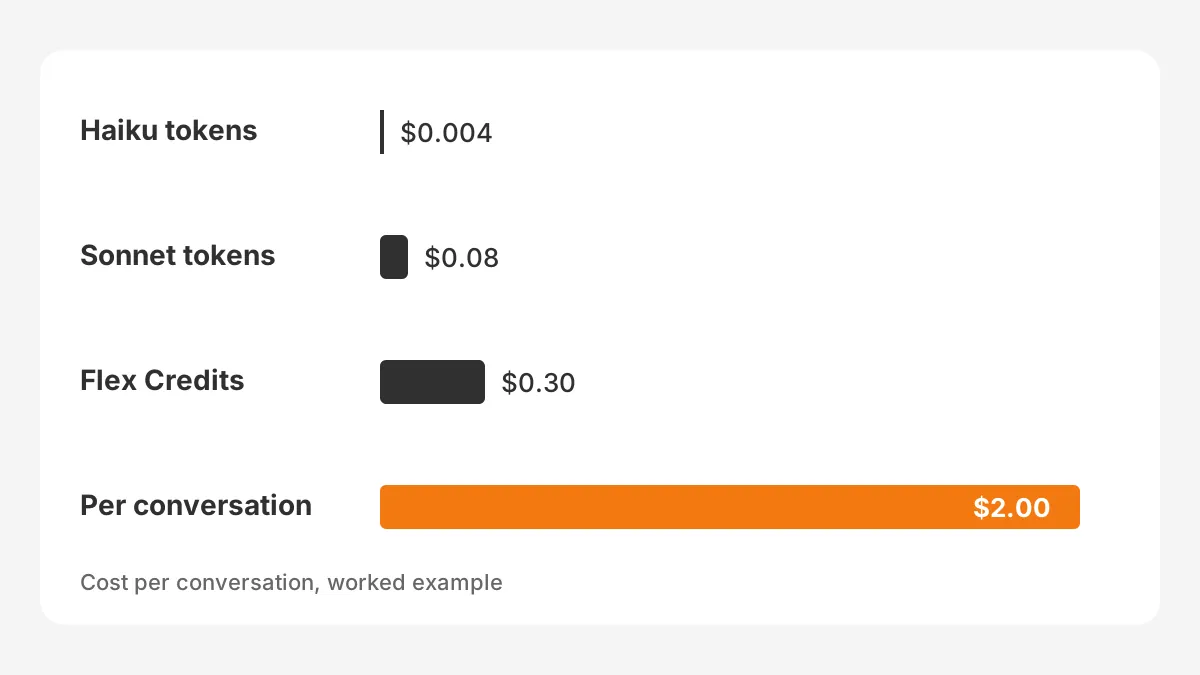
Now price the same workload on a platform. With Agentforce Flex Credits, assume three actions per conversation. Sixty credits cost $0.30, which puts the month at $1,800. On the $2 per conversation model, the bill is $12,000 a month.
The workload never changed, yet the AI agent cost moved by a factor of 500. Only the pricing model differed.
These figures are not directly comparable, and that matters. Platform prices include hosting, security, the CRM data layer and support. Token prices cover the model only. The ai agent cloud cost for hosting, logging and a vector database comes on top of tokens for custom agents.
In this example, how much AI agents cost to run ranges from $24 to $12,000 a month before staff time. The cost per task an AI agent reaches depends more on pricing than on model quality.
An AI agent pricing calculator built on these three inputs helps buyers compare quotes. Ask every vendor for tasks, tokens or actions per task, and the unit price. Then run the same workload through each.
How Does AI Agent Cost Compare With Human Work?
In the worked example, AI agent cost per task comes in far below human labor. That result holds only for tasks the agent finishes without rework, and only when both sides carry their full costs.
The Bureau of Labor Statistics reports a median wage of $21.53 an hour for customer service representatives in May 2025. That equals $44,770 a year, before benefits and management overhead.
Return to the worked example. Assume each of the 6,000 conversations takes a representative 10 minutes. The team spends 1,000 hours a month, or $21,530 in median wages alone.
Now add the agent's real monthly bill. Assume Sonnet tokens at $480, hosting and logging at $300, and 15 hours of maintenance at $150 an hour. Add 40 hours of human review at the median wage. The total is about $3,890 a month.
The $17,640 monthly gap is the basis of AI agent ROI. It holds only if the agent resolves most conversations without a person redoing the work. Track the resolution rate weekly, because a falling rate erases the savings fast.
The worked AI agent cost of $3,890 a month is an estimate. Your own figure will move with volume, model choice and review hours.
Agents rarely replace a whole team. They take the repetitive share of requests, and people handle exceptions. This is how to reduce operational costs with AI agents without hurting service quality. The AI agent use cases guide shows which tasks agents handle well.
Which Hidden Costs Do Teams Miss?
The hidden costs are human review, monitoring, governance and rework. They rarely appear in a vendor quote. Yet they decide whether the AI agent total cost of ownership beats the business case.
Five lines get missed most often:
- Human review: staff who check agent actions, especially refunds, discounts and contract changes.
- AI agent observability: tools and time to trace each step, catch failures and measure accuracy.
- AI agent governance: access controls, audit logs, data retention rules and approval workflows.
- Data cleanup: an agent acting on duplicate or stale CRM records makes confident mistakes.
- Rework: fixing what the agent got wrong, plus the customer time lost while it happens.
Bad data costs more with an agent than without one. An agent that reads wrong account owners routes tasks to the wrong people at machine speed. Clean the records the agent depends on before launch, not after.
AI agent cost visibility is the other gap. Token spend often sits on a developer's API account, while platform fees sit in IT's budget. Put every line in one cost report, tagged by agent and by use case.
The Agentforce cost breakdown shows how these lines add up for one platform in its first year.
How Can You Reduce AI Agent Cost?
You can reduce AI agent cost by sending fewer tokens, using cheaper models for simple steps and narrowing scope. These moves are the core of LLM cost optimization. None of them requires lower answer quality.
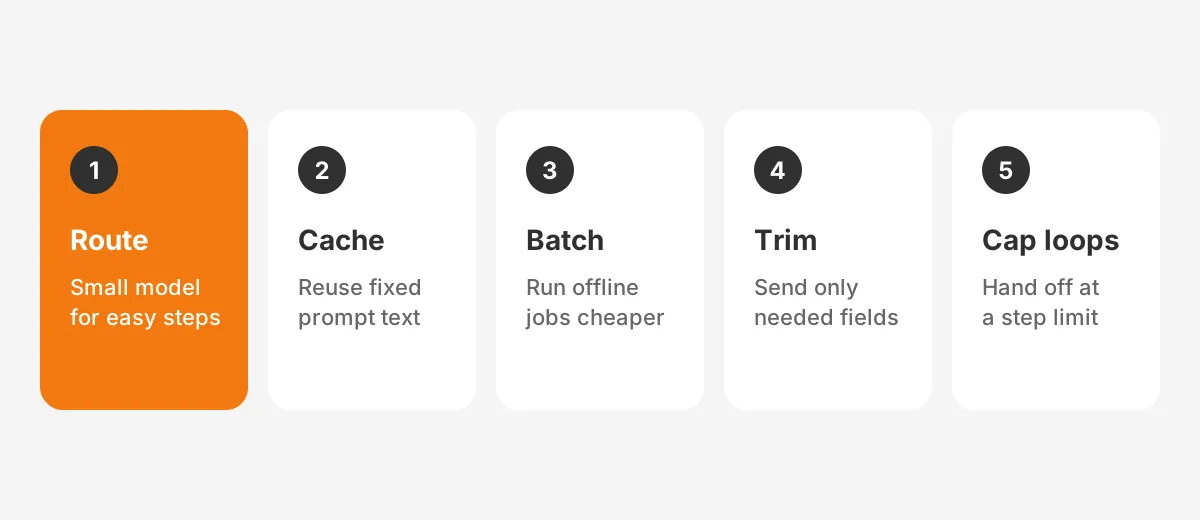
- Route by difficulty: send classification and lookup steps to a small model, and keep the large model for judgment.
- Use prompt caching: reuse a stable system prompt and policy text instead of paying full price each call.
- Batch offline work: run data cleanup and enrichment as batch jobs at the published batch discount.
- Trim context: send the fields the agent needs, not the full account history.
- Cap loops: set a maximum step count, and hand the task to a person when the agent hits it.
Prompt caching matters most for agents with long instructions. Suppose 2,000 tokens of policy text repeat in every call. Caching stops you paying full input price for them each time.
How to reduce AI agent inference costs on a platform is different. You cannot change the platform's model price. You can cut actions per task, which lowers credits consumed per conversation.
How to control AI agent infrastructure costs for custom builds? Set monthly budget alerts on every API key and cloud account. Review the 10 most expensive tasks each month. Runaway loops on a handful of tasks can drive a large share of AI agent cost.
AI cost management works best as a monthly routine with one named owner. Unboxx's AI business automation services include this kind of cost review alongside agent design and integration.
How Do You Budget Year-One AI Agent Cost?
Budget AI agent cost for year one by adding the build cost to twelve months of run and maintenance cost. Then add a buffer for scope growth. Agents that work tend to get more tasks.
Using the worked example, year one looks like this. The build costs $42,000. Run and maintenance cost about $3,890 a month, or $46,680 for twelve months. The total is $88,680 before scope growth.
Compare that with $21,530 a month in median wages for the same conversations. At a $17,640 monthly saving, the $42,000 build pays back in under three months. That assumes the agent resolves most conversations alone.
What does AI agent deployment cost for a smaller firm? Less, because the scope is smaller. Take an agent with 100 build hours at the assumed $150 rate. Its AI agent deployment cost for small businesses is $15,000 before run costs.
The cost of implementing AI agents in 2026 also depends on readiness. Clean data, documented processes and a named owner shorten every phase. The AI implementation roadmap sets out a 90-day path that keeps the first build small.
Across a whole company, how much agentic AI costs is best budgeted per agent, not per program. Each agent has its own volume, model and integrations, so each needs its own line. That also keeps AI implementation cost reviews honest when one agent outperforms another.
Before you approve the budget, compare it with what a rules-based workflow would cost. Some tasks do not need an agent at all. The AI agent vs traditional automation comparison helps you decide.
Frequently Asked Questions
How much does an AI agent cost?
An AI agent costs a one-time build fee plus a monthly run cost. In this guide's example, the build was $42,000 and running it cost about $3,890 a month. Narrow agents inside an existing CRM cost far less. Multi-system custom agents cost more.
How much does AI agent software cost per user?
Platforms that bill per user charge a monthly seat fee for each employee who works with agents. Salesforce lists Agentforce add-ons at $125 per user per month. Per-user pricing suits internal teams, while customer-facing agents usually bill per conversation or action instead.
Which is the cheapest way to run an agent?
The cheapest way to run an AI agent is to use a small model for simple steps. Cache repeated prompt text and cap the number of steps per task. Batch any work that does not need an instant answer at the published batch discount.
Who should own AI agent spend inside a company?
One named owner should hold AI agent spend, usually in operations or IT. That person tracks tokens, platform fees and review hours in one report. They also review the most expensive tasks monthly and approve any change to the agent's scope.
How much does it cost to deploy AI agents?
Deploying AI agents across teams costs roughly one build per distinct process, plus shared costs for governance and monitoring. Shared integrations get cheaper with reuse. Expect each new agent on the same CRM to cost less than the first one.
What Should You Do Next About AI Agent Cost?
Start by pricing one use case with real volumes, not a company-wide program. Count tasks per month, estimate tokens or actions per task, and run the numbers through two pricing models. That gives you an AI agent cost you can defend to finance.
Unboxx designs, prices and builds AI agents on Salesforce, HubSpot and custom stacks for B2B teams. To get a cost model for your first agent, schedule a consultation with our team.
Let's create something out of this world together.
Have a project in mind? Contact us for expert design and development solutions. Let's discuss how we can help grow your business.
Ready to Unboxx Your Potential?
Build smarter systems. Automate faster. Scale confidently.