
Most AI agent pilots start with a demo, not a business problem. Gartner predicts agentic AI will resolve 80% of common customer service issues without human help by 2029 (Gartner, 2025). That forecast means little until a team picks the right first job.
AI agent use cases are repeatable jobs where software reads context, decides the next step and acts inside your systems. This guide lists AI agent use cases by team and shows how to score them. It also sets the guardrails each one needs before launch.
Key Takeaways
- The strongest AI agent use cases are frequent tasks with clear rules, reachable data and one measurable outcome.
- Sales, customer service, finance operations and IT hold the fastest payback for mid-sized B2B companies.
- Every agent needs a set autonomy level, from drafting work to acting alone, before it touches live records.
What Are AI Agent Use Cases in Business?
AI agent use cases in business are multi-step tasks an agent completes toward a goal, using company data and tools. An AI agent is software that uses a large language model to read a request, plan steps and call tools.
That is the short answer to what is an AI agent. A fuller AI agent definition adds one condition: the software must act, not only answer.
The difference from older tools is the decision step. A chatbot answers questions. A robotic process automation (RPA) bot repeats fixed clicks. An agent chooses which action fits the case in front of it, then takes that action through an API.
| Factor | Chatbot | RPA bot | AI agent |
|---|---|---|---|
| Input | A typed question | Structured fields | Emails, tickets, records and documents |
| Decision | Picks an answer | Follows a fixed script | Plans the next step per case |
| Action in systems | Rarely | Yes, on fixed screens | Yes, through APIs and tool calling |
| Best fit | FAQs | Stable, rule-only tasks | Varied cases with clear goals |
How does agentic AI work in practice? The agent reads the trigger, pulls context from the CRM or knowledge base, plans, acts and checks the result. Retrieval-augmented generation (RAG) grounds its answers in your own knowledge articles instead of general web text.
IBM describes five types of AI agents: simple reflex, model-based reflex, goal-based, utility-based and learning agents (IBM, 2025). Business AI agent use cases mostly rely on goal-based agents, because each job has a defined finish line.
Reading types of AI agents with examples helps with vocabulary. For planning, the job matters more than the label, so the sections below group AI agent use cases by team.
Here are AI agents explained in one test. The software must finish a task, not only describe it. Every one of the agentic AI use cases examples below passes that test.
A quick way to see agentic AI vs generative AI examples side by side is a sales email. Generative AI drafts the email. An agent drafts it, checks the account in the CRM, sends it, logs it and books the follow-up task.
Which AI Agent Use Cases Fit B2B Sales Teams?
Sales holds the AI agent use cases most mid-sized companies try first. The work is frequent, and the CRM already holds the data. Unboxx builds these agents through its AI business automation services, starting from the sales process rather than the tool.
Account and lead research
Before a first call, a rep spends time on the company website, LinkedIn and past emails. A research agent gathers that material, summarizes it into five lines and writes it to the account record. This is one practical AI agent example that saves time on every new lead.
Lead routing and first follow-up
An agent can read an inbound form, score fit against your ideal customer profile and assign the lead by territory. Our guide to lead routing rules and methods covers the assignment logic the agent should follow. The agent then drafts a first reply for the owner to approve.
CRM updates after meetings
Reps skip data entry. An agent reads the call transcript, updates the opportunity stage, next step and close date, and flags missing fields. Sales managers get forecasts built on current data instead of week-old notes.
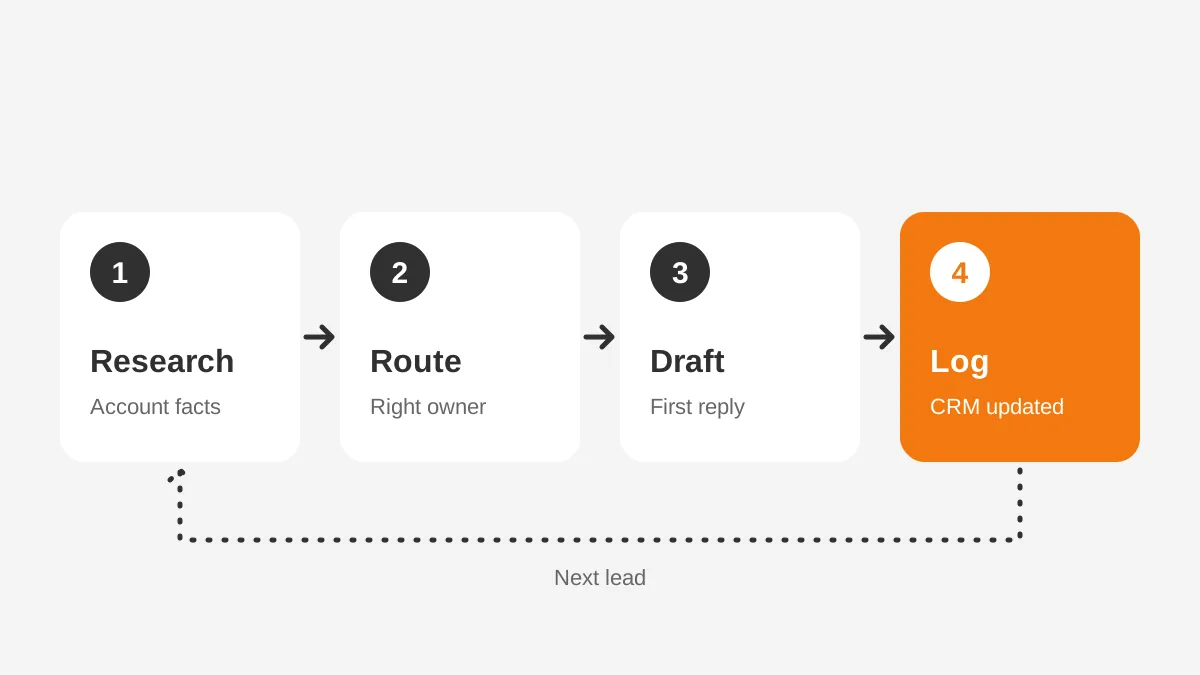
Salesforce Agentforce, HubSpot Breeze and Microsoft Copilot Studio with Dynamics 365 all offer sales agents inside the CRM. See how Agentforce for sales teams handles prospecting and coaching. These AI sales agent B2B use cases work best when the CRM data is clean first.
For an example of an AI agent with quick payback, start with meeting-to-CRM updates. Every rep sees the saved time on their own calls. Among AI agents examples in real life, it is also the easiest to measure. Count the fields filled and the admin hours removed.
What Do AI Agents Do in Customer Service?
In customer service, AI agents triage tickets, answer routine questions and complete simple actions such as order lookups. These are the clearest examples of AI agents in live use today.
Gartner expects agentic AI to resolve 80% of common service issues by 2029, cutting operational costs by 30% (Gartner, 2025). The word "common" matters. Complex complaints still need people, so service AI agent use cases focus on routine volume.
- Ticket triage: the agent reads each new ticket in Zendesk or Service Cloud, sets category and priority, and routes it.
- Answer and resolve: it replies from approved knowledge articles and closes the ticket when the customer confirms.
- Order and account actions: it checks order status in the ERP, resends invoices or books a service visit.
- Escalation with context: it hands hard cases to a person with a summary, so the customer never repeats the story.
All four agentic AI real world examples share one trait. Each has a clear end state, such as a closed ticket or a booked visit. Measure first contact resolution, handle time and the share of escalations a person reverses.
Voice is the next channel. AI voice agent examples include after-hours phone lines that book appointments and confirm delivery windows. Each example of AI agents here works because the agent can only act on a short, approved list of actions.
Which AI Agent Use Cases Suit Finance and Operations?
Finance and operations suit AI agent use cases that handle exceptions. Clean, routine transactions already flow through the ERP without help. The agent takes the leftover cases that sit in someone's inbox today.
Accounts payable and invoice matching
An agent compares the purchase order, goods receipt and invoice, which is the three-way match. When amounts differ inside a set tolerance, it posts the invoice. When they differ beyond it, it emails the supplier and logs the query. These are core agentic AI use cases in finance.
Collections and treasury
Collections agents send reminders based on payment history and promise-to-pay dates. Agentic AI treasury use cases include a daily cash position summary built from bank feeds and open invoices. A person still approves every payment.
Supply chain and manufacturing
Agentic AI use cases in supply chain start with late shipments. The agent spots the delay, checks which customer orders it affects and drafts updates for the account manager.
In plants, agentic AI use cases in manufacturing include quote requests, spare-parts orders and service scheduling. Those manufacturing AI agent use cases depend on clean machine and order data.
Platforms such as Odoo, Dynamics 365 and NetSuite expose the APIs these agents need. This is an agentic AI example where clean master data decides success more than the model does.
Exception handling ranks high among the best use cases for AI agents in enterprise operations. Its volume is steady, and its rules are already written down.
Agentic AI examples in real life from finance teams look modest. A month-end close agent that chases 40 missing receipts saves a controller a full day, as an assumed example. Small, repeated wins like that make the case for the next agent.
Finance AI agents examples carry one more advantage. Every action leaves an ERP record, so auditors can trace what the agent did and when.
How Do Marketing and HR Teams Use AI Agents?
Marketing and HR teams use AI agents for content preparation, lead quality and policy-based employee requests. The output usually goes to a person for review, so the risk stays low.
In marketing, an agent can turn a product brief into a campaign plan, then draft emails and landing page copy. It can also run lead scoring, merge duplicate contacts and pause sends to bounced addresses. These are the agentic AI examples that save the most hours in small teams.
One example of AI agent work in marketing is a weekly pipeline brief. The agent pulls campaign results from HubSpot or Salesforce and compares them with last week. It then writes five findings for the team meeting.
Agentic AI use cases in HR include interview scheduling, onboarding checklists and answers to policy questions from the handbook. A new hire asks how to claim travel expenses. The agent answers from the policy and opens the right form.
Keep hiring decisions with people. Screening agents can sort applications, but a recruiter should review every rejection before it goes out. HR AI agent use cases work best at the draft or approve level.
What Do AI Agents Handle in IT and Data?
IT teams use AI agents for help desk requests, access changes, incident triage and plain-language data questions. McKinsey reports that companies most often scale agents in IT, knowledge management and software engineering (McKinsey, 2026).
The same survey found that large organizations scaling agents in at least one function rose from 27% to 40%. Those AI agents enterprise use cases start in IT because requests are standard and systems are documented.
- Help desk: password resets, software requests and laptop orders through ServiceNow or Jira Service Management.
- Access management: grant and remove app access when HR changes a role, with a manager approval step.
- Incident triage: group alerts, find the likely cause and open one ticket instead of forty.
- Data questions: answer "what were Q3 renewals by region?" by querying the data warehouse.
Agentic AI security use cases follow the same pattern. An agent enriches a security alert with user, device and recent activity, then routes it to an analyst. These examples of agentic AI keep a person on every containment step.
One AI agents example from data teams is a Slack assistant that answers metric questions. It shows the SQL it used, so analysts can check the logic.
Which Tools Run These AI Agent Use Cases?
Most AI agent use cases run on agent builders inside the CRM, help desk or ERP the team already uses. Salesforce Agentforce, HubSpot Breeze, Microsoft Copilot Studio and ServiceNow are the common agentic AI tools examples for B2B firms.
Built-in agents reach CRM records without extra integration work. Custom agents built on a large language model and APIs suit cross-system jobs. One example is a job that spans CRM, ERP and email.
Generative AI agents examples on these platforms include drafting replies, summarizing calls and writing record updates. Each still needs tool calling to finish a task, not only to write text.
Lists of AI agents practical business examples 2026 often skip the boring work of preparing data. Budget at least as much time for data cleanup as for agent setup.
Pick the platform after choosing the use case. A team that starts with the tool often ends up with a capable agent and no clear job for it.
How Do AI Agent Use Cases Differ by Industry?
AI agent use cases change by industry mainly in the data they touch and the rules they follow. The core jobs of research, triage, drafting and updating records stay the same.
Agentic AI use cases in healthcare include appointment scheduling, referral intake and prior authorization paperwork. Clinics that ask how to use AI agents in dental practices usually start with recall reminders and insurance checks. Patient data rules mean every agent needs strict access limits.
Agentic AI in banking use cases include know-your-customer document checks and dispute intake. AI agent use cases in healthcare and finance share one rule: the agent prepares, and a licensed person decides.
Agentic AI insurance use cases cover quote preparation, renewal reminders and first notice of loss intake. Whether AI will replace insurance agents gets a practical answer in these workflows. The software takes the paperwork, while producers keep the advice and the client relationship.
Manufacturers, distributors and professional services firms see the most value in quoting, order status and project updates. These AI agent use cases sit where CRM and ERP data meet.
How Do You Rank AI Agent Use Cases?
Rank AI agent use cases by scoring volume, rule clarity, data access, risk and measurability. Then start with the highest total. This keeps the first project small, safe and easy to prove.
Score each factor from 1 to 3. Volume asks how often the task happens. Rule clarity asks whether two staff members would handle it the same way. Data access asks whether the agent can reach every system it needs through an API.
Risk asks what happens if the agent gets one case wrong. Measurability asks whether you can count the result in hours, days or dollars. The table below scores four use cases for AI agents as a worked example. The scores are illustrative, not survey data.
| Use case | Volume | Rules | Data | Low risk | Measurable | Total |
|---|---|---|---|---|---|---|
| Meeting notes to CRM | 3 | 3 | 3 | 3 | 2 | 14 |
| Ticket triage | 3 | 3 | 2 | 3 | 3 | 14 |
| Invoice exceptions | 2 | 3 | 2 | 2 | 3 | 12 |
| Contract negotiation | 1 | 1 | 1 | 1 | 2 | 6 |
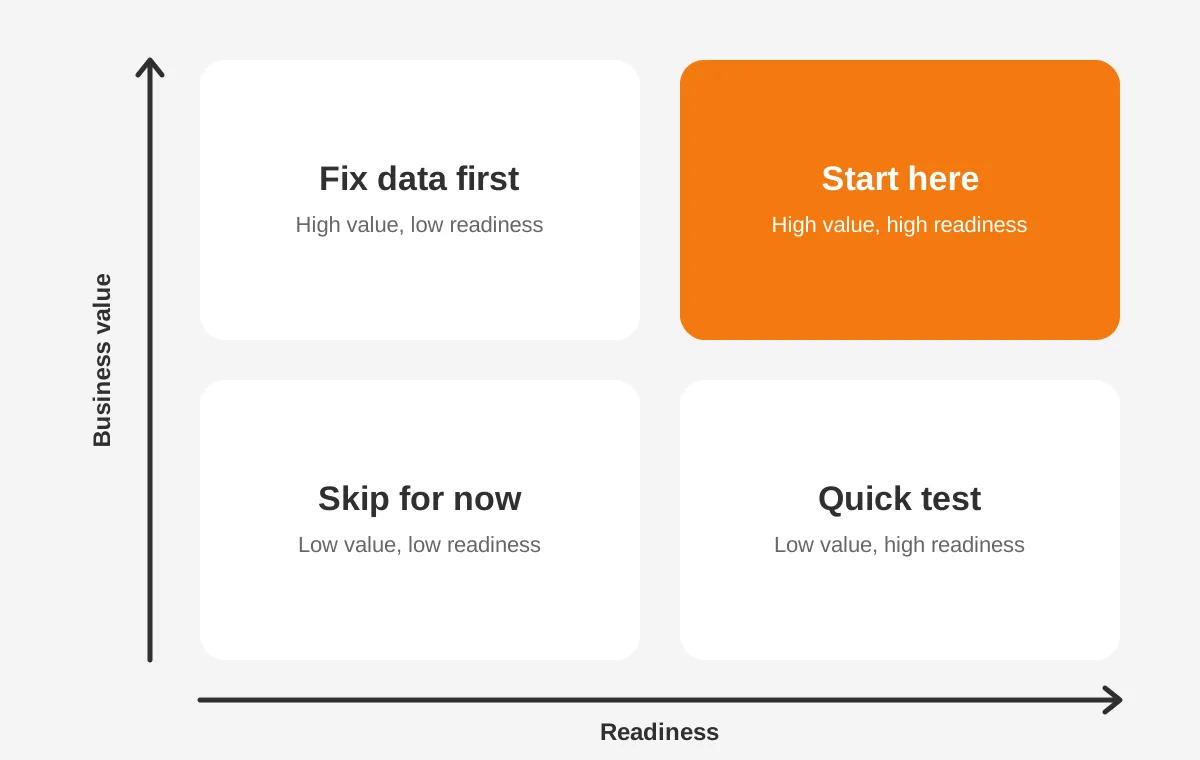
Plot the totals on a simple grid of business value against readiness. AI agent use cases in the top right go first. Ideas with high value but weak data need cleanup before any agent work.
Here is an assumed example of the math. A service team gets 1,200 tickets a month and spends 6 minutes triaging each one. That is 120 hours a month. If an agent handles 70% of triage, the team gets back 84 hours.
A sum like this turns AI agents business impact examples into a business case a CFO can check. Gartner expects at least 15% of day-to-day work decisions to be made by agentic AI by 2028 (Gartner, 2024). The scoring method tells you which decisions to hand over first.
Treat agentic AI business use cases that score under 9 as a warning. Fix the process first, or choose rules-based automation instead. Our comparison of AI agents and traditional automation helps with that choice.
On paper, the best AI agent use cases look dull. They are frequent tasks that two staff members would already describe the same way.
What Guardrails Do AI Agent Use Cases Need?
AI agent use cases need a set autonomy level and separate access rights. They also need action limits, an audit log and an escalation path. Set these before go-live, not after the first mistake.
Use three autonomy levels, with a human-in-the-loop at the first two. At the draft level, the agent prepares work and a person sends it. At the approve level, the agent acts only after a person clicks approve.
At the act level, the agent works alone within limits and logs every step. Keep finance and HR agents at the approve level for their first quarter, then review the error log.

Should AI agents have their own identity and permission system? Yes, because shared logins hide who did what. Give each agent a named service account with the fewest permissions its job needs. That makes every action traceable in the audit log.
Cost is a guardrail too. McKinsey found about 20% of respondents say AI operating costs, including token costs, limited their AI use (McKinsey, 2026). Set a monthly budget per agent and alert the owner at 80% of it.
Test the agent on 100 real past cases before launch. Compare its decisions with what staff did, and fix each disagreement in the instructions or data. These steps apply to all use cases for agentic AI, whatever the platform.
Frequently Asked Questions
How do AI agents work?
AI agents read a trigger, gather context from connected systems and plan steps with a large language model. They act through APIs. After each action, the agent checks the result against its goal. It then continues, finishes the task, or escalates the case to a person with a summary.
How much does an AI agent cost?
AI agent cost has three parts: platform licensing, build work and usage fees such as tokens or per-conversation charges. Data cleanup is often the hidden fourth cost. Our breakdown of Agentforce pricing and first-year totals shows how these lines add up for one platform.
Who should own an AI agent project?
The business leader whose team does the work should own an AI agent project, with IT as a partner. The owner sets the goal, approves the autonomy level and reviews results each month. IT manages access, security and integrations. A named admin keeps instructions and knowledge content current.
When is an AI agent the wrong tool?
An AI agent is the wrong tool for fixed-rule tasks with no judgment. It also fails when data is unreachable or one error is costly. Rules-based workflows handle fixed tasks more cheaply. See these workflow automation examples for tasks that need no agent at all.
How do you build an agent for enterprise work?
To build an AI agent for enterprise use cases, define one goal and list the systems and actions it needs. Write clear limits. Connect data through APIs, test on past cases and start at draft level. How to make an AI agent safe is mostly process work, not coding.
Which AI Agent Use Cases Should You Start With?
Start with AI agent use cases that score high on volume, rules and data. Good examples are meeting notes to CRM, ticket triage and invoice exceptions. Learning how to create an AI agent for one of these jobs teaches your team more than a broad pilot.
Our guide to agentic AI workflow automation explains the build steps. Unboxx helps B2B teams pick, score and launch first agents on Salesforce, HubSpot, Dynamics 365 and Odoo. Book a consultation with Unboxx to rank your AI agent use cases and plan a safe first launch.
Let's create something out of this world together.
Have a project in mind? Contact us for expert design and development solutions. Let's discuss how we can help grow your business.
Ready to Unboxx Your Potential?
Build smarter systems. Automate faster. Scale confidently.