
Buyers now ask ChatGPT, Perplexity and Google AI Overviews which vendor to call. Some stop reading before the links. Pew Research Center found that users clicked a traditional result in 8% of visits with an AI summary. Without a summary, they clicked in 15% of visits (Pew Research Center, 2025).
An AI search roadmap is a 90-day plan for getting your company named and cited inside those answers. For a mid-size company, the AI search roadmap runs in three 30-day phases. Fix access and set a baseline, publish answer-first content, then measure citations against pipeline.
Key Takeaways
- An AI search roadmap splits 90 days into an audit phase, a content phase and a measurement phase.
- Google states that AI Overviews need no special markup, so classic SEO hygiene still carries most of the load.
- Track AI referral traffic in GA4 and tie those leads to pipeline in HubSpot or Salesforce.
What Is an AI Search Roadmap?
An AI search roadmap is a time-boxed plan for earning mentions and citations in AI answer engines. It covers Google AI Overviews, Google AI Mode, ChatGPT search, Perplexity, Microsoft Copilot, Gemini and Claude. Each of these tools writes a direct answer and links to a short list of sources.
The discipline behind the plan has two common names. Generative engine optimization (GEO) focuses on being cited in generated answers. Answer engine optimization (AEO) focuses on being the direct answer to a question. Some teams also call the work AI SEO or LLM SEO.
So what is generative engine optimization in practice? It is SEO work aimed at a new output: a cited sentence instead of a ranked link. The page still needs to be crawlable, accurate and useful. It also needs passages an AI model can lift and quote without editing.
A good AI search strategy builds on classic search engine optimization rather than replacing it.
Google says a page must be indexed and eligible to show with a snippet. Only then can it appear in AI features (Google Search Central, 2025). That rule makes topical authority and technical health the first layer of any AI search roadmap.
The plan also fits inside a wider AI implementation roadmap. That matters when a company is rolling out AI across sales and operations.
The roadmap adds three layers that classic SEO plans tend to skip. The first is prompt tracking, a fixed list of buyer questions tested in each engine.
The second is brand mentions in AI answers on third-party sites. The third is CRM attribution, so the board sees revenue instead of screenshots. A 90 day SEO plan rarely covers these layers.
Why Do Mid-Size Companies Need an AI Search Roadmap?
A mid-size company needs an AI search roadmap because organic clicks are shrinking on the questions buyers ask first. Ahrefs found that an AI Overview correlated with a 34.5% lower average clickthrough rate for the top-ranking page (Ahrefs, 2025).
The same Pew study found that users clicked a link inside the AI summary in 1% of visits. These are zero-click searches. The buyer reads the answer, forms a shortlist and moves on. A brand that is missing from the answer is missing from the shortlist.
Enterprise brands have teams for this work. Mid-size B2B companies usually have one marketing manager, an agency and a part-time web developer. That team cannot chase every engine at once.
A 90-day AI search roadmap gives it a fixed scope, a fixed prompt list and clear owners. Unboxx runs this work as part of its AI growth marketing services.
There is also a sales reason. AI answers often compare vendors by name in a table. If your pricing model, integrations and industries are unclear online, the model fills the gap with a competitor. A clear entity profile stops the model from guessing.
Finally, the roadmap prevents waste. Vendors now sell llms.txt files, special AI schema and prompt hacks. Google states that no new machine-readable files or AI text files are needed to appear in its AI features. A written AI search roadmap keeps the budget on work with evidence behind it.
What Does a 90-Day AI Search Roadmap Include?
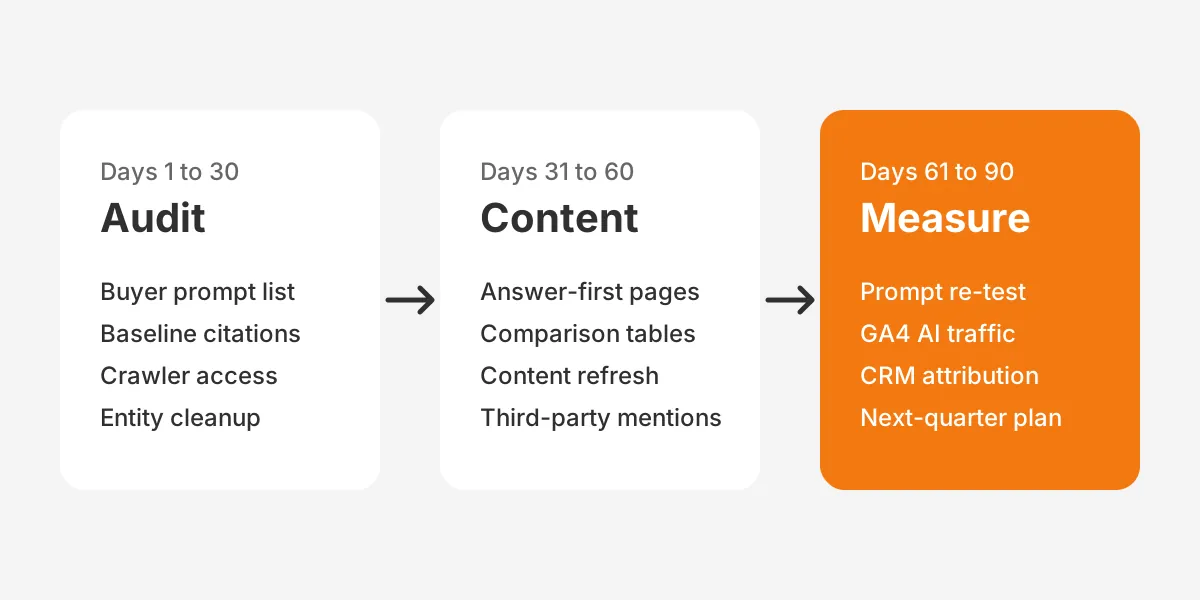
A 90-day AI search roadmap includes three phases of 30 days, each with one goal and one exit check. Phase one fixes access and sets a baseline. Phase two publishes and refreshes content. Phase three measures citations, AI referral traffic and pipeline, then sets the next quarter.
The table below shows the full AI search roadmap at a glance. Each row lists the work, the owner and the proof that the phase is finished.
| Phase | Main work | Lead owner | Exit check |
|---|---|---|---|
| Days 1 to 30: Audit | Prompt list, baseline, crawler access, entity cleanup | SEO lead | Baseline citation rate recorded for 30 to 50 prompts |
| Days 31 to 60: Content | Answer-first pages, comparison tables, FAQ refresh, third-party mentions | Content lead | 10 to 15 priority pages rebuilt or published |
| Days 61 to 90: Measure | Prompt re-test, GA4 AI traffic, CRM attribution, next-quarter plan | Marketing ops or RevOps | Report linking AI citations to leads and pipeline |
The page counts in the table are planning targets, not benchmarks. A company with a small site may rebuild eight pages. A company with a large resource library may refresh 25. Pick a number the team can finish without cutting quality.
Two rules apply across all three phases. First, every task maps to a buyer question on the prompt list. Second, nothing is reported as a win until a re-test or a CRM record proves it.
What Should a Mid-Size Team Prepare Before Day One?
A mid-size team should prepare access, data and one decision-maker before day one of the AI search roadmap. Missing access is a frequent reason the first month slips. A two-hour kickoff settles most of it.
Gather these items before the clock starts:
- Admin access to Google Search Console, Bing Webmaster Tools and GA4.
- Edit access to the website, robots.txt and the sitemap.
- A CRM admin in HubSpot or Salesforce who can add fields and reports.
- Six months of sales call notes, lost-deal reasons and demo form answers.
- A list of three to five named competitors that buyers compare you with.
The competitor list matters more than it seems. Share of voice only makes sense against named rivals. Without them, a 20% citation rate has no context.
Agree on scope too. A mid-size company should pick one product line or one industry for the first AI search roadmap. A manufacturer might start with its main equipment category. A consultancy might start with its highest-margin service.
Narrow scope keeps the prompt list to 30 to 50 questions. It also means the content team rebuilds pages that sales will use. Once the first cycle proves the method, the next AI search roadmap can add a second product line.
What Happens in Days 1 to 30?
The first month builds the baseline and removes anything that stops AI engines from reading the site. Without a baseline, the team cannot prove progress at day 90. The month ends with an AI search audit, a scored prompt list and a short fix list.
- Write 30 to 50 buyer prompts. Use sales call notes, CRM lost-deal reasons and Search Console queries.
- Test each prompt in ChatGPT, Perplexity, Google AI Mode and Copilot. Record who is cited and whether your brand appears.
- Calculate the baseline citation rate: prompts that mention your brand, divided by prompts tested.
- Check robots.txt so search crawlers such as OAI-SearchBot and PerplexityBot are not blocked.
- Submit the sitemap in Google Search Console and Bing Webmaster Tools. Microsoft Copilot draws on the Bing index.
- Fix entity consistency: company name, services, industries and locations must match across the site, LinkedIn and G2.
Prompt tracking is the heart of this phase. A prompt such as "best CRM consultant for a manufacturer" shows which domains each engine trusts. That list of trusted domains becomes the target list for phase two.
Keep the audit honest. AI answers vary between sessions, so test each prompt twice and log both results. Paid AI visibility tracking tools exist, but a shared spreadsheet works for a first quarter. Semrush Academy also publishes a 90-day AI search template for planning.
Do not spend this month on llms.txt or new structured data types. Google states there is no special schema.org structured data needed for AI features. Valid schema markup such as Organization and FAQPage still helps classic results, so fix errors you already have.
What Happens in Days 31 to 60?
Month two goes to the pages behind the prompts you lost in month one. The aim is answer-first content: a direct answer in the first sentence under each heading, then proof. AI models quote passages that stand alone, so every section must make sense on its own.
Evidence supports this shift. The academic paper that introduced generative engine optimization tested this idea. It reported that GEO can boost visibility by up to 40% in generative engine responses (Aggarwal et al., KDD 2024).
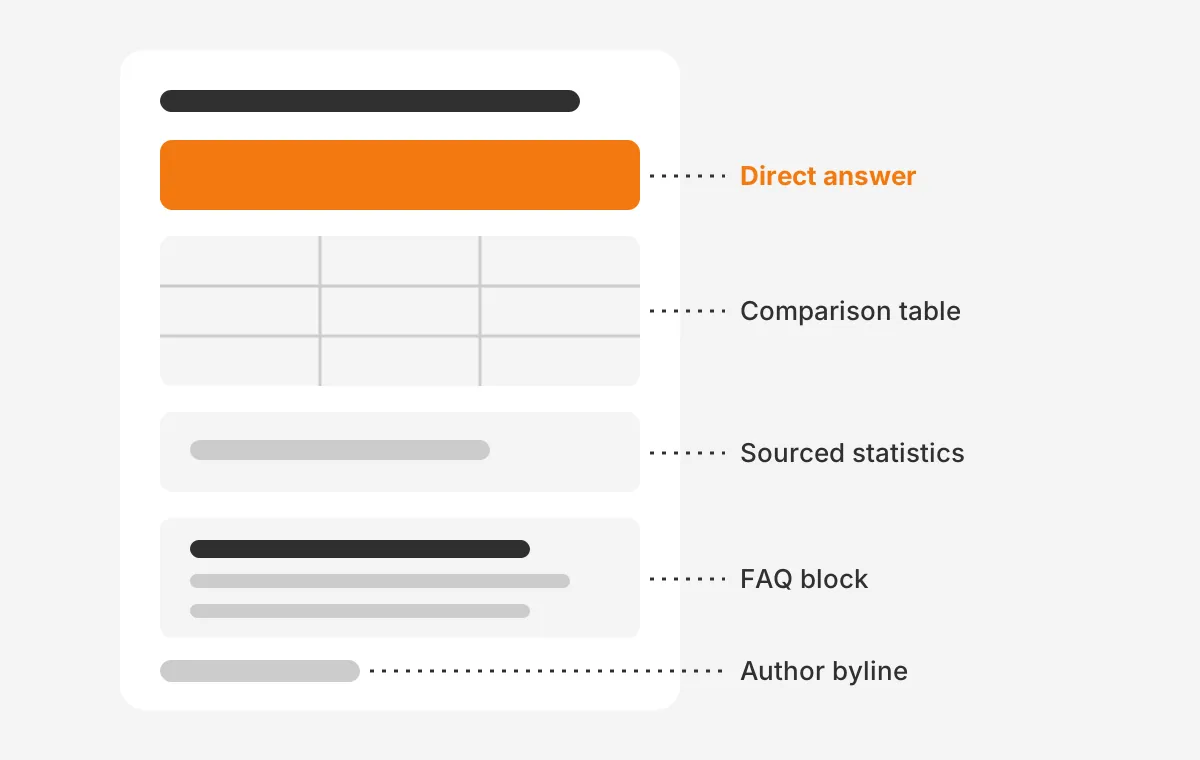
A rebuilt page in this phase usually carries five parts. Each part gives an answer engine a clean passage to cite.
- A one-sentence answer under a question heading.
- A comparison table with named options, prices or limits.
- Statistics with a named source and year.
- An FAQ block that covers follow-up questions.
- An author byline that shows real experience, which supports E-E-A-T.
Content refresh comes before new content. A page that already ranks in Google is usually a quicker route into an AI Overview. Update its numbers, add a table and tighten the opening answer. Change the published date only when the content changed.
Brand mentions in AI answers also depend on other websites. Answer engines often cite review sites, Reddit threads, LinkedIn posts and industry directories. Ask happy clients for third-party reviews on G2. Pitch one expert quote to a trade publication. Answer real questions in relevant communities.
Keep the work honest. Fake reviews, planted forum posts and keyword stuffing damage trust with buyers. They also break the rules of review sites such as G2 and communities such as Reddit.
How Do You Get Cited by ChatGPT and Perplexity?
You get cited by ChatGPT and Perplexity by being a source they retrieve. Then you give them a passage worth quoting. Retrieval depends on access and reputation. Quoting depends on clear, specific, sourced writing.
The question of how to get cited by ChatGPT has no secret answer. The engines look for pages that answer the exact question, from sources other sites trust. Each step of the AI search roadmap feeds one of those two needs.
AI search visibility also differs by engine, so test each one separately. The table below lists what to check for each engine and where its visits appear.
| Engine | Access check | Where visits show up |
|---|---|---|
| Google AI Overviews and AI Mode | Page indexed in Search Console | Search Console Web report, mixed with organic |
| ChatGPT search | OAI-SearchBot allowed in robots.txt | GA4 referrer chatgpt.com |
| Perplexity | PerplexityBot allowed in robots.txt | GA4 referrer perplexity.ai |
| Microsoft Copilot | Sitemap submitted in Bing Webmaster Tools | GA4 referrer copilot.microsoft.com |
Learning how to rank in AI Overviews follows the same logic as ranking in Google. Google states that a page must be indexed and snippet-eligible to appear, so classic SEO comes first. The AI search roadmap then sharpens the passages on those pages.
For the other engines, third-party proof carries weight. A comparison article on a trade site names you in context. So do a G2 profile with recent reviews and an active LinkedIn company page. Keep those profiles accurate and consistent.
Write for the follow-up question as well. Buyers rarely stop at one prompt. They ask about price, then integrations, then implementation time. Pages that answer the chain of questions earn more citations across the whole prompt list.
What Happens in Days 61 to 90?
The last 30 days measure what changed and connect it to revenue. The team re-runs the full prompt list, compares the citation rate with the baseline and reviews AI referral traffic. The quarter closes with a report and a plan for the next AI search roadmap.
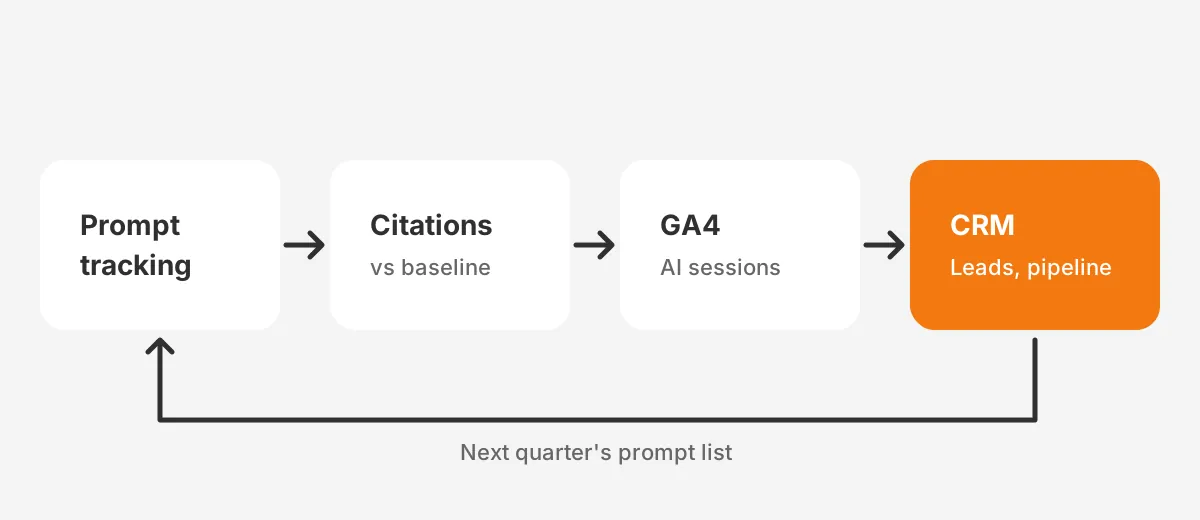
Measurement uses four sources, and together they show how to measure AI search visibility without guesswork. Each one answers a different question for leadership.
- Prompt tracking shows share of voice: how often your brand appears against named competitors.
- Google Search Console includes AI feature traffic inside the Performance report under the Web search type.
- GA4 shows sessions from referrers such as chatgpt.com, perplexity.ai and copilot.microsoft.com.
- The CRM shows which of those visitors became leads, opportunities and closed revenue.
The CRM step is where most plans stop short. Set a lead source value for AI referral traffic in HubSpot or Salesforce. A recent CRM audit helps, because lead source fields are often messy.
Add a self-reported attribution field to demo forms that asks where the buyer heard about you. Buyers who read an AI answer often type your URL directly. That visit looks like direct traffic in GA4.
Here is a worked example with assumed figures. A 150-person manufacturer tests 40 prompts and is cited in 6 at day one, a 15% citation rate. At day 90 it is cited in 14, a 35% rate. GA4 logs 120 AI-referred sessions, and the CRM logs 9 leads.
Those numbers are illustrative, not a forecast. The point is the chain of proof: prompt, citation, session, lead. When a link in that chain is missing, fix tracking first before you judge the content.
Who Should Own the AI Search Roadmap?
The marketing lead should own the AI search roadmap, with named owners for each workstream. Without one owner, AI search work drifts between the SEO agency, the web team and sales. A one-page RACI chart settles this in the first week.
| Role | Owns | Time per week |
|---|---|---|
| Marketing lead | Prompt list, priorities, quarterly report | 2 to 3 hours |
| SEO lead or agency | AI search audit, technical fixes, prompt re-tests | 6 to 8 hours |
| Content lead | Answer-first pages, content refresh, FAQs | 10 to 12 hours |
| Web developer | Robots.txt, sitemaps, schema markup errors | 2 to 4 hours |
| RevOps or CRM admin | Lead source values, attribution fields, pipeline reports | 2 hours |
The hours in this table are planning assumptions for a mid-size company, not research figures. Adjust them to your team. The key point is that the CRM admin has a named role from day one.
Clean lead source data also lets scoring rules weight AI-referred leads, as in this guide to HubSpot lead scoring.
Sales also has a part to play. Account executives hear the questions buyers ask AI tools before the first call. A monthly ten-minute review with sales keeps the prompt list current and grounded in real deals.
Which Mistakes Slow an AI Search Roadmap Down?
The first mistake to avoid is measuring rankings and ignoring citations. A page can rank third in Google and still be absent from the AI Overview above it. Prompt tracking closes that gap in the AI search roadmap.
Other mistakes follow a pattern. Teams buy tools before they write the prompt list. Some skip the basics of marketing automation implementation that make attribution work.
Teams also publish new posts while older ranking pages go stale. They block AI crawlers by accident through a firewall rule. They report screenshots instead of CRM records.
Another mistake is writing for the engine instead of the buyer. Pages stuffed with the same phrase read badly and convert badly. An AI search roadmap should improve the page a human reads first. Citations follow when the answer is clear, current and specific.
Scope creep slows teams too. A plan that targets every engine, every product and every region at once rarely finishes. Keep the first AI search roadmap to one product line and one prompt list.
A last mistake is treating ai search optimization as a one-off project. Answer engines change their models and source choices often. Treat the 90 days as the first cycle, then repeat the audit, content and measurement phases each quarter.
Frequently Asked Questions
How long does GEO take to show results?
GEO has no fixed timeline, and no vendor can promise one. Refreshed pages that already rank tend to move first because they are indexed and trusted. New pages take longer. Judge results at day 90 against the baseline prompt list, not week by week.
Is GEO different from SEO?
GEO vs SEO is a difference of output, not of foundations. SEO aims for a ranked link, while GEO aims for a citation inside a generated answer. Both need indexed pages, clear entities and useful content. GEO adds prompt tracking, passage-level writing and third-party brand mentions.
Does schema help AI search?
Schema helps classic results. Google says no special structured data is required to appear in AI Overviews or AI Mode. Keep valid Organization, Article and FAQPage markup and fix existing errors. Then spend the remaining time on clear answers and sourced facts, which AI engines quote.
How do you track AI referral traffic in GA4?
Create a custom channel group in GA4 that matches referrers such as chatgpt.com, perplexity.ai, gemini.google.com and copilot.microsoft.com. Name the channel AI referral traffic. Then pass that source into HubSpot or Salesforce through UTM or hidden form fields, so every lead keeps its origin.
Is AI search worth it for B2B companies?
AI search for B2B is worth testing because some buyers now research vendors in ChatGPT and Perplexity before calling sales. A 90-day plan limits the cost to one quarter of focused work. If the citation rate and CRM leads do not move, the team can reset priorities with real data.
How Can Unboxx Help With Your AI Search Roadmap?
Unboxx helps mid-size B2B companies build an AI search roadmap that ends in the CRM, not in a slide deck. The growth marketing team runs the audit, the content plan and the GA4 setup. The CRM consulting team connects AI referral traffic to HubSpot or Salesforce pipeline.
If you want a 90-day AI search roadmap with named owners and a measured baseline, book a consultation with Unboxx. The first session maps your prompt list and shows where competitors are already cited.
Let's create something out of this world together.
Have a project in mind? Contact us for expert design and development solutions. Let's discuss how we can help grow your business.
Ready to Unboxx Your Potential?
Build smarter systems. Automate faster. Scale confidently.