
Salesforce teams switch on Agentforce, build a demo agent in an afternoon, and then stall for months. The demo answers easy questions, but nobody trusts it with real customers. A two-action order-status agent costs about $0.20 per use on the Agentforce pricing page (2026).
This Agentforce implementation guide covers what does block teams: unclear scope, messy data, untested instructions and no rollout plan. To implement Agentforce well, pick one use case and clean its data. Then build one agent, test it against written cases, and release it in stages.
Key Takeaways
- Start with one narrow use case, such as order status, that has clean data and a clear escalation path.
- Test every agent against written cases in a sandbox before any customer sees it.
- Budget from Salesforce's published Flex Credit rates, then add Data 360 and partner costs.
What Is Agentforce and How Does an Agent Work?
Agentforce is the Salesforce platform for building AI agents that answer questions and take actions on CRM data. An agent reads a request, plans the steps, and calls approved actions to finish the job. Throughout this Agentforce implementation guide, each agent is treated as a small product with an owner.
The planning work is done by the Atlas Reasoning Engine. Salesforce says it breaks the first prompt into smaller tasks, evaluates each step and proposes a plan. The engine can only use the tools you give it, so design matters more than the model.
Every agent is built from four parts:
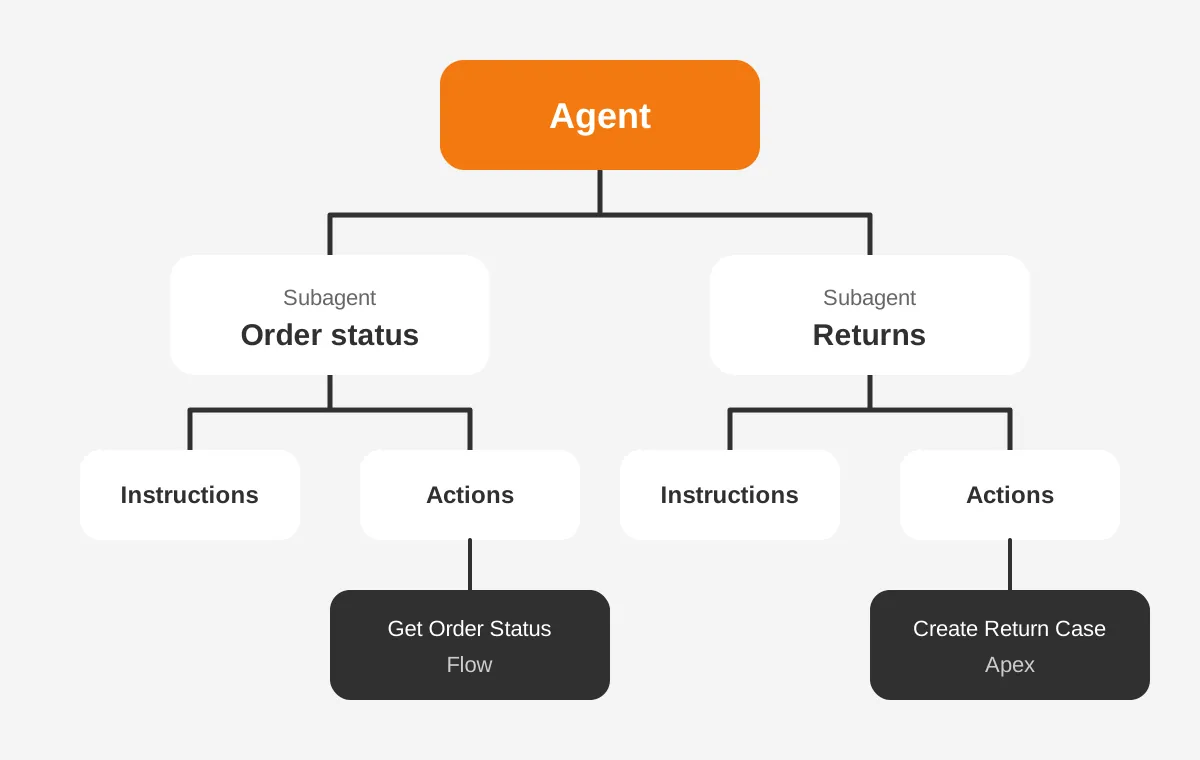
- Subagents group one job, such as order status or returns. Salesforce renamed topics to subagents in April 2026.
- Instructions tell the agent, in plain language, how to behave inside each subagent.
- Actions are the tasks the agent may run, such as a Salesforce Flow, an Apex class or a prompt template.
- Channels are where people reach the agent: web chat, phone, apps or an API.
Salesforce AI agents differ from older chatbots in one key way. A chatbot follows a fixed script. Autonomous agents choose which action to run based on the request and the instructions. That freedom is useful, and it is also why guardrails and testing take most of the effort.
That difference shapes the plan. A chatbot project would centre on scripts. An Agentforce implementation guide centres on scope, instructions, actions and tests, in that order.
The Agentforce for sales article shows the same parts applied to pipeline work. The running example in this Agentforce implementation guide is a customer service agent. Service is where most first agents start.
What Do You Need Before Implementing Agentforce?
You need four things before setup: a licence model, an admin with full access, a sandbox and clean data. Missing any one of them stalls the build before the first test. Each prerequisite in this Agentforce implementation guide gets a short section below.
Licences and pricing model
Salesforce sells Agentforce through Flex Credits, per-conversation pricing or per-user add-ons. Treat that choice as step zero of any Agentforce implementation guide.
The pricing page states that Flex Credits and Conversations cannot run in the same org. Pick the model first, because it shapes which agents make financial sense. The Agentforce cost breakdown compares the models in detail.
People and access
Name three owners before setup: a Salesforce admin, a business owner and a reviewer for agent answers. The admin needs permission to configure agents, Flows and channels. The business owner signs off on instructions and escalation rules.
A sandbox or Developer Edition org
Never build the first agent in production. Salesforce's own Agentforce implementation guides start in a Developer Edition org. A full or partial sandbox works better for real projects, because it holds a copy of your data.
Data 360 and source data
Data 360, formerly Data Cloud, lets agents read data from outside Salesforce. Salesforce lists Data 360 credits as a separate cost. Teams often ask whether they need Data Cloud for Agentforce at all. The answer depends on the use case, so confirm it with your account executive before you sign.
Agentforce implementation checklist
Use this Agentforce implementation checklist before anyone opens Setup. Each line is a yes or no question.
- Is the pricing model chosen and approved?
- Can the admin set up Agentforce, Flows and channels?
- Is a sandbox refreshed with current data?
- Is the first use case written down with its escalation rule?
- Are 50 test cases drafted with expected answers?
The checklist keeps Agentforce setup short and calm. Without it, Agentforce configuration starts before the scope is fixed, and the scope then changes mid-build. Every later step in this Agentforce implementation guide assumes all five answers are yes.
How Do You Choose the First Use Case?
Choose a use case with high volume, low risk, clean data and a clear human fallback. Order status, appointment changes and simple account questions fit that test. Refunds above a set value, legal questions and contract changes do not fit a first agent.
Salesforce's free Agent Planning module on Trailhead takes about 55 minutes. Its five units cover the use case, the architecture, guardrails, the agent's work and a prototype. Run it with the business owner before any build starts.
Score each candidate on four questions. What volume arrives each month? What happens if the agent gets one wrong? Is the data the agent needs complete and current? Can a person take over in under a minute? Fail two, and it waits.
Your first Agentforce use case sets the pattern for every agent after it. The Agentforce implementation guide rule here is single ownership: one team owns the use case end to end. Shared ownership slows every decision about instructions and escalation.
The table below scores four common Agentforce use cases against those questions. The ratings are worked examples for a mid-sized service team, not benchmarks.
| Use case | Volume | Risk if wrong | Data readiness | First agent? |
|---|---|---|---|---|
| Order status | High | Low | Usually clean | Yes |
| Appointment changes | Medium | Low | Depends on calendar sync | Yes |
| Refund approvals | Medium | High | Mixed | No, phase two |
| Contract questions | Low | High | Unstructured | No |
Agentforce for customer service is the usual starting point for this reason. Service requests repeat, answers live in knowledge articles, and Omni-Channel already routes escalations to people. Sales and field service agents tend to follow once the team has one success.
How Do You Prepare Data and Knowledge Sources?
Prepare data by fixing the exact records and articles the first agent will read. Keep cleanup inside that scope, as the rest of this Agentforce implementation guide assumes. Agentforce data readiness is not a company-wide cleanup. An order-status agent needs accurate orders, shipments and contact records.
Start with a short audit of those objects. Count duplicate contacts, blank status fields and orders without a shipment record. Fix them at the source, then add validation rules so the gaps do not return. The CRM data cleansing guide covers the methods step by step.
Knowledge articles need the same care. The agent grounds its answers in the sources you connect. If two articles give different return windows, the agent may quote either one. Retire duplicates, date every article, and give each one a single owner.
Salesforce describes dynamic grounding as the way to connect the model to business data and reduce hallucinations. Its implementation guides also use Agentforce Data Libraries to hold the documents an agent searches. Keep the first library small: 20 to 50 approved articles beat 2,000 unreviewed ones.
Set a refresh rule for that library too. For the library, the Agentforce implementation guide default is a monthly review of every connected article. The business owner signs off each change.
CRM data quality also decides how far the agent can go later. An agent that updates records will copy any bad pattern it finds. Every Agentforce implementation guide worth following puts this step before the build.
How Do You Build the Agent in Agentforce Builder?
Build the agent in Agentforce Builder with one subagent per job, clear instructions and only the actions it needs. Start from a Salesforce template where one fits, then edit it. Templates save setup time but carry generic instructions.
A typical Agentforce setup guide stops at the template. Here the Agentforce implementation guide goes past it, to the instructions and actions a real subagent needs.
The figure below shows how the parts connect for the order-status example. One agent holds two subagents. Each subagent has its own instructions and its own short list of actions.
Write subagents and instructions
Give each subagent a name and a one-line scope, such as "Answers order status questions for existing customers." Then write instructions as short rules. Good instructions name the data to check, the order of steps and when to hand over to a person.
Here is a worked example of instructions for an order-status subagent:
- Confirm the customer's email and order number before sharing any details.
- Run the Get Order Status action and quote the carrier and expected date.
- If the order is more than five days late, offer a transfer to a service agent.
- Never promise a refund, a discount or a new delivery date.
Agent Script, the language behind Agentforce Builder, lets developers add fixed logic where plain instructions are too loose. Use it for steps that must always run in the same order, such as identity checks.
Attach agent actions
Agent actions do the real work. Most teams build them as Salesforce Flow first, because admins can read and change a Flow. Use Apex when the logic calls an external system or needs heavy processing. Use prompt templates when the output is text, such as a case summary.
Keep each action small and name it like a verb: Get Order Status, Create Return Case, Book Callback. The reasoning engine picks actions by their names and descriptions. Vague names lead to wrong choices.
Developers can also build in code with Agentforce DX through the Salesforce CLI and VS Code. That route suits teams that already run source control and deployment pipelines for Salesforce.
How Should You Test the Agent Before Launch?
Test the agent against written cases in a sandbox, and fix instructions until it meets an agreed bar. Testing is where an Agentforce implementation guide earns its keep. Production failures usually trace back to cases nobody wrote down.
Salesforce offers three test tools, according to its Agentforce developer guide:
| Tool | Interface | Test format | Custom evaluations |
|---|---|---|---|
| Testing Center | Setup UI | CSV file | No |
| Agentforce DX | Salesforce CLI | YAML file | Yes |
| Testing API | Code | XML | Yes |
Admins usually start in the Agentforce Testing Center. Developers move to Agentforce DX once tests need to run with every deployment.
Treat the test set as a living asset in your Agentforce implementation guide. It grows with every bad answer found after launch, and it runs before every change.
Write the test cases
Aim for at least 50 test cases for the first subagent, in four groups. Happy-path requests check normal answers. Edge cases check odd inputs, such as two order numbers. Escalation cases check the hand-off. Security cases check that the agent refuses data it should not share.
Set the pass bar
Every Agentforce implementation guide needs a fixed pass bar. Agree it with the business owner before testing starts, so nobody moves it later. A common working rule is zero failures on security cases and zero failures on escalation cases. Happy-path accuracy should match what a trained new hire achieves.
Run manual tests first, then batch testing with the full set. Read the failures one by one. In practice, an Agentforce implementation guide fix is usually an instruction edit, not a new action. Re-run the full batch after every change, because one edit can break an unrelated case.
How Do You Roll Out Agentforce in Stages?
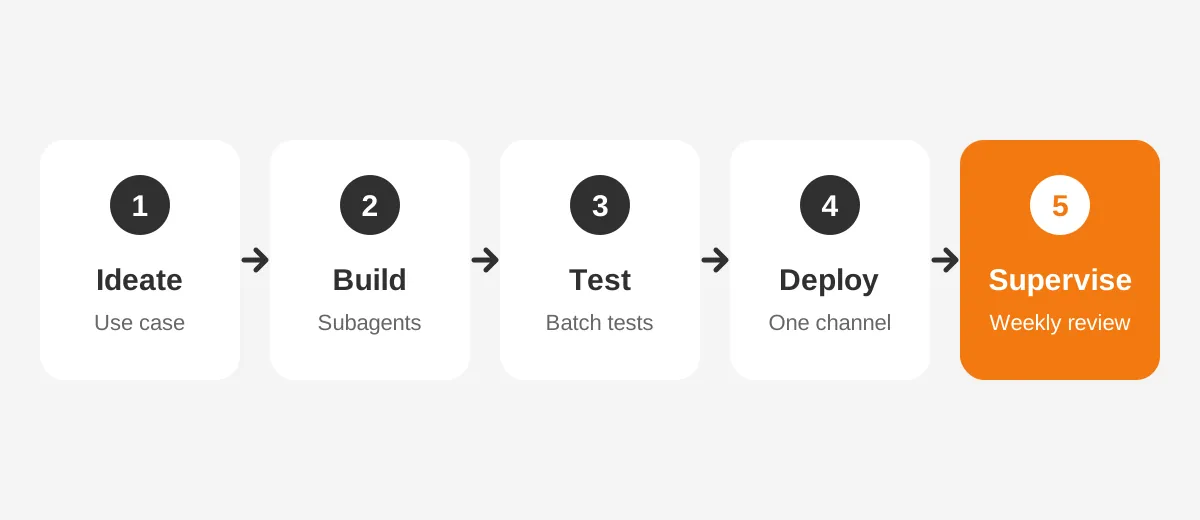
Roll out Agentforce in stages: internal users first, then a small share of customers, then full traffic. Each stage runs until the numbers hold steady. Salesforce describes the full lifecycle in five phases: Ideate, Build, Test, Deploy and Supervise.
The figure below maps those phases to the work in this Agentforce implementation guide. Supervise never ends, which is why the agent needs a named owner.
Choose the first channel
Launch on one channel. For service agents, that is usually web chat through Enhanced Chat, routed by an Omni-Channel flow. Other channels include the Agent API for custom apps and the Agentforce Mobile SDK. Add channels only after the first one is stable.
Teams that deploy Agentforce agents on one channel first can compare results with a clean baseline. Agentforce go-live on that channel should happen on a weekday, with the agent owner and a service lead watching transcripts.
Track four numbers
Track resolution rate, escalation rate, time to resolution and customer satisfaction (CSAT) from the first day. Compare them with the same numbers for human agents on the same request type. Review a sample of transcripts every week, and turn each bad answer into a new test case.
Below is a worked Agentforce implementation timeline for one service agent. This Agentforce rollout timeline assumes clean data, and its durations are not Salesforce figures.
- Weeks 1 and 2: use case, owners, test cases and data audit.
- Weeks 3 and 4: data fixes, subagents, instructions and actions in a sandbox.
- Weeks 5 and 6: batch testing and instruction fixes until the pass bar holds.
- Weeks 7 and 8: internal pilot, then 10% of customer chats.
- Week 9 onward: full traffic, weekly reviews and the next subagent.
Keep the internal pilot in every Agentforce implementation guide plan, even for low-risk agents. Staff find odd answers faster than customers report them.
The AI implementation roadmap shows how a first agent fits into a wider AI programme across sales, service and operations.
How Much Does Agentforce Cost to Run?
Agentforce costs $500 per 100,000 Flex Credits, $2 per conversation, or $125 per user per month. Those are the rates Salesforce listed in November 2026. Data 360 credits and implementation work come on top. The right model depends on volume and on who uses the agent.
Flex Credits work out to $0.005 each. Salesforce's examples charge 20 credits per action, so each action costs about $0.10. The figure below plots four of Salesforce's published example use cases by cost per use.
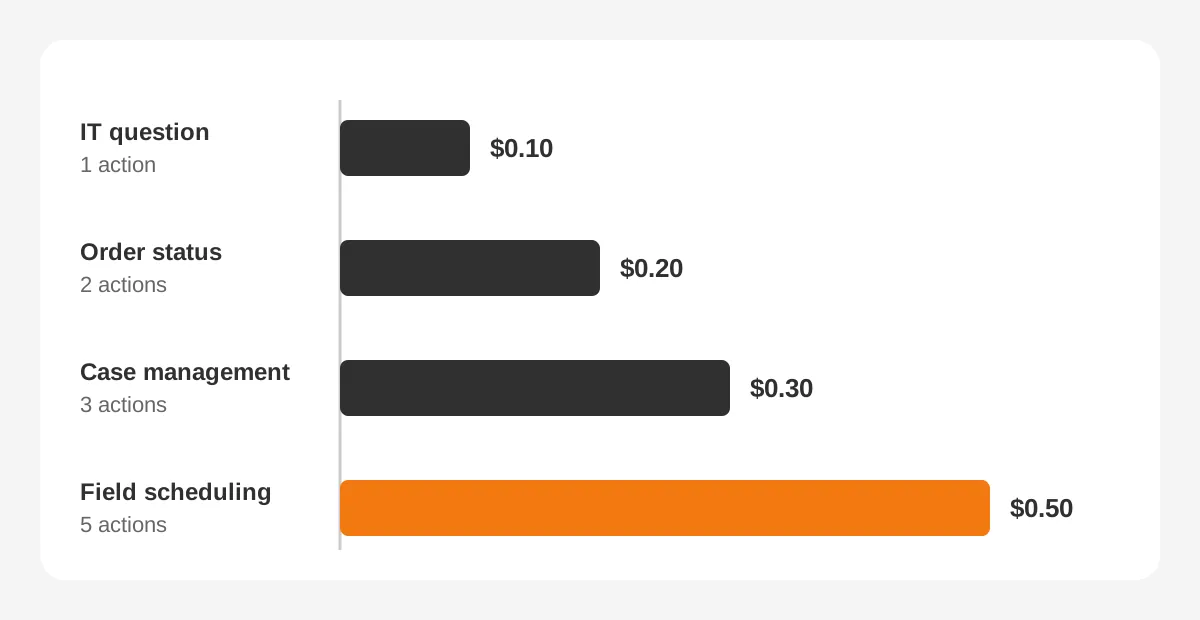
A worked example shows the gap. An order-status agent handles 3,000 chats a month and runs two actions each. That is 120,000 credits, or $600 a month on Flex Credits. The same 3,000 chats would cost $6,000 a month at $2 per conversation.
The Agentforce per conversation pricing suits agents that run five or more actions per chat. Flex Credits suit short requests. Per-user add-ons at $125 per month give employees unmetered use, which suits internal agents.
Agentforce 1 Editions start at $550 per user per month and include 2.5 million Flex Credits per org per year.
Two pricing rules affect budgets. Unused Flex Credits do not roll over into the next term. There is no overage penalty, so extra use bills at the contracted rate. Agentforce implementation cost from a partner sits outside these figures.
Use the arithmetic above as the budget method in your own Agentforce implementation guide. Count actions per request, multiply by monthly volume, and add 20% for testing and retries. That buffer is a planning assumption, not a Salesforce rule.
Which Mistakes Does This Agentforce Implementation Guide Prevent?
Following an Agentforce implementation guide like this one prevents five mistakes that stall first agents. Each one breaks a rule from Agentforce implementation best practices. All five are cheap to avoid early.
- Starting with a high-risk use case, such as refunds, before the team has one success.
- Connecting every knowledge article instead of a small, reviewed library.
- Writing vague instructions, such as "be helpful", instead of numbered rules.
- Skipping security test cases because the demo looked fine.
- Launching on every channel at once with no named owner.
Agentforce governance ties these together. The Salesforce Trust Layer documentation covers the Einstein Trust Layer. It lists PII masking, zero data retention with third-party models, and toxicity detection. Those controls protect data, but they do not decide what your agent may do. Your instructions, actions and escalation rules decide that.
Human escalation is the last guardrail. Write down when the agent must hand over, and test it. Check that the person receiving the chat sees the full transcript. Agentforce adoption by customers depends on that hand-off feeling smooth.
Treat the agent as an ongoing Agentforce project, not a one-off build. An Agentforce implementation guide that ends at launch leaves the agent without an owner when products, prices and policies change.
For a client example, read how Unboxx helped a business automate enterprise work with secure AI agents.
Frequently Asked Questions
How long does Agentforce implementation take?
A first Agentforce agent often takes six to ten weeks when data is clean. That estimate is an assumption, not a Salesforce figure. Cleanup and testing take longest. Later agents move faster, because the sandbox, test process and owners already exist. Plan each new subagent as its own short project.
Do you need coding skills to implement Agentforce?
No, an admin can build a first agent with Agentforce Builder, Salesforce Flow and templates. Code helps later. Apex handles calls to outside systems, Agent Script fixes the order of steps, and Agentforce DX runs automated tests. Most teams pair one admin with one developer for the first project.
Can Agentforce work with data outside Salesforce?
Yes, Agentforce can read outside data through Data 360 and call outside systems through Apex or Flow actions. Each connection adds cost and risk. Start with data already in Salesforce for the first agent. Add outside sources once the agent passes its tests and has a stable owner.
Will Agentforce replace a customer service team?
No, Agentforce takes repeat requests so people can handle complex cases. Every service agent needs a human escalation path for anything outside its scope. Teams usually move staff toward escalations, quality review and agent supervision. The goal is faster answers on simple requests, not an empty support queue.
What is the difference between Agentforce and Einstein Copilot?
Einstein Copilot was Salesforce's earlier assistant that helped employees inside the CRM. Agentforce replaced it with agents that can act on their own across channels, including customer-facing chat. The building blocks changed too. Topics became subagents in April 2026, with no change to how they work.
Where Should Your Agentforce Implementation Guide Go Next?
Your Agentforce implementation guide should go next to one use case, one owner and one written test set. Build that agent in a sandbox and prove it against the pass bar. Reuse the same Agentforce implementation guide for the second agent and every one after it.
Unboxx is a Salesforce Crest Partner that plans and builds Agentforce agents. The work runs through its AI-native CRM services and Salesforce Einstein AI consulting. To turn this Agentforce implementation guide into a dated plan for your org, schedule a consultation with the team.
Let's create something out of this world together.
Have a project in mind? Contact us for expert design and development solutions. Let's discuss how we can help grow your business.
Ready to Unboxx Your Potential?
Build smarter systems. Automate faster. Scale confidently.