
Connected Finance Software: Advisory Wins for CPA Firms

Most accounting firms want more advisory work. Yet their staff still spend month-end chasing bank statements and retyping invoices. The 2025 Wolters Kluwer Future Ready Accountant report found that 94% of U.S. firms offer advisory services. Advisory still made up only 13% of firm revenue.
Connected finance software closes that gap. It links bank feeds, the ledger, billing, payroll and a CRM, so data arrives current without manual entry. The hours it saves on data work, and the live numbers it produces, become paid forecasting, KPI and CFO-level services.
Key Takeaways
- Connected finance software turns client data from a monthly chore into a live feed that supports paid advisory work.
- Firms with integrated, cloud-based tech stacks report faster growth, and CAS practices that keep investing in technology serve more clients.
- A CRM linked to the ledger shows which clients are ready for advisory, so partners sell at the right time.
What Is Connected Finance Software for Accounting Firms?
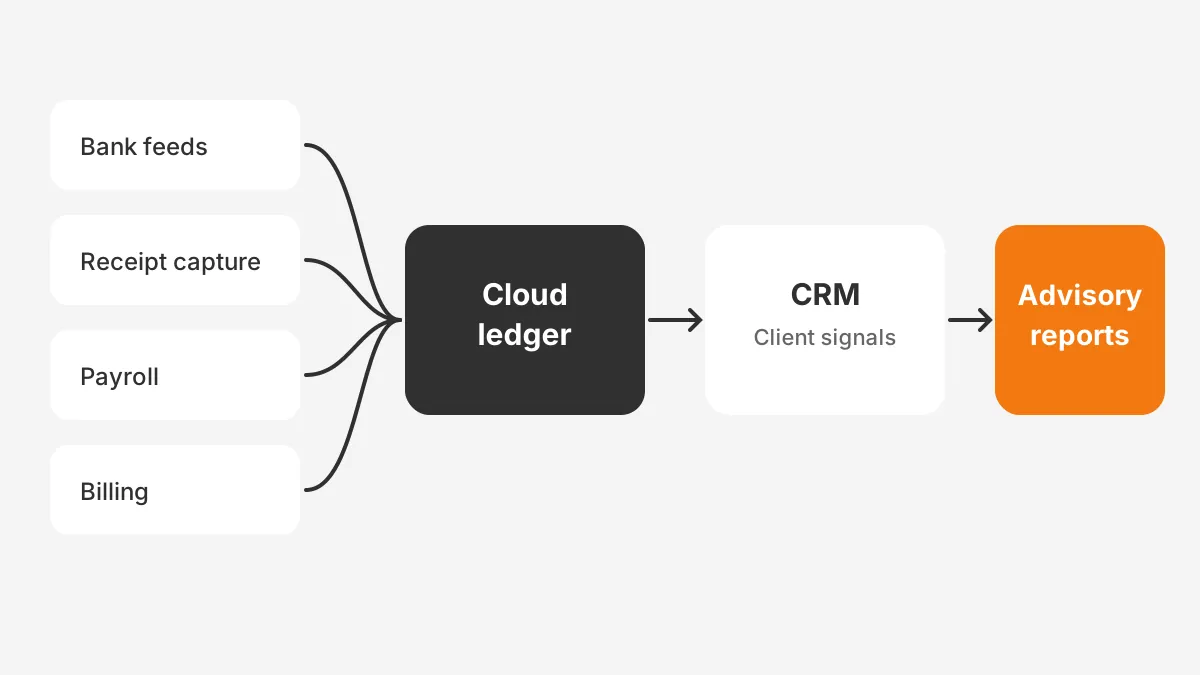
Connected finance software is a set of cloud finance tools that share data through integrations, not exports. A cloud ledger usually sits at the center. Common choices are Xero, QuickBooks Online, Sage Intacct and NetSuite. Bank feeds, receipt capture, payroll, billing and a CRM connect to it.
Older desktop software differs in where the data lives and how often it moves. A desktop file sits on one computer and gets updated when someone remembers. A connected stack updates through an API or a direct bank connection, often daily. The firm and the client see the same numbers.
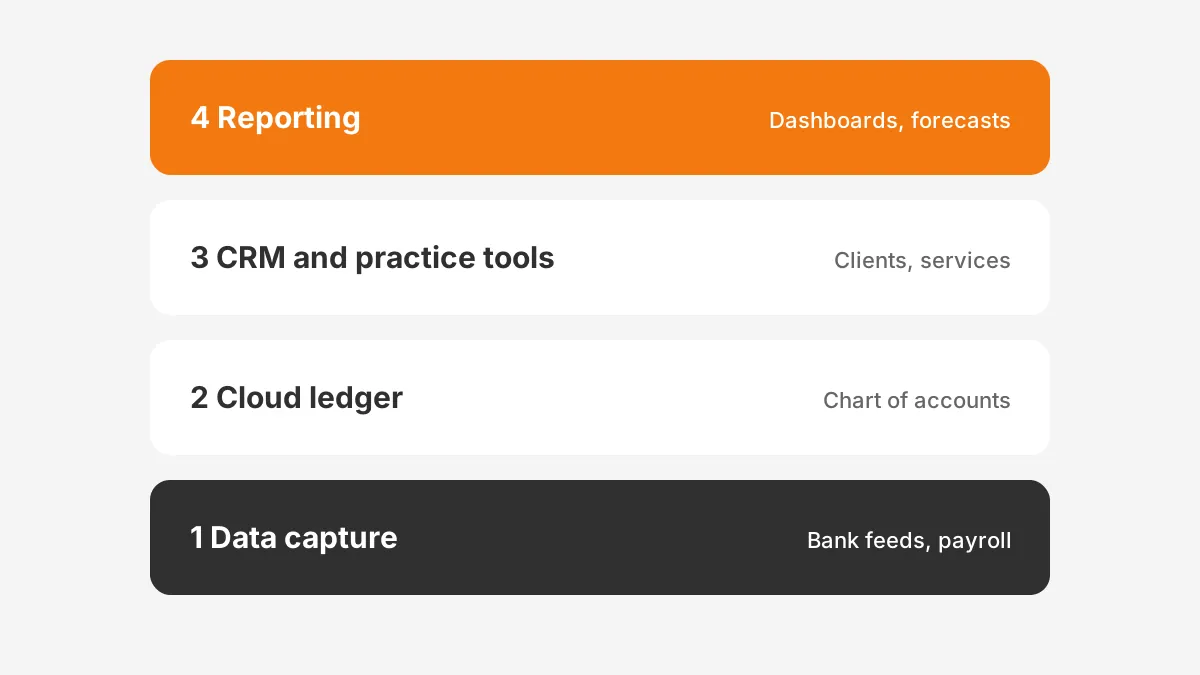
Connected finance software has four layers that matter for advisory work:
- Data capture: bank feeds, card feeds, receipt and bill capture, and payroll exports.
- The system of record: the cloud general ledger that holds the chart of accounts.
- Relationship data: a CRM or practice management software that tracks clients, services and engagements.
- Insight tools: reporting, forecasting and KPI dashboard software that turns ledger data into decisions.
Each layer can come from a different vendor. What makes it connected is that data passes between layers on a schedule, with mapping rules, instead of through spreadsheets. The 2025 Wolters Kluwer survey found that 81% of U.S. firms run a stack that is at least partly cloud-based.
Connected finance software is not one product a firm buys. It is a design choice about how products share data. A firm can run connected finance software on Xero for one niche and Sage Intacct for another. Each stack follows the same capture, ledger, CRM and reporting pattern.
How Does Connected Finance Software Create Advisory Opportunities?
Connected finance software creates advisory opportunities in three ways. It frees staff time, gives current data and shows patterns across clients. Each one removes an old reason a firm could not sell advisory. Each also changes what a partner brings to a client meeting.
The first change is capacity. When transactions arrive categorized and bills arrive coded, a bookkeeper reviews exceptions instead of typing. The Journal of Accountancy (2025) profiles a CAS leader who cut yearly hours from about 1,700 to 500 or 600. Her CAS practice still grew revenue by 47%.
The second change is timeliness. Advice built on a ledger closed six weeks ago is history. Advice built on yesterday's cash balance is planning. Connected data lets a firm talk about next quarter instead of last quarter, which is the conversation clients pay for.
The third change is comparison. A firm with 80 clients on one cloud platform can benchmark margins, debtor days and payroll ratios across a niche. A single client cannot see that view. The firm can sell it.
These three changes map to specific advisory opportunities for accounting firms:
- Cash flow forecasting built on live bank and receivables data.
- Monthly KPI reviews with a dashboard the client can open any day.
- Budget versus actual reporting with variance notes.
- Fractional CFO services for clients that cannot hire a full-time finance lead.
- Pricing, margin and profitability analysis by product, job or location.
- Systems advisory: choosing and setting up the client's own connected stack.
Which Advisory Services Does Connected Data Make Possible?
Connected data makes recurring, data-led advisory services possible, priced as fixed monthly fees rather than hours. The table below matches six common services to the data each one needs and the tools that usually supply it.
| Advisory service | Data it needs | Typical connected tools | Common billing model |
|---|---|---|---|
| Cash flow forecasting | Bank balances, receivables, payables, payroll dates | Bank feeds, cloud ledger, forecasting app | Fixed monthly fee |
| KPI dashboard and review | Revenue, margin, debtor days, headcount | Cloud ledger, reporting app, CRM | Fixed monthly fee |
| Budget versus actual | Approved budget, monthly actuals by class | Cloud ledger with classes or tracking categories | Fixed monthly or quarterly fee |
| Fractional CFO | All of the above plus pipeline and sales data | Ledger, CRM, payroll, forecasting app | Monthly retainer |
| Profitability analysis | Revenue and cost by job, product or location | Ledger, job costing or inventory app | Project fee |
| Systems advisory | Current tools, pain points, transaction volumes | App marketplace, integration platform | Project fee plus support plan |
The billing model matters as much as the service. The 2025 Journal of Accountancy article reports that 90% of CAS practices sell fixed-fee recurring services. Connected finance software supports that model. Once data flows on its own, the monthly cost to deliver becomes predictable.
These services also build on each other. A client with a KPI dashboard already has the clean data a forecast needs. The forecast is the logical next offer. A forecast then supports CFO-level help with a loan, a hire or an acquisition. Each step reuses the same data.
Why Does Real-Time Data Change the Advisory Conversation?
Real-time data changes the advisory conversation because the firm can discuss decisions still ahead. A cash warning in week two of a month is useful. The same warning in a report six weeks later is a record of a problem the client already felt.
Compliance work runs on a fixed calendar. The firm closes the books, prepares the return and meets once a year. Connected finance software replaces that calendar with a continuous feed. Meetings can then follow events, such as a large customer paying late or payroll rising faster than revenue.
The Wolters Kluwer 2025 report ties live, connected data to growth. Firms with highly integrated tech stacks were 53% more likely to report high growth.
Firms with strong cloud adoption were 24% more likely to say the same. The survey also found that 88% of firms analyze client data to tailor advisory offerings.
Real-time data also changes who starts the conversation. With alerts set on cash, debtor days or gross margin, the firm can contact the client first. A partner who calls with an early warning and a plan earns trust that a year-end meeting rarely builds.
The frequency of contact matters for revenue too. A client who hears from the firm once a year sees an annual vendor. A client who gets a monthly review from connected finance software reports sees an adviser. That client pays a monthly fee to match.
Three conditions have to hold before live numbers turn into advice a client trusts:
- Bank rules and bill coding are reviewed weekly, so the live numbers stay accurate.
- The chart of accounts is consistent across clients in a niche, so comparisons hold up.
- Alert thresholds are agreed with the client, so warnings reach the right person.
Real-time data matters most for advisory clients with tight cash, seasonal sales or fast growth. Those clients feel a two-week delay in their numbers. Cash flow forecasting for clients in that position is a natural first package on connected finance software.
What Do the CAS Benchmark Numbers Show?
The CAS benchmark numbers show that firms building advisory on connected systems grow faster and serve more clients. The 2024 AICPA and CPA.com CAS Benchmark Survey collected data from 206 U.S. CAS practices.
Its main findings for firms weighing connected finance software:
- Median CAS revenue growth was 17%, with 99% median growth projected over the following three years.
- Median CAS revenue rose 61% compared with the 2022 survey.
- Firms that keep investing in technology served a median of 100 clients, compared with 67 for other firms.
- Firms with significant CFO-level advisory revenue reported more than 30% higher monthly recurring revenue.
- Only 10% of respondents still used hourly billing as their main pricing method.
The 100 versus 67 figure ties most closely to connected finance software. Serving 100 clients instead of 67 means 49% more client relationships to manage.
Data capture that runs without manual entry is one of the few ways to absorb that load. The Journal of Accountancy's 2024 coverage of the survey adds that 78% of CAS practices now have dedicated CAS staff.
Benchmarks describe correlation, not cause. A firm that invests in technology may also be a firm that plans well and prices well. Still, the pattern across both surveys points the same way. Integrated systems and recurring advisory revenue tend to arrive together.
For a firm planning advisory revenue growth, the practical reading follows. Connected finance software is a precondition, not a strategy. The strategy is the service menu, the niche and the pricing that sit on top of it.
Where Does a CRM Fit in Connected Finance Software?
A CRM fits in connected finance software as the layer that tracks the client relationship. The ledger tracks the client's money. Without a CRM, advisory opportunities stay hidden in partners' heads and email inboxes. With one, the firm can see which clients are ready for which service.
A CRM for accounting firms holds engagement letters, services, renewal dates, contacts and meeting notes. Linked to the ledger or practice management software, it also holds finance signals. Revenue growth above 20%, a new location or a cash shortfall can each trigger a task for the account manager.

Platforms such as HubSpot, Salesforce and Microsoft Dynamics 365 all support this pattern through native integrations or middleware. The setup questions are the same on each: which fields sync, how often, and who owns each task. Unboxx covers these choices on its CRM for accounting firms page.
The CRM also keeps advisory work measurable. Each proposal, win and lost deal sits against a client record. Partners can see which services sell, which niches buy them and how long each sale takes. That data shapes next year's service menu.
Firms comparing tools can read CRM for CPA firms versus practice management software. It explains where each system starts and stops.
The CRM and practice management software often run side by side. An accounting firm CRM integration usually syncs client records from practice management and finance fields from the ledger.
How Should a Firm Build Its Connected Tech Stack?
A firm should build its connected tech stack in order. Choose one ledger per niche, add capture tools, then link a CRM and reporting. The order matters. Reporting on top of messy data only shows the mess faster.
- Pick target niches first. The CPA.com survey found niche-focused firms reported 38% higher median CAS revenue. A niche also narrows the software choice, for example Yardi for property managers or NetSuite for growing distributors.
- Standardize the ledger per niche. Use one cloud ledger and one chart of accounts template per niche, so benchmarks compare like with like.
- Connect data capture. Turn on bank feeds and card feeds, add receipt and bill capture, and link payroll. Write bank rules for the 20 most common transaction types.
- Link the CRM and practice management software. Sync client records, services, renewal dates and key finance fields. The guide to accounting software integrations and the data they transfer covers the field map.
- Add a reporting and forecasting layer. Build one KPI dashboard template per niche and one cash flow forecast template.
- Set alerts and review routines. Agree thresholds with each client and assign an owner for every alert type.
- Package and price the services. Turn the dashboards and forecasts into tiered monthly packages with a clear scope.
Most firms do not need a custom build. The Xero and QuickBooks Online app marketplaces list prebuilt connectors for payroll, billing and reporting tools. Custom work is usually limited to the CRM link and to niche systems without a standard connector. Unboxx handles that layer through its CRM integration services.
Integration methods fall into three groups. Native connectors come from the vendor and need little setup. Middleware such as Zapier, Make or Workato moves data on rules the firm defines. Custom API work suits niche systems and two-way CRM sync.
Connected finance software usually mixes all three. Each link needs a named owner and a test after every vendor update.
Staff skills belong in the plan too. The Wolters Kluwer 2025 report found that 31% of firms named advanced technical skills a significant issue. A firm adding connected finance software should budget training time for the ledger, integration rules and reporting tool.
What Does a Worked Advisory Example Look Like?
A worked example shows how connected finance software converts saved hours into recurring advisory fees. The figures below are assumptions for illustration, not survey data.
Assume a 12-person firm serves 60 small business clients with monthly bookkeeping. Before the change, each client takes about 6 hours a month of data entry and reconciliation. That is 360 hours a month spent on data work.
After the move to a connected stack, assume each client needs 2.5 hours a month for exception review. That frees about 210 hours a month. The firm puts 140 of those hours into advisory and keeps 70 as buffer for growth.
The firm then offers a KPI review package at an assumed $750 a month. Each one takes about 3 hours. If 25 clients take it, that is $18,750 a month in new recurring fees using 75 hours. The remaining 65 advisory hours can support 4 or 5 forecasting clients.
Advisory services for small business clients fit this model because the packages are standard. Each client in a niche gets the same dashboard, forecast template and review agenda. Connected finance software keeps the inputs current, so staff spend the 3 hours on analysis rather than data preparation.
The example rests on three conditions. Bank rules must be maintained, the chart of accounts must be standard, and the firm must sell the packages actively. A CRM helps with the last condition, because it shows which clients have the profile for each package.
The step-by-step guide to implementing CRM in an accounting firm covers that sales side. It includes pipelines for advisory proposals.
What Mistakes Slow Advisory Growth?
The mistakes that slow advisory growth are mostly about data quality, scope and sales, not about the software itself. Connected finance software removes data entry, but it does not decide what the firm sells or to whom.
- Connecting tools before cleaning the chart of accounts, so dashboards show inconsistent categories.
- Running a different ledger for each client in a niche, which blocks benchmarking.
- Letting bank rules go stale, so live numbers drift away from reality within weeks.
- Selling advisory by the hour, which caps revenue at the hours saved.
- Keeping client signals out of the CRM, so partners miss the moment a client needs help.
- Skipping staff training, so the tools sit half-used and the hours saved never appear.
Each mistake has a matching control. A quarterly data quality review catches drift in bank rules and coding. A written service menu with fixed prices stops hourly creep. A CRM report of clients with no advisory service, sorted by revenue, gives partners a weekly call list.
Automation can handle part of the review work too. Rules can flag uncategorized transactions, duplicate bills or unusual payroll changes for a person to check. The AI business automation service page covers how Unboxx builds those checks.
One more mistake is treating connected finance software as an IT project only. The tools change how staff spend their week and how partners sell. The service menu, pricing and training need planning alongside the integrations. Switching on tools and waiting rarely produces advisory revenue.
Frequently Asked Questions
Is connected finance software the same as cloud accounting?
No. Cloud accounting software is the ledger, such as Xero or QuickBooks Online. Connected finance software is the wider set of tools linked to that ledger. It includes bank feeds, payroll, billing, reporting and a CRM. The ledger sits at the center, and the integrations make the stack connected.
How long does moving clients to cloud accounting take?
As a planning range, one small business client can move in two to six weeks. How long it takes to move clients to cloud accounting depends on data history. A whole client base usually moves in waves by niche. Starting with the cleanest clients builds templates the later waves reuse.
Who should own advisory services inside an accounting firm?
A named CAS or advisory lead should own the service menu, pricing and quality. A single owner keeps packages consistent from one client to the next. Partners usually own the client relationship and the sale, while the advisory team delivers dashboards, forecasts and reviews each month.
Why do small firms benefit from connected finance software?
Small firms benefit because they have the least spare capacity. Automating bank feeds and bill capture frees hours that a small team could not otherwise find. Those hours can go into one or two advisory packages. Revenue per client rises without hiring before demand is proven.
What does connected finance software cost a firm?
Cost depends on the ledger plan, the number of apps and any custom integration work. Ledger and app vendors commonly price per client entity per month. Firms often pass those fees on inside a package price. Custom CRM integration is usually a one-time project with optional ongoing support.
How Can Unboxx Help With Connected Finance Software?
Unboxx helps accounting firms connect their CRM to the ledger and practice tools. With that link in place, connected finance software surfaces advisory opportunities instead of hiding them. The team sets up client records, finance signals and advisory pipelines on HubSpot, Salesforce or Dynamics 365.
Past projects such as ending manual revenue reconciliation with HubSpot automation show the approach. A firm on a cloud ledger often lacks only the link between client data and the relationship record. To map that link for your firm, schedule a consultation with Unboxx and bring your current tool list.
Let's create something out of this world together.
Have a project in mind? Contact us for expert design and development solutions. Let's discuss how we can help grow your business.
Ready to Unboxx Your Potential?
Build smarter systems. Automate faster. Scale confidently.