
Fund CRM: How Much Internal IT Support Does It Need?
A partner asks for a new fund CRM, and the IT department hears about it last. The vendor promises a fast start, and a kickoff date goes on the calendar.
Nobody has decided who connects Outlook, who moves ten years of contacts, or who answers compliance. Affinity's own guide says up to 70% of CRM implementations fail, citing lack of strategy (Affinity, 2026).
The direct answer: a fund CRM needs less internal IT support than most firms fear, but it needs named owners. Plan for one part-time technical owner and one CRM administrator. Add short bursts of IT work for access, email sync, data migration and security.
Key Takeaways
- A fund CRM on a purpose-built platform needs a part-time IT owner, not a full IT team.
- Configurable platforms such as Salesforce Financial Services Cloud usually need a dedicated CRM administrator.
- Security, records retention and email sync are the IT tasks that cannot be skipped or delegated away.
How Much IT Support Does a Fund CRM Need?
A fund CRM needs IT for four jobs: identity and access, email and calendar sync, data migration, and records controls. Everything else in the rollout belongs to operations, deal teams and investor relations.
Firms tend to go wrong in one of two directions. Some hand the whole project to IT. Others leave IT out until launch week. Either way, gaps surface after go-live.
Vendor estimates show the range. Affinity says firms on a fast platform spend 5 to 10 hours in total across four weeks (Affinity, 2026). For long rollouts, it says a COO or VP of Operations can spend 10 to 20 hours weekly. That pace can last half a year.
Both figures are vendor claims, so treat them as bounds rather than promises. They also measure the project owner's time, not only IT time.
For a typical private equity CRM or venture capital CRM, internal IT support falls into three levels:
- Light: an out-of-the-box investor CRM with built-in email sync and data enrichment. IT handles sign-on, permissions and a migration review.
- Moderate: a fund CRM with custom fields, a data warehouse feed and fund administration software links. IT adds integration testing and monitoring.
- Heavy: a configurable platform built around your deal pipeline and investor workflows. A CRM administrator becomes a standing role.
Most funds with 20 to 60 staff land in the light or moderate level. The deciding factor is how far the fund CRM must bend to fit your process. User count matters far less than custom work.
Who Does the Work in a Fund CRM Rollout?
The work in a fund CRM rollout splits across five roles, and IT is only one of them. Intapp, which sells DealCloud, describes a cross-functional team (Intapp, 2023). It draws on investment staff, IT, marketing, investor relations, and legal and compliance.
- Executive sponsor: a senior partner who settles process disputes and holds the deal team to using the system.
- Project owner: usually the COO or head of operations, who runs the plan and the vendor relationship.
- IT owner: the person who handles single sign-on, device access, email sync and security reviews.
- CRM administrator: the person who manages fields, permissions, reports and user requests after launch.
- Champions: one or two deal team members who test early and help peers.
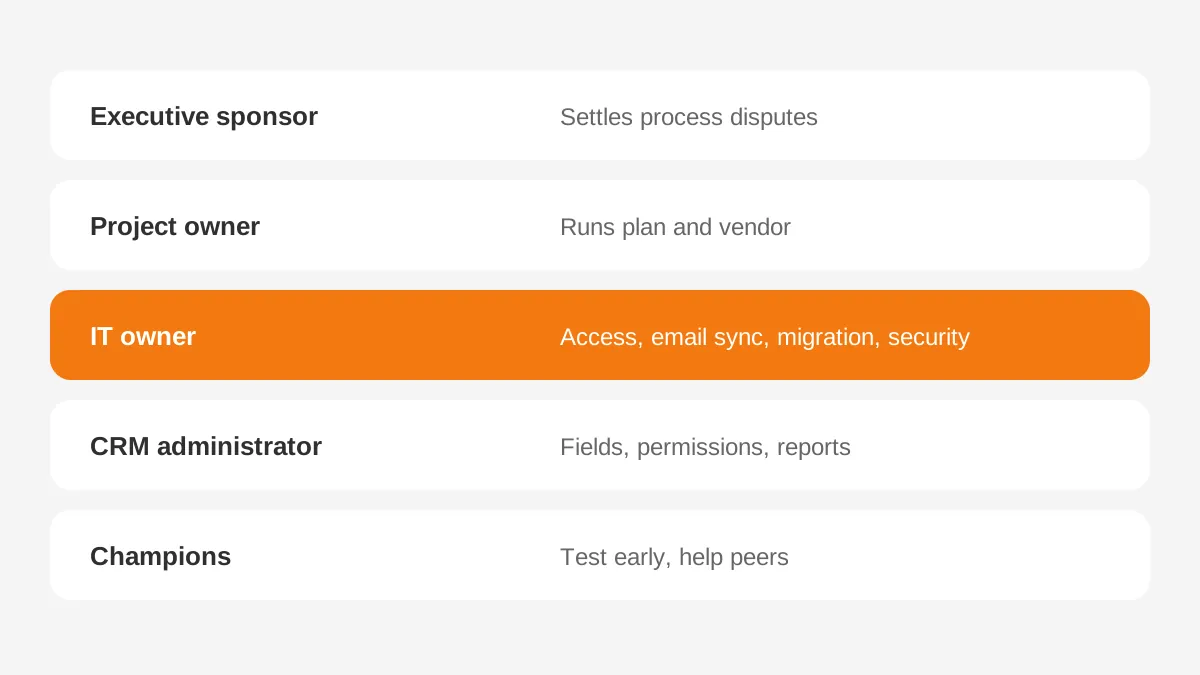
In a small fund, one person often holds two roles. A COO can act as project owner and CRM admin. An outsourced IT provider can act as the IT owner, if the scope is written down.
Affinity's guide quotes Sozo Ventures, a firm of 30. There, three people can add companies and move them down the pipeline. Everyone else reads and logs activity.
The CRM implementation team should be named before the contract is signed. When nobody owns a task such as Outlook integration, it waits until a partner complains. For the reasons funds adopt a specialized system in the first place, see why VC firms need a CRM.
What Does Platform Choice Change for IT Workload?
Platform choice is the biggest driver of IT workload in a fund CRM project. Purpose-built private equity CRM tools ship with fund objects, relationship intelligence and data feeds in place. General platforms give more control but leave more configuration, testing and upkeep to your side.
Vendor material describes the spread, and each vendor favors its own product:
| Platform | Stated implementation time | IT and admin load | Source |
|---|---|---|---|
| Affinity CRM | 60 days or less | Light; onboarding included | Affinity, 2026 |
| Intapp DealCloud | 6 to 12 months (per Affinity) | Moderate to heavy | Affinity, 2026 |
| Salesforce Financial Services Cloud | 3 to 6 months (per Affinity) | Heavy; dedicated admin | Affinity, 2026; Satuit, 2026 |
| Backstop | Not stated | Moderate; 2FA, SSO and IP locking built in | Satuit, 2026 |
| Dynamo Software | Phased, can be lengthy | Moderate | Satuit, 2026 |
Satuit, which sells its own hedge fund CRM, says Salesforce suits organizations with dedicated IT teams (Satuit, 2026). It adds that ongoing administration can burden lean hedge fund teams. Affinity says Salesforce needs a dedicated Salesforce administrator for PE-specific workflows.
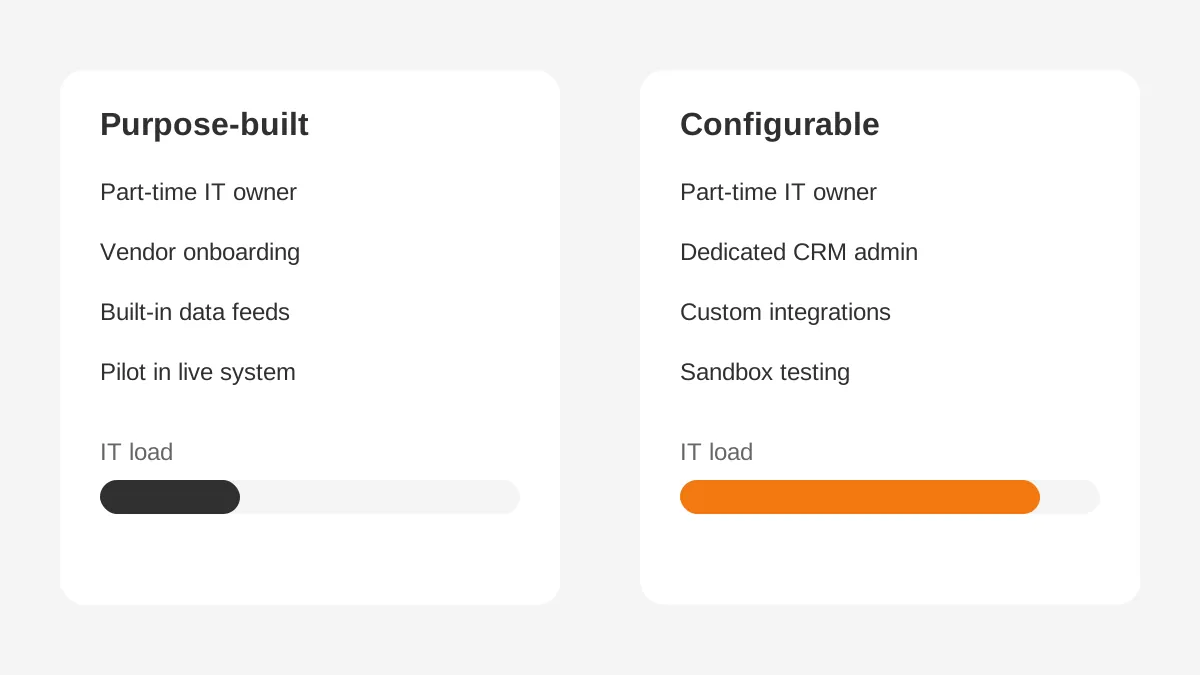
These are claims from competitors, so test them in demos. Ask each vendor for a written list of tasks your IT department must complete. The answer tells you more than any timeline on a sales slide.
A crm for venture capital teams with heavy sourcing needs data enrichment more than custom objects. A crm for private equity teams with complex portfolio reporting may need the configurable route. A crm for hedge funds often needs investor relations CRM features and audit-ready records first.
What Should IT Ask Vendors Before Signing?
IT should ask vendors who does each technical task, what the firm must provide, and what happens after launch. These answers size your internal effort better than a license quote.
Use the same questions for every shortlisted vendor, from Affinity and 4Degrees to a DealCloud private equity CRM proposal. Ask the same of broader asset management CRM and investment management CRM products.
- Which identity providers do you support for single sign-on, and is it included in our tier?
- Who maps and loads our data, and does the fee cover test loads?
- Which mailboxes sync, and can we exclude personal or compliance-sensitive folders?
- How do you log exports, deletions and permission changes?
- What does your support team handle after go-live, and what falls to us?
- Which integrations are built and maintained by you, and which need our own work?
Ask for answers in writing and attach them to the contract. Vague answers on questions two and six usually mean hidden work for your team.
Compare private equity CRM solutions on these answers, not on feature lists alone. A tool that suits fundraising CRM private equity work may still leave IT with a heavy integration load.
Which IT Tasks Come Before Go-Live?
Before go-live, IT owns six tasks, and each one blocks launch if it slips. These are the core CRM implementation steps that fall outside the vendor's onboarding team.
- Set up single sign-on through your identity provider and enforce multi-factor authentication for every user.
- Design role-based access control so deal teams, investor relations and compliance see the right records.
- Approve the email and calendar connection for Outlook or Gmail, including which mailboxes sync.
- Review the data migration plan, file formats and the cutover date.
- Run user acceptance testing with champions, using real deal and investor scenarios.
- Confirm the records retention and backup settings with the Chief Compliance Officer.
On Salesforce, testing happens in a Salesforce sandbox before changes reach production. Purpose-built tools often test in the live system with a pilot group instead. Affinity's guide recommends a pilot of a couple of months before full rollout.
Access design deserves early attention. Permission requests are the most frequent admin task after launch. Simple groups, such as deal team, investor relations and compliance, keep that work small.
On Salesforce, build access with permission sets on top of a minimal profile. Each group gets one permission set, and exceptions get their own. Purpose-built tools use simpler roles, but the same rule applies: fewer groups mean fewer requests.
A sound CRM implementation plan puts these six tasks in the first two weeks. The rest of the fund CRM rollout can then move at the speed of the deal team. That ordering is one of the most useful CRM implementation best practices for small funds.
For the full sequence of phases, owners and budget lines, see this CRM implementation plan. It shows how to implement a CRM step by step beyond the IT tasks.
How Should IT Handle Data Migration and Integrations?
IT should own the mechanics of data migration and integrations, while operations owns the content. That split keeps CRM data quality decisions with the people who know the deals and investors.
Fund data usually sits in spreadsheets, Outlook contacts, an old deal flow CRM and the fund administrator's investor files. Affinity's guide says to assign a person and a process to clean up data. IT's role in CRM data migration is narrower:
- Export data from old systems in a format the new platform accepts.
- Match duplicate contacts and companies by email domain before import.
- Load a test batch, check counts, then load the full set.
- Keep the old system read-only for a set period after cutover.
Intapp recommends moving deal tracking and contact management workflows into the CRM in the first month. Investor records can follow once the deal pipeline works. Affinity notes that firms often run both systems in parallel during the first weeks.
Set a cutover rule before the first load. A common one: the old system freezes on a named Friday. A final export runs that evening, and the fund CRM opens on Monday. Partners then know exactly which system holds the truth.
Keep a migration log for the fund CRM. Record each export, its row counts and who checked it. The log helps compliance later, because it shows where each record came from and when it moved.
Integrations are where the IT workload grows. Common links for a fund CRM include market data providers, email and calendar, and fund administration software. Affinity says it draws on more than 40 data sources, including PitchBook, Crunchbase and Dealroom. Satuit lists FactSet, PitchBook and PrivCo integrations for DealCloud.
The hardest link is private equity CRM and fund accounting integration. Capital accounts, commitments and distributions live with the fund administrator. Decide early whether the CRM shows a nightly summary or nothing at all.
A read-only summary is often enough for investor relations. It also avoids a fragile two-way CRM integration that someone must monitor every month.
What Security and Compliance Work Falls to IT?
Security and compliance work falls to IT because a fund CRM holds investor data, deal terms and communications. Regulators can ask to see that material. CRM security is the part of the project that cannot be handed fully to the vendor.
Rule 204-2 requires SEC-registered advisers to keep most records for at least five years (eCFR, 17 CFR 275.204-2, 2026). The first two years must be in an appropriate office of the adviser. Records must also be indexed for easy retrieval and limited to authorized personnel.
That shapes the data retention policy for the fund CRM. IT should confirm four points with compliance:
- Which CRM records count as books and records under the firm's policy.
- Whether synced emails in the CRM are the official copy or a convenience copy.
- How deleted records are kept or logged.
- Who can export data, and whether exports are logged.
Most funds archive email in a separate compliance system, so the CRM copy is a working copy. Write that decision into the SEC compliance manual. If the CRM becomes the record for investor communications, its retention settings must match the rule.
Data governance also covers who may edit investor records. Limited partners' contact details and commitments should be editable by investor relations only. Deal teams can read them where the firm allows it.
How Much IT Time Does Each Phase Take?
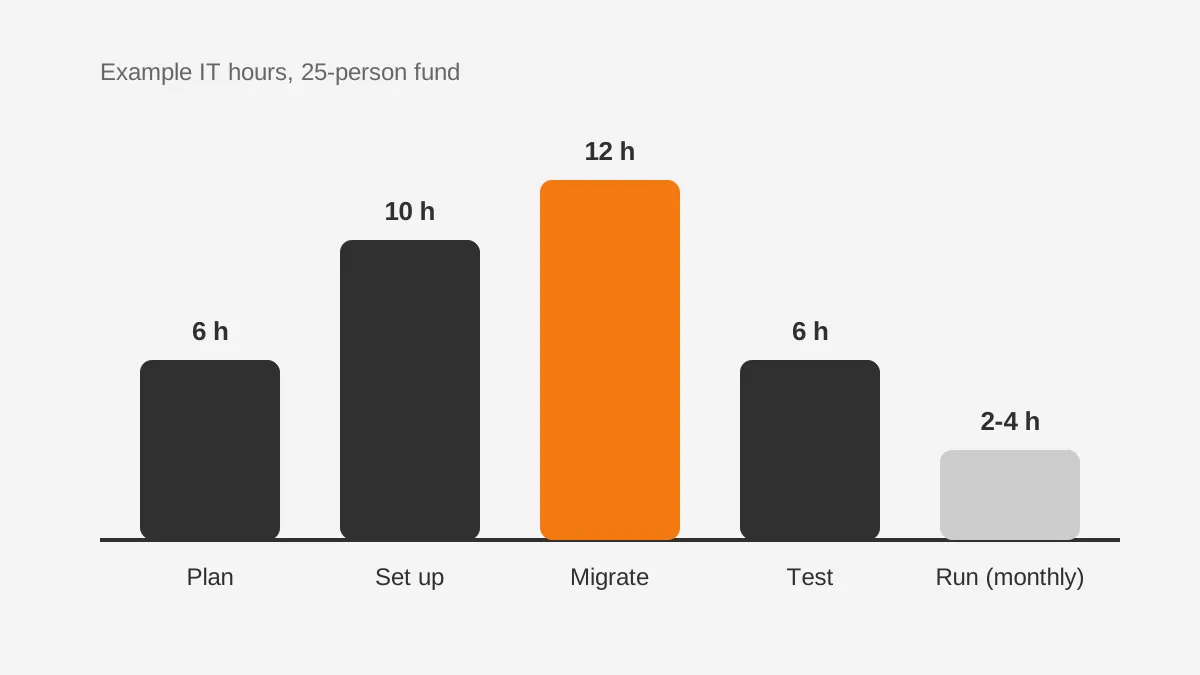
IT time in a fund CRM project is front-loaded, then drops to a steady trickle. The worked example below uses assumed figures for a 25-person fund on a purpose-built platform. It is an illustration, not a benchmark.
| Phase | Weeks | IT hours (example) | Main IT work |
|---|---|---|---|
| Plan | 1 to 2 | 6 | Access design, vendor security review |
| Set up | 3 to 4 | 10 | SSO, MFA, email sync approval |
| Migrate | 5 to 6 | 12 | Exports, test load, cutover |
| Pilot and test | 7 to 8 | 6 | Fixes from user acceptance testing |
| Run | Monthly | 2 to 4 | New users, leavers, access reviews |
In this example, the total before go-live is 34 hours over eight weeks. On a configurable platform, add the CRM administrator's time on top. That role can be part time in a small fund and full time in a larger one.
How long does it take to implement a CRM system for a fund? Vendor figures range from under 60 days to 12 months, as the platform table shows. The CRM implementation process is longest where custom configuration and integrations are deepest.
Share these numbers with partners early. A short IT effort does not mean a short project. Training, adoption and data cleanup still take weeks after IT is done.
How Does Fund Size Change the IT Answer?
Fund size changes who does the IT work more than how much there is. The tasks stay the same across a 10-person venture firm and a 150-person private equity firm. What changes is whether they sit with one person, an outsourced provider or a team.
- Under 20 staff: an outsourced IT provider covers sign-on and devices, and the COO acts as CRM admin.
- 20 to 60 staff: one internal IT generalist owns access and integrations, with a part-time admin in operations.
- Over 60 staff: a dedicated CRM administrator sits alongside IT, often with a data analyst for reporting.
These bands are a planning guide, not a rule. A small fund with complex fund accounting links can need more support than a larger fund on a simple platform.
Write the chosen model into the project charter. Name each owner, their weekly hours and their backup. That one page prevents the most common stall in a fund CRM rollout: a task nobody believes is theirs.
Firms using an outsourced IT provider should check the contract. Some managed IT agreements exclude application work such as CRM configuration or integration monitoring. If so, budget for it separately or give it to the CRM partner.
What Ongoing Support Does a Fund CRM Need?
Ongoing support for a fund CRM covers user changes, access reviews, data quality and vendor updates. This is the part funds most often underestimate. It is also the reason CRM adoption fades after launch.
A practical CRM support routine for a small fund looks like this:
- Weekly: add and remove users, answer how-to questions and fix sync issues.
- Monthly: check duplicate records and broken integrations.
- Quarterly: review access rights with compliance and review new vendor features.
- Yearly: confirm retention settings and test a records export.
Affinity's guide suggests surveying users one month and one quarter after launch. It also suggests meeting the vendor at least once per quarter. Intapp expects power users to have time to support peers.
That makes CRM training a continuing task rather than a launch event. New hires need it as much as the launch group did.
Firms without an in-house CRM admin often use outside help. Options include the vendor's support team, a CRM implementation consultant on retainer, or outsourced Salesforce administration. Salesforce managed services suit funds that chose Salesforce Financial Services Cloud but have no admin on staff.
Change management matters as much as IT support. A fund CRM only pays off when partners log meetings and investor relations keeps records current. The benefits of CRM for private equity firms come from consistent use, not from the software alone.
Partners who skip logging are the usual weak point. This guide to private equity CRM questions shows how firms keep portfolio check-ins current.
Frequently Asked Questions
How much IT support does a fund CRM need?
Most funds need one part-time IT owner and one CRM administrator. IT handles single sign-on, email sync, data migration and security reviews. On a purpose-built platform this can be 30 to 40 hours before go-live. Configurable platforms need more, plus a standing admin role.
Do venture capital firms need a dedicated CRM administrator?
Small venture firms on an out-of-the-box venture capital CRM software product rarely need a full-time admin. A part-time owner in operations is usually enough. Firms on configurable platforms with custom objects and integrations usually need a dedicated administrator. That can be on staff or through a partner.
Why do CRM implementations fail at investment firms?
Why CRM implementations fail usually comes down to strategy and ownership, not software. Affinity cites lack of strategy as a top reason. At funds, common causes include no executive sponsor and no named admin. Poor data at import and partners who never log meetings also hurt.
Can a fund CRM connect to fund administration software?
Yes, most fund CRM platforms can receive data from fund administration software through files or an API. Funds often show a read-only summary of commitments and capital accounts. A two-way sync adds testing and upkeep, so start with the summary investor relations needs.
When should a fund hire a CRM implementation partner?
Hire a CRM implementation partner when the fund chooses a configurable platform or needs fund accounting integration. The same applies when there is no internal admin. A partner sets up access, migration and workflows, then trains staff. Purpose-built platforms often include onboarding instead.
When Should Funds Get Outside Fund CRM Help?
Bring in outside help when the fund CRM needs custom configuration, fund administrator integrations, or an admin you lack. Light rollouts on purpose-built tools can run on internal effort. Heavier rollouts need a plan, a CRM admin and tested integrations from day one.
Unboxx plans and runs fund CRM projects on Salesforce, HubSpot and Dynamics 365 through its CRM implementation services. See the CRM for private equity and CRM for venture capital pages. You can also schedule a consultation to size your IT support.
Let's create something out of this world together.
Have a project in mind? Contact us for expert design and development solutions. Let's discuss how we can help grow your business.
Ready to Unboxx Your Potential?
Build smarter systems. Automate faster. Scale confidently.