
A partner gets a warm intro to a founder. The call goes well, but nobody logs it. Six months later, a colleague meets the same founder cold. Affinity notes VCs can receive on the order of 5,000 emails each month, so one unlogged call slips by.
Why do VC firms need CRM software? A fund's edge is its network, and a network kept in personal inboxes leaks. A venture capital CRM holds every founder, co-investor and LP relationship in one shared system.
Below: why do VC firms need CRM records, what to model, which platforms fit, and the cost.
Key Takeaways
- A VC CRM tracks relationships, deal flow and LP commitments in one system the whole fund can search.
- Generic sales CRMs assume a linear pipeline, so funds need custom objects for funds, rounds and LPs.
- Purpose-built tools, Salesforce and HubSpot can all work when the data model and adoption plan come first.
Why do VC firms need CRM at all?
VC firms need a CRM because deals come from relationships, and relationships decay when nobody records them. A fund that cannot see who knows whom misses warm introductions it already had. A shared record turns personal networks into a firm asset.
Scale is the first reason why do VC firms need CRM support. Memory fails at this volume. The Q3 2025 PitchBook-NVCA Venture Monitor counts more than 60,000 private, VC-backed companies in the US.
The same report says AI accounted for a record 39.5% of deal count in Q3 2025. Competition for those founders is intense, and speed of response matters.
A shared inbox cannot do the four jobs that explain why do VC firms need CRM tools:
- Deal sourcing: log every founder, referral source and first meeting.
- Deal flow: move each company through screening, diligence and the investment committee.
- LP relationships: track limited partners, commitments and capital calls for each fund.
- Portfolio monitoring: record board notes, KPIs and follow-on decisions for portfolio companies.
A spreadsheet can hold any one of these lists. It cannot connect them, and the connections hold the value. A founder you passed on may be an LP's portfolio CEO next year.
What breaks when a fund runs on spreadsheets?
Spreadsheets break when two people edit the same pipeline and nobody owns the truth. A tracker in Microsoft Excel or Google Sheets works for one partner with 30 companies. It fails once a fund has 3 partners, 2 associates and 400 companies in review.
The failures follow a pattern. Duplicate rows appear for the same startup under two spellings. Meeting notes stay in Gmail or Outlook and never reach the sheet. Nobody can answer a simple question, such as which co-investors have seen this deal.
Consider a worked example with assumed figures. A seed fund reviews 1,200 companies a year. Each partner spends 10 minutes a day searching email for context. Across 3 partners and 250 working days, that is 125 hours a year spent finding information the fund already owns.
The cost also shows up in founder relationships. A founder who pitched last year and returns with traction expects the fund to remember. Without a CRM, the associate starts from zero. Data hygiene suffers as well, so reports to the investment committee rest on stale numbers.
Here, why do VC firms need CRM discipline has a plain answer. Analysis built on messy records is wasted. Funds moving off a messy tracker can start with a CRM data cleansing runbook before any import.
What signs show a fund has outgrown spreadsheets?
A fund has outgrown spreadsheets when the same questions take longer to answer each quarter. Five signs appear first:
- Two partners meet the same founder without knowing it.
- The pipeline sheet has more than one owner and more than one version.
- Investment committee memos quote numbers that nobody can trace.
- LP updates take a week to compile from email threads.
- A departing associate takes founder relationships along.
If two of these sound familiar, the timing part of why do VC firms need CRM tools is settled. Fixing records between raises is cheaper than fixing them mid-raise.
Why do VC firms need CRM built for relationships?
VC firms need a relationship-first CRM because their best deals come through warm introductions, not cold outreach. A sales CRM asks which stage a lead is in. A VC CRM asks who at the fund knows this founder best.
Relationship intelligence answers that question automatically. Email and calendar sync captures meetings from Gmail, Outlook and Microsoft 365. The CRM then scores relationship strength by recency and frequency of contact. A partner can see a warm path to a founder in seconds.
The data shows how concentrated networks are. Affinity's 2026 PE Benchmark Report found that one person holds a median 31% of a firm's strong relationships. The top three people hold 72%. When one of them leaves, the network walks out the door.
A relationship intelligence CRM protects against that loss. Contacts stay with the firm, and their history stays searchable. Retention of that network is the strongest reason why do VC firms need CRM platforms with custom relationship data models. Such a model records people, firms and the ties between them.
Data enrichment adds context without typing. Integrations with PitchBook, Crunchbase, Dealroom and Harmonic fill in headcount, funding rounds and investors. Analysts spend time on judgment, not copy and paste. That is why do VC firms need CRM integrations early. Unboxx builds this setup on its CRM for venture capital service.
What does relationship scoring measure?
Relationship scoring measures how strong a tie is between a fund member and a contact. Intapp describes relationship intelligence CRM scores built on the volume, recency and type of engagement. A high score suggests a partner can ask for an introduction today.
Scores help with deal sourcing in a concrete way. Before a partner meeting, an associate filters by sector and sorts by score. The list shows which co-investors know the founders in that sector.
Gut feel tends to favour whoever emailed last week. Scoring is the part of why do VC firms need CRM data that corrects that bias.
How does a VC CRM differ from sales CRMs?
A VC CRM differs from a sales CRM in its pipeline shape, its objects and its users. Sales teams run a linear path from lead to closed deal. Funds run a branching path with passes, re-engagements and follow-on rounds.
The table below compares the two models side by side.
| Factor | Sales CRM | VC firm CRM |
|---|---|---|
| Main record | Lead and opportunity | Company, founder and fund |
| Pipeline | Linear, lead to close | Branching, sourced to portfolio |
| Source of deals | Marketing and outbound | Warm introductions and networks |
| Second pipeline | None | LP fundraising pipeline |
| Key metric | Win rate and revenue | Relationship strength and deal quality |
| After the deal | Account management | Portfolio monitoring and follow-ons |
A typical deal pipeline runs through sourced, screening, partner meeting, due diligence, investment committee, term sheet and portfolio. A pass is a stage with a reason code, not a deleted row. The fund can revisit the company when it raises again.
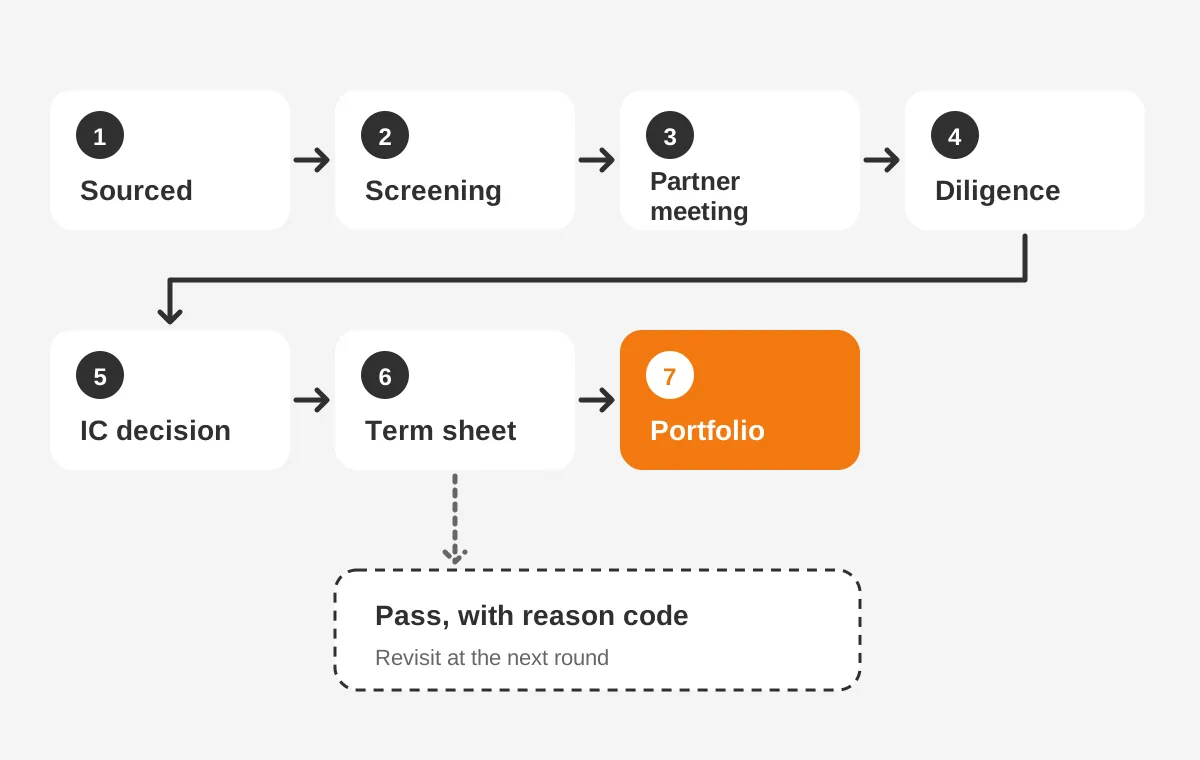
Users differ too. Partners want a one-screen view before a meeting. Associates want fast data entry. Platform teams want founder and co-investor lists for events. A good dealflow management setup gives each role its own view of the same records.
Shape, objects and users together explain why do VC firms need CRM software designed for investing rather than selling. Pipedrive or a default sales setup forces workarounds, and each one costs some adoption.
What should a VC CRM data model include?
A VC CRM data model should include funds, companies, people, deals, LP commitments and interactions as linked objects. Each object has its own fields and history. The links between them answer the questions partners ask.
A practical vc crm data model looks like this:
- Fund: vintage, size, strategy and target ownership.
- Company: sector, stage, location and enrichment fields.
- Person: founders, co-investors, advisors and LP contacts.
- Deal: round, amount, stage, lead investor and pass reason.
- LP commitment: fund, amount, status and capital calls.
- Interaction: emails, meetings and notes, synced automatically.
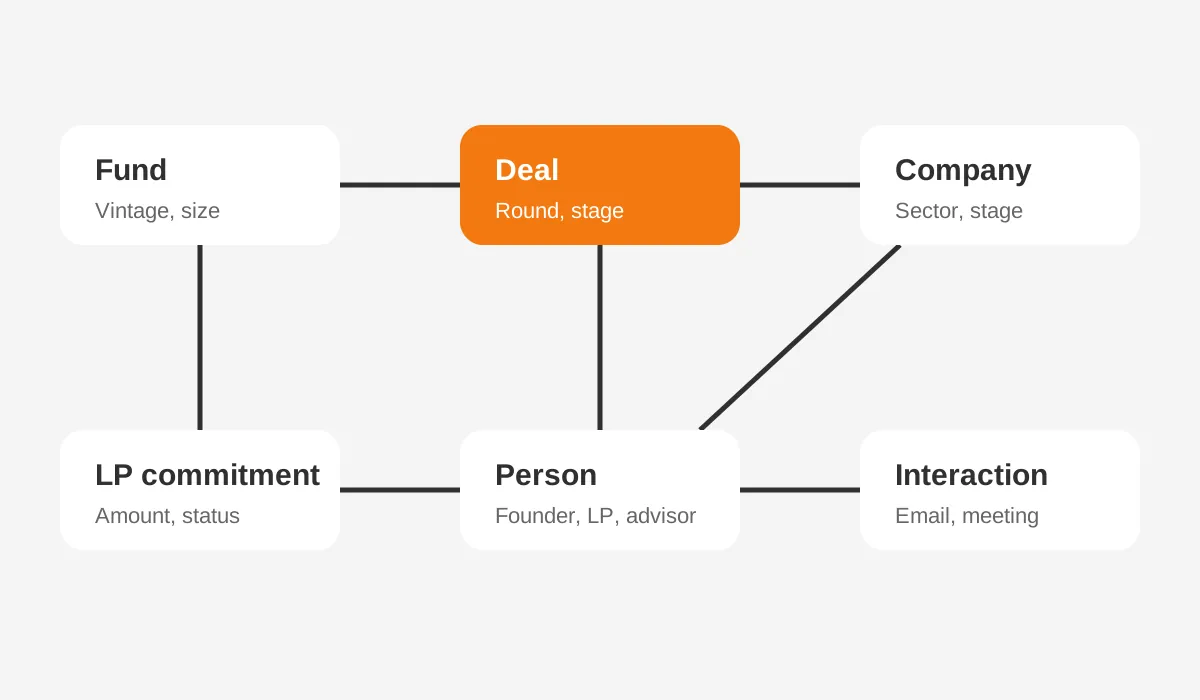
Store each LP commitment as its own record tied to one fund. Store each round as a deal tied to one company. Those two rules prevent most rework later. A company can then hold a seed deal, a Series A deal and a follow-on.
The model also feeds vc data crm integration with other tools. Carta holds the cap table, DocSend tracks deck views and Juniper Square handles investor reporting.
The CRM links to them rather than copying their job. Writing these needs down first saves months, and a guide to CRM requirements shows how to rank them.
Linked objects answer why do VC firms need CRM platforms with custom objects. A contact list cannot show that one founder is also an LP in Fund II. Tags cannot hold amounts, dates or stages.
That limit is why do VC firms need CRM objects rather than labels.
Why do PE firms need a specialized CRM too?
Private equity firms need a specialized CRM for the same reason as VC funds: deals come from relationships with intermediaries. Bankers, brokers and operating partners are common deal sources. Knowing who sent which deal tells partners where to spend time.
The question of why do PE and VC firms need a specialized CRM has a numeric answer.
A Grant Thornton survey of 217 middle-market portfolio companies, cited by Intapp on relationship intelligence, found a gap. Only 10% of fund investors made valuable introductions for them. Nearly 85% of companies called those connections critical.
A private equity crm adds objects a venture fund may not need. Common examples include LOI tracking, add-on acquisitions, management teams and lender relationships. The investment committee workflow often links memos, votes and conditions to each deal.
Private equity crm solutions also support longer, larger deals. A PE crm must handle data rooms such as Datasite and due diligence checklists per target. Unboxx covers these workflows on its CRM for private equity page.
Common private equity crm questions are practical. Who owns a banker relationship? How should the firm log intermediary fees and report deal source attribution? Each one needs a structured field, not a free-text note.
Reports cannot count free text, which is why do VC firms need CRM structure as much as PE firms do. The same strict fields answer why do VC firms need CRM reporting LPs can trust.
How does a CRM support LP fundraising?
A CRM supports LP fundraising by running a second pipeline beside deal flow. Each limited partner moves from prospect to soft commitment, hard commitment and closed. The fundraising pipeline shows the gap to target size at any moment.
Good crm for lp management setups also log due diligence questionnaires, data room access and re-up history. When Fund III opens, the team sees which Fund II LPs re-upped quickly. Cross-fund history like this is a large part of why do VC firms need CRM records that span vintages.
Which platforms do VC and PE firms use?
VC and PE firms mostly choose between purpose-built tools and configurable platforms such as Salesforce and HubSpot. Purpose-built tools include Affinity, DealCloud from Intapp, 4Degrees and Attio. Each option trades setup speed against flexibility.
This vc crm comparison summarises the main venture capital crm software options.
| Platform | Best fit | Strength | Trade-off |
|---|---|---|---|
| Affinity | VC and PE deal teams | Automatic relationship intelligence | Focused on deal teams |
| DealCloud (Intapp) | Large PE and VC firms | Deep fundraising and compliance modules | Longer, consultant-led setup |
| 4Degrees | Small and mid-sized funds | Network mapping and warm intros | Focused on network mapping |
| Salesforce | Funds with complex processes | Custom objects and Experience Cloud portals | Needs design and admin effort |
| HubSpot | Emerging managers and platform teams | Ease of use and marketing tools | Custom objects need Enterprise |
| Odoo | Funds wanting CRM plus ERP | Custom fund and capital call modules | More custom development |
Salesforce for venture capital usually runs on Financial Services Cloud or Sales Cloud. Relationship groups model households of investors. Experience Cloud adds LP and founder portals, and Agentforce adds AI agents for research tasks.
HubSpot for venture capital suits funds that also market to founders and LPs. Custom objects for funds, rounds and LP commitments require HubSpot Enterprise. Can HubSpot be used for venture capital? Yes, when the fund accepts some workarounds for complex fund structures.
The best crm for venture capital depends on fund size. A crm for emerging managers favours fast setup and low cost. A larger platform team favours custom reporting and an investor crm portal.
Should a fund pick Salesforce or a purpose-built tool?
A fund should pick a purpose-built tool when speed matters most, and Salesforce when processes are complex. Purpose-built tools ship with relationship scoring and VC pipelines on day one. Salesforce needs design work but adapts to almost any fund structure.
Three questions settle the choice. Does the fund need LP or founder portals? Does it run more than one fund strategy? Does it already use Salesforce for portfolio company support? Two or more yes answers point to Salesforce.
Brand matters less than adoption. If partners ignore the tool, the case for why do VC firms need CRM software collapses. The fix is fit, not a new logo. LPs and founders span vintages, which is also why do VC firms need CRM consistency across funds.
What does a VC CRM cost and take?
A purpose-built VC CRM costs about $1,500 to $8,000 per user per year, per 4Degrees' 2026 VC CRM guide. Enterprise tools such as DealCloud price by configuration. Salesforce and HubSpot add licence costs plus setup work.
So how much does a venture capital CRM cost in total? A worked example with assumed figures helps. A 10-person fund at $4,000 per user spends $40,000 a year on licences. Setup, migration and integrations add a one-off project fee on top.
Timelines follow complexity. The same 4Degrees guide gives these ranges:
- 1 to 3 months for purpose-built CRMs at small and mid-sized firms.
- 3 to 6 months for moderate complexity deployments.
- 6 to 12 months or more for enterprise platforms with heavy customization.
How long does a VC CRM implementation take for a typical seed fund? Usually the short end, if data is clean before import. Cleanup first is the scheduling side of why do VC firms need CRM planning. Budget lines are covered in detail in this breakdown of CRM implementation cost.
Budget is the other side of why do VC firms need CRM planning before purchase. Data work belongs in the budget from day one, alongside licences. A tool bought without a data model tends to cost more in rework than in licences.
How should a fund roll out its CRM?
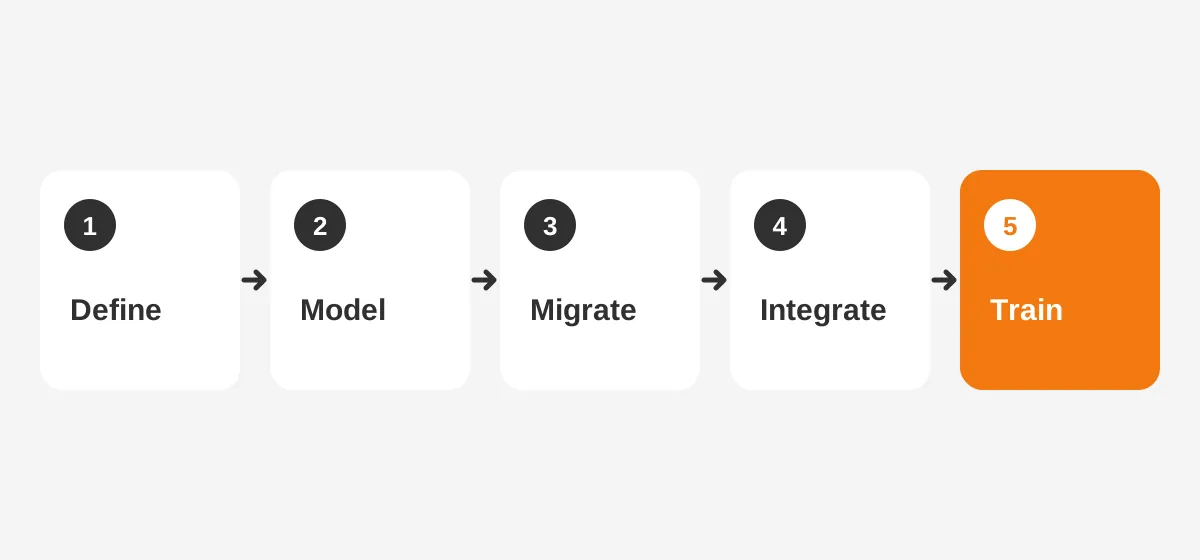
A fund should roll out its CRM in five steps: define, model, migrate, integrate and train. Each step has one owner and one sign-off. That order is why do VC firms need CRM projects run in phases. Skipping a step usually shows up later as low adoption.
- Define: list the questions partners ask each week and the reports the investment committee needs.
- Model: design objects for funds, companies, people, deals and LP commitments.
- Migrate: clean the spreadsheet, merge duplicates and import with stage history.
- Integrate: connect email and calendar sync, data enrichment and the cap table tool.
- Train: run role-based sessions and set one weekly pipeline review inside the CRM.
How to choose a VC CRM fits inside step one. Score each platform against the partner questions, not against a feature list. Prefer the tool that answers the most questions without a workaround.
Adoption decides the outcome. Partners use a CRM when it saves them time before meetings. Automatic capture removes much of the manual entry. The weekly pipeline review then runs from CRM data, so the habit sticks.
Which mistakes slow CRM adoption at funds?
Four mistakes slow adoption more than any feature gap:
- Choosing a generic sales CRM and forcing deals into a linear pipeline.
- Importing old spreadsheets without merging duplicate companies first.
- Asking partners to type notes that email and calendar sync could capture.
- Running the pipeline meeting from slides instead of the CRM.
Each mistake has the same root cause: the tool was bought before the workflow was defined.
Funds that settle why do VC firms need CRM design work before buying avoid all four. Training follows the same logic: partners keep using tools that save them time in the first week.
Data platforms matter for larger firms. Unboxx helped a financial services firm build an AI data platform for investment decisions with Salesforce sync. The project reported a 94% improvement in data consistency across enterprise sources.
Seen from the project plan, why do VC firms need CRM help from specialists comes down to fund data models. Teams that have built them before skip the trial and error.
Frequently Asked Questions
How much does a venture capital CRM cost?
A venture capital CRM costs about $1,500 to $8,000 per user per year for purpose-built tools, according to 4Degrees. Enterprise platforms such as DealCloud use custom pricing. Salesforce and HubSpot add licence fees plus a setup project for custom objects, migration and integrations.
Can a fund use HubSpot as its CRM?
Yes, a fund can use HubSpot as its CRM, especially for founder and LP marketing. Custom objects for funds, rounds and LP commitments need HubSpot Enterprise. Funds with complex structures or LP portals often find Salesforce or a purpose-built VC CRM a better fit.
Should a VC firm build its own CRM?
Most VC firms should configure an existing platform rather than build a CRM from scratch. Salesforce, HubSpot and purpose-built tools already handle email sync, permissions and reporting. A custom build makes sense only when workflows are unusual and the fund can fund ongoing maintenance.
Does a VC CRM replace a cap table tool?
No, a VC CRM does not replace a cap table tool such as Carta or Pulley. The cap table tool holds ownership and share classes. The CRM holds relationships, deals and LP commitments. An integration links the two so partners see ownership beside deal history.
What is a VC CRM?
A VC CRM is a customer relationship management system built for venture capital workflows. It tracks founders, companies, deal flow, co-investors and limited partners in one shared record. Most include relationship intelligence, email and calendar sync, and data enrichment from PitchBook or Crunchbase.
Why do VC firms need CRM partners like Unboxx?
Why do VC firms need CRM partners at all? The licence is the easy part. The data model, the migration and partner adoption decide whether the system works. Unboxx designs VC and PE CRMs on Salesforce, HubSpot and Odoo. Each build includes deal flow, LP management and portfolio monitoring.
If your fund still runs on spreadsheets and inboxes, start with a short review of your process. Schedule a consultation with Unboxx to map your objects, pick a platform and plan a rollout your partners will use.
Let's create something out of this world together.
Have a project in mind? Contact us for expert design and development solutions. Let's discuss how we can help grow your business.
Ready to Unboxx Your Potential?
Build smarter systems. Automate faster. Scale confidently.