
A Salesforce org rarely fails on day one. It fails slowly, as unowned fields, broken flows and half-finished projects pile up. Most teams reach the point where they need outside help.
Salesforce reports that 70% of Salesforce implementations are led by consulting partners. Who you hire shapes the result.
To hire Salesforce consultant help well, define the problem first, pick the engagement model second and verify credentials third. Then score every candidate on one rubric and sign a statement of work before anything is built. Costs, contract terms and red flags follow below.
Key Takeaways
- Write a one-page problem statement before you hire Salesforce consultant support, because the scope decides the model and the price.
- Verify every certification on Trailhead and ask for the current Agentforce credential names, since Salesforce renamed its consultant exams.
- Put deliverables, change requests, ownership and knowledge transfer into the statement of work before the first workshop.
What Does a Salesforce Consultant Do?
A Salesforce consultant turns business processes into a working Salesforce design and guides the build. The role sits between the people who run sales or service and the people who configure the platform. A good consultant asks why a process exists before asking which field it needs.
The daily work covers discovery workshops, requirement mapping, solution design, configuration, data migration, testing and training. On a Sales Cloud project, that means lead routing, opportunity stages, forecasting and reports. On a Service Cloud project, it means case routing and service consoles. Newer work adds Agentforce agents and Data Cloud.
A strong consultant also says no. When a request adds complexity without business value, the consultant should push back and explain the cost. Teams that hire Salesforce consultant help for that judgment get a simpler org, not a bigger one.
Two neighbouring roles share part of the title, and buyers often pay consultant rates for their work. Separate them before you hire Salesforce consultant time.
| Role | Main job | Typical output | Best moment to bring in |
|---|---|---|---|
| Salesforce consultant | Design the solution around the business process | Requirements, solution design, build plan | New implementation, redesign, new cloud |
| Salesforce administrator | Run and maintain the org day to day | Users, permissions, reports, small changes | After go-live, for steady upkeep |
| Salesforce developer | Write code where configuration stops | Apex, Lightning components, integrations | Custom logic or complex integration |
Salesforce consultant vs administrator is the pair buyers confuse most. The consultant designs change, and the administrator keeps the org healthy once it is live. Salesforce consultant vs developer is clearer: the developer writes Apex and builds integrations the consultant specifies.
When Should You Hire Salesforce Consultant Support?
You should hire Salesforce consultant support when the work needs design decisions your team cannot make with confidence. Four situations account for most engagements.
- A first implementation of Sales Cloud, Service Cloud or another cloud.
- A migration from HubSpot, Dynamics 365, Zoho or spreadsheets.
- An org with low user adoption, slow pages or reports nobody trusts.
- A new capability such as Agentforce, Data Cloud or an ERP integration.
Some needs do not call for a consultant at all. Adding users, building a report or fixing one validation rule is administrator work. For that, an outsourced Salesforce administration service costs less than a project team.
A quick test sorts the two. If the request starts with "add" or "fix", an administrator can handle it. If it starts with "redesign", "connect" or "decide", hire Salesforce consultant expertise. The second group needs judgment across sales, service, data and integration at once.
The org itself shows warning signs. Duplicate records, two versions of the pipeline report and managers exporting to spreadsheets all point to design problems. Patching them one by one rarely works, and a proper review needs outside eyes. That is the point to hire Salesforce consultant expertise.
Bring the consultant in before you sign licence contracts where possible. Edition and cloud choices made without design input can force rework later. The cheapest moment to hire Salesforce consultant input is before the first licence is signed.
Freelancer, Partner or Employee: Which Model Fits?
The right model depends on scope, duration and how much risk your team can absorb. A freelance Salesforce consultant fits narrow, well-defined work. A Salesforce consulting partner covers projects that need four or five skills at once. A full-time hire makes sense for a steady, long-term roadmap.
The risks differ too. An independent Salesforce consultant is one person, so illness or a new contract can stall the project. A Salesforce consulting firm brings an architect and developers, at a higher rate. An employee builds deep knowledge of your business but takes months to recruit.
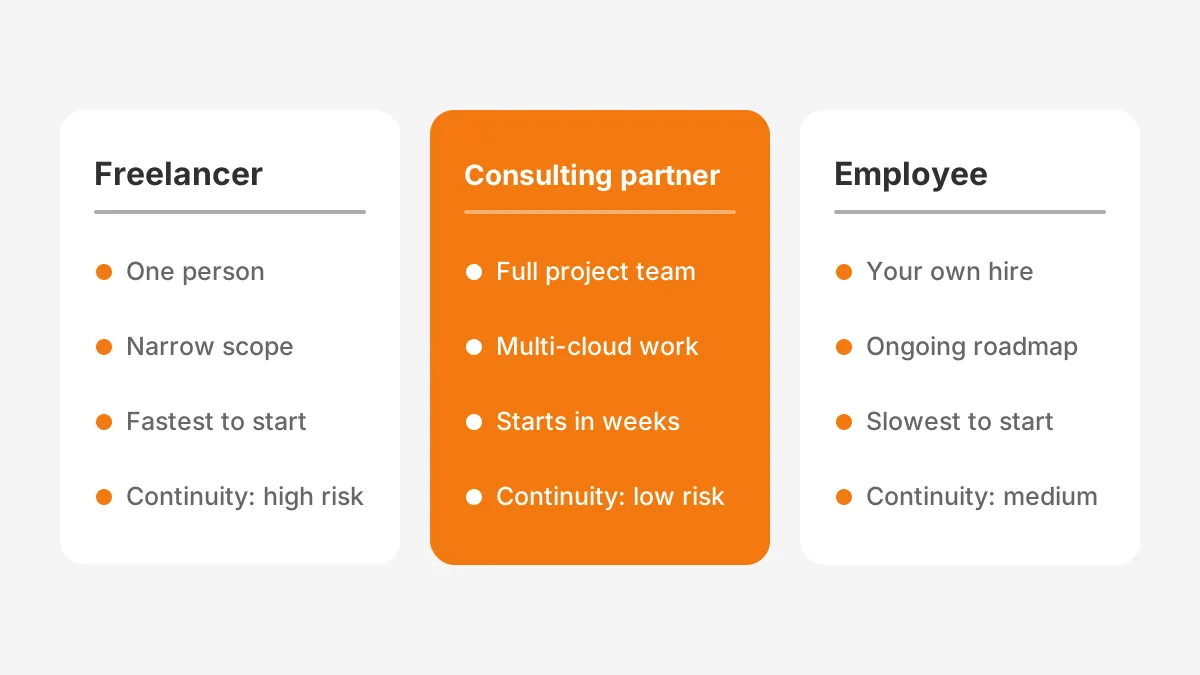
| Factor | Freelancer | Consulting partner | Employee |
|---|---|---|---|
| Best for | One cloud, clear scope | Multi-cloud or integration projects | Ongoing roadmap |
| Team depth | One person | Consultant, architect, developers, project manager | One person plus your team |
| Speed to start | Days to weeks | Weeks | Months |
| Continuity risk | High | Low | Medium |
| Pricing | Hourly or day rate | Fixed price, time and materials or retainer | Salary and benefits |
Salesforce is also changing how it recognises partners. Its Consulting Partner Program page describes replacing generic tiers with specific competencies. Ask any Salesforce implementation partner which competencies it holds for your cloud and industry.
Unboxx works as a partner on Salesforce CRM services, from first build to redesign, so this model is familiar ground. Even so, a small, single-cloud fix may be cheaper with a freelancer.
Mixed models work well too. Some teams hire Salesforce consultant capacity from a partner for the build. Then an administrator runs the org after go-live. Design skill stays on the project, and daily knowledge stays inside the business.
Which Certifications Should a Salesforce Consultant Hold?
A certified Salesforce consultant should hold the Platform Administrator credential plus the consultant credential for your cloud. Salesforce renamed its main consultant exams in 2026. The old Sales Cloud Consultant page now shows the Salesforce Certified Agentforce Sales Consultant. Its listed prerequisite is Platform Administrator.
The Service Cloud Consultant credential follows the same pattern and is now the Agentforce Service Consultant. A candidate who quotes only the old names may have let a credential lapse. Before you hire Salesforce consultant candidates, ask each one to list their current credentials by the new names.
Match credentials to the work:
- Sales process work: Agentforce Sales Consultant.
- Case and support work: Agentforce Service Consultant.
- Code and integration: Platform Developer credentials.
- Multi-cloud design: an architect credential on the partner team.
Never accept a screenshot as proof. Salesforce runs a public credential verification tool on Trailhead. You search by first name and surname, and Salesforce notes that updates can take up to one business day.
Certifications prove knowledge, not delivery. Five credentials and no live projects make a weaker hire. Two credentials and three references from similar orgs make a stronger one.
Each reference call needs three questions. Did the project finish on budget? Did the consultant handle change requests fairly? Would they hire Salesforce consultant support from the same person again? A hesitant answer to the last one outweighs any certificate.
Where Do You Find Qualified Salesforce Consultants?
The best places to find Salesforce consultants are referrals, AppExchange consulting listings, the Trailblazer Community and vetted talent marketplaces. Each source leans toward one engagement model, so search where yours lives. Start the search two to four weeks before you need to hire Salesforce consultant capacity.
- Referrals: ask peers at companies of similar size which consultant they would hire again.
- AppExchange: Salesforce lists consulting partners by expertise, industry and region.
- Trailblazer Community: user groups and forums show who answers hard questions well.
- Marketplaces: Upwork and Toptal list freelancers with reviews and rates.
Referrals give the most honest picture. A peer can tell you how a consultant behaved when a deadline slipped, which no profile shows. When you hire Salesforce consultant help through a marketplace, read the full review history rather than the star average.
Industry fit counts as much as platform skill. A consultant who has built Salesforce for manufacturers knows quoting and distributors. A nonprofit specialist knows donations and grants. Ask for two projects in your industry before you hire Salesforce consultant time for a core process.
Location is a smaller factor, since discovery workshops and build reviews run well on video calls. Time zone overlap is different, because design decisions need quick answers. Aim for at least four shared working hours a day.
How Do You Hire Salesforce Consultant Talent Well?
To hire Salesforce consultant talent well, follow the same six steps every time, in order. The steps work for a freelancer, a partner or an employee. Skip the first step and every later step works from a guess.
- Write a one-page problem statement: the process, the users, the pain and the deadline.
- Choose the engagement model from the table above.
- Build a shortlist of three to five candidates from the sources above.
- Verify every credential on Trailhead and call two references per candidate.
- Run a paid discovery session or a scored interview with a real scenario.
- Agree a statement of work, then start with a short first phase.

The problem statement carries the most weight. It turns a vague brief into something a candidate can price. Use the same document for every candidate, so the quotes compare like for like. A clear list of CRM requirements makes this step faster.
How long does it take to hire a Salesforce consultant? A freelancer can start within one to three weeks. A consulting partner usually needs two to four weeks for scoping and contracts. A full-time hire takes a full recruitment cycle.
The scenario in step 5 should come from your own org. Describe a real process, such as a quote moving from sales to finance. Ask for a design sketch in 30 minutes. Firms that hire Salesforce consultant staff this way see how candidates think, not how they present.
Onboarding decides how fast the work starts. Before day one, create sandbox access, name one product owner on your side and book a weekly review. Share the problem statement and a list of known issues. A consultant who spends the first week waiting for logins is a cost you created.
A short first phase protects both sides. A two-week discovery sprint with a fixed fee shows how the person works. If it goes well, the design documents carry into the next phase. If it goes badly, you have lost two weeks instead of six months.
What Should You Ask in the Interview?
Good questions make candidates describe past decisions instead of reciting features. Good Salesforce consultant interview questions include these five.
- Walk me through a Salesforce project that went wrong and what you changed.
- How would you design lead routing for our team of 12 reps?
- When do you choose Salesforce Flow over Apex?
- How do you handle a change request in the middle of a sprint?
- What does your knowledge transfer look like at the end?
Then score every answer on the same scale. A simple rubric weights four areas: platform skill, business understanding, communication and delivery record. Give each a score from 1 to 5 and multiply by the weight.
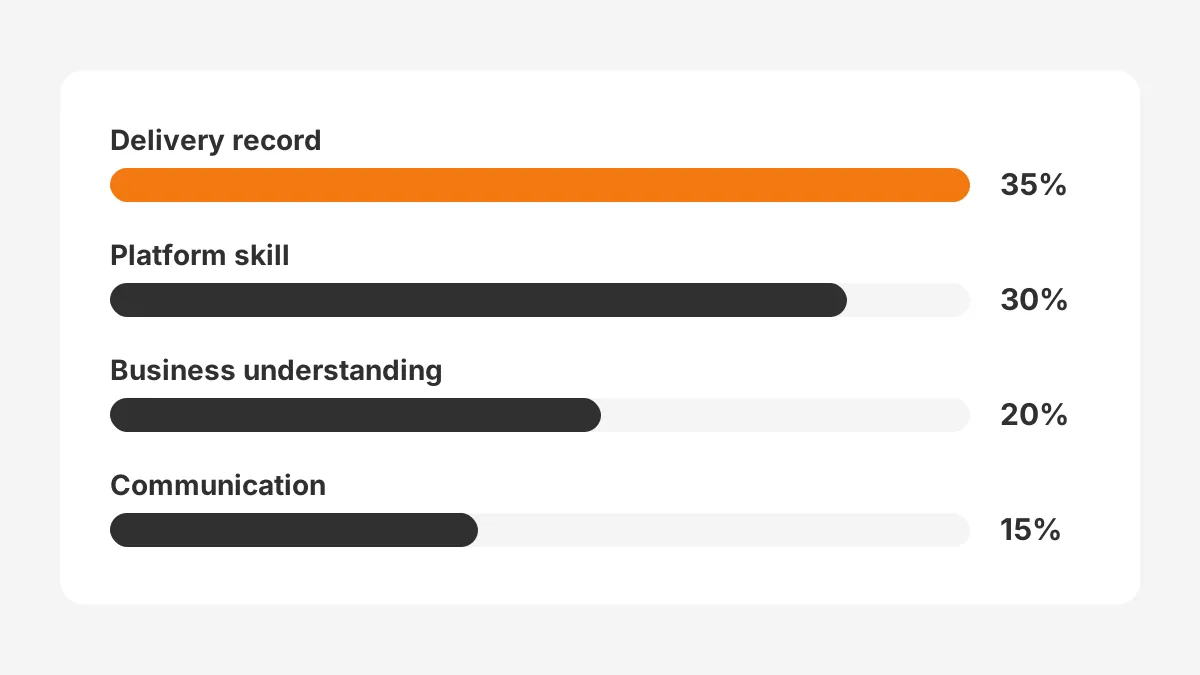
In this rubric, delivery record carries 35%, platform skill 30%, business understanding 20% and communication 15%. Treat the weights as a starting point.
A more technical or more political project may need different weights. Agree the weights with your sponsor before you hire Salesforce consultant candidates. Then the scores settle debates.
Questions to ask a Salesforce consultant should also cover staffing. Ask who will do the work day to day, by name. The architect in the sales meeting is not always the person who builds.
How Much Does a Salesforce Consultant Cost?
Salesforce consultant cost depends on scope, seniority, location and pricing model, so no single rate applies. Public salary data gives a floor to work from. The U.S. Bureau of Labor Statistics puts the median wage for management analysts at $101,860 a year in May 2025. That equals $48.97 an hour.
That benchmark covers employed analysts, not contractors, so treat it as a sanity check when you hire Salesforce consultant support. A Salesforce consultant hourly rate is usually higher. The contractor pays for their own benefits, tools, idle weeks and certification upkeep.
Quotes usually arrive in one of three pricing models:
- Time and materials: you pay for hours worked, which suits unclear scope.
- Fixed price project: you pay an agreed sum for agreed deliverables, the usual model for a fixed price Salesforce project.
- Retainer: you buy a monthly block of hours for ongoing work.
A worked example shows how to compare quotes, using assumed rates rather than market data.
Suppose a discovery and design phase needs 80 hours. At an assumed $150 an hour, that phase costs $12,000. A fixed-price quote of $14,000 for the same scope adds about 17% for the risk the consultant carries.
How much does a Salesforce consultant cost over a full project? The build decides. The Unboxx guide to Salesforce Sales Cloud implementation breaks a typical project into phases with cost drivers for each.
Pick the model that matches how well you know the scope. Fixed price works when the problem statement is detailed and stable. Time and materials works for discovery and for problems you cannot yet describe. A retainer works when you hire Salesforce consultant hours for ongoing advice after go-live.
Ask every candidate to price the same problem statement in the same model, or the quotes will not compare. A quote that looks low may leave out testing, training or data migration.
Judge each quote by the total cost of the outcome. A cheap consultant who leaves technical debt can end up costing more than a careful one.
What Belongs in the Statement of Work?
A Salesforce consultant statement of work should name the deliverables, the process for change and who owns the result. Without one, every disagreement turns into a negotiation.
Every Salesforce consultant contract should cover these seven items:
- Scope: the processes, objects, clouds and integrations in and out of scope.
- Deliverables: design documents, configured features, test scripts and training sessions.
- Change requests: how new requests are priced and approved.
- Environments: work happens in a sandbox, never straight in production.
- Ownership: your company owns all configuration, code and documentation.
- Knowledge transfer: recorded walkthroughs and admin notes before final payment.
- Exit terms: notice period and handover if either side ends the contract.
Add a confidentiality agreement before you share data. Give the consultant the minimum permissions the work needs, and remove access on the last day. Use a named login, never a shared admin account. Then every change has an owner in the audit trail.
Ask for a delivery plan inside the statement of work. It should list each phase, its length, its owner on both sides and its exit criteria. When you hire Salesforce consultant teams without a plan, scope tends to grow while the deadline stays fixed.
User acceptance testing deserves its own line. Name the people who sign off each feature, and tie payment milestones to their approval rather than to dates alone.
What Red Flags Should Stop the Hire?
Stop the hire when a candidate cannot show verified credentials, real references or a clear plan. Each of these Salesforce consultant red flags points to a specific project risk.
- A quote given before any discovery questions.
- Promises to build everything in production to save time.
- No written change request process.
- Reluctance to name the people who will do the work.
- Credentials that do not appear in the Trailhead verification tool.
- No plan for documentation or handover.
One red flag is a reason to ask more questions. Two or more is a reason to move on. If you hire Salesforce consultant help despite these signs, expect to pay twice. Restarting with a new consultant is cheaper than untangling a poorly built org.
Check how the candidate treats your existing org. A good consultant audits first, the way a Salesforce build planned right from day one starts with structure before features.
Frequently Asked Questions
How long does a typical Salesforce consulting project take?
A focused fix or a single-cloud redesign often takes four to eight weeks. A first implementation with data migration and one integration usually takes three to six months. The timeline depends on scope, data quality and how quickly your team can review and approve each design decision.
Can a small business hire a consultant part time?
Yes. Small teams often hire Salesforce consultant hours on a monthly retainer of 10 to 20 hours. It is the usual model for Salesforce consultant for small business work. It covers design advice, small builds and reviews for teams with fewer than 50 users.
What should a Salesforce consultant job description include?
A Salesforce consultant job description should name the clouds, the processes and the integrations involved. Add the required credentials, the reporting line and the success measures for the first 90 days. Specific expectations attract candidates with matching experience and filter out generalists early.
Who owns the configuration a consultant builds?
Your company should own all configuration, code, documentation and data. Who owns Salesforce configuration must be written into the contract. Ask for every custom component to be stored in your own repository or org. A consultant who resists this clause may plan to make your org depend on them.
What happens after the consultant's project ends?
After go-live, someone must own the org. Most teams move to an internal administrator or a managed service, and the handover plan should name which one. The Unboxx guide to Salesforce managed services compares that option with an in-house team, including scope, response times and cost.
Why Hire Salesforce Consultant Support From Unboxx?
Teams that hire Salesforce consultant support from Unboxx work with a Salesforce Crest Partner. Unboxx starts with discovery, documents every decision and hands over a clean org. The team works across Sales Cloud, Service Cloud, Flow and integrations, with B2B companies in manufacturing, professional services and logistics.
If your org needs a redesign, a migration or a second opinion, schedule a consultation with Unboxx. Bring your problem statement, and leave with a scoped plan. Whichever partner you pick, run the same checks each time you hire Salesforce consultant help.
Let's create something out of this world together.
Have a project in mind? Contact us for expert design and development solutions. Let's discuss how we can help grow your business.
Ready to Unboxx Your Potential?
Build smarter systems. Automate faster. Scale confidently.