
Planned Giving Platform vs a CRM Module: Which Do You Need?
Picture a gift officer taking a call from a donor's attorney. A long-time supporter has died and left the charity a share of her estate. Nobody in the office knew the gift existed, because the intention sat in a note field nobody reported on.
Charitable bequests reached about $62.2 billion in 2025, up 19.7%, according to Giving USA 2026 as reported by NonProfit PRO. A planned giving platform is purpose-built software that illustrates, markets and administers deferred gifts. A CRM planned giving module records those gifts as future pledges beside each donor's history.
Key Takeaways
- A planned giving platform calculates, illustrates and administers complex gifts. A nonprofit CRM tracks the donor and the expected gift.
- A CRM module is enough for a bequest-only program. Charitable gift annuities and trusts usually need dedicated planned giving software.
- Teams with both tools should keep donors in the CRM as the system of record and sync gift details back.
What Is a Planned Giving Platform?
A planned giving platform is software built for the technical side of deferred gifts. It runs the math, produces donor proposals and keeps the legal and tax records that some gift types require.
Planned gifts are arranged now and benefit the charity later, or pay the donor income in return. The common types are bequests in a will, beneficiary designations on retirement accounts, charitable gift annuities and charitable remainder trusts. Some charities also run a pooled income fund.
A purpose-built planned giving platform covers three jobs that a fundraising CRM was never designed for:
- Gift illustration: a gift officer enters the donor's age, asset and gift type. The software shows income, tax deduction and remainder value.
- Gift administration: the platform schedules annuity payments, tracks trust assets and produces the year-end tax forms each annuitant needs.
- Planned giving marketing: web calculators, legacy pages and mailings that invite donors to request an illustration.
PG Calc is a long-standing example, serving charities since 1985. Its product list separates the jobs clearly. PGM Anywhere calculates and illustrates planned gifts, GiftWrap handles gift administration, and Bequest Manager tracks bequest administration. GiftCalcs puts gift calculators on a charity's website.
The same Giving USA 2026 figures put total US giving at $617.2 billion in 2025. Bequests made up about 10% of it. Individuals gave $394.2 billion, or 64% of the total. Every bequest in that 10% started as a decision by one individual donor.
Other planned giving tools focus on one piece of the work. FreeWill, for example, offers online will-writing so donors can add a bequest at no cost. Either way, a planned giving platform is a specialist tool that sits next to the donor database.
What Does a CRM Planned Giving Module Track?
A CRM planned giving module tracks the donor relationship and the expected gift, not the gift mechanics. It answers who has made a commitment, what kind, roughly how much, and who is stewarding that donor.
In a typical crm for nonprofits, the planned giving data sits in four places:
- A planned gift or expectancy record with the gift type, estimated value and status.
- Donor flags such as legacy society member or confirmed bequest intention.
- Activities and tasks that log every stewardship call, visit and thank-you letter.
- Moves management stages that show where each prospect sits, from identified to confirmed.
Donor databases such as Raiser's Edge NXT list legacy giving and planned gifts tracking as a built-in feature. Salesforce, HubSpot and Microsoft Dynamics 365 reach the same result through configuration, usually a record type or a custom object.
The strength of the CRM module is context. A gift officer sees the planned gift beside 20 years of gifts, events and volunteer hours. That context tells the officer when a legacy conversation makes sense.
Unboxx explains the core data model in its guide to what a nonprofit CRM is and how it works.
The weakness is depth. A CRM module stores an estimated value and a date. It does not calculate an annuity rate, a charitable deduction or the payout from a remainder trust.
How Is a Planned Giving Platform Different From CRM?
A planned giving platform handles the calculations, contracts and compliance behind a gift. A CRM handles the person and the relationship. For a board summary: one tool knows the gift's math, and the other knows the donor.
The table compares the two on the tasks that planned giving teams perform every month.
| Task | Planned giving platform | CRM planned giving module |
|---|---|---|
| Donor profile and gift history | Limited, often imported | Full record, the system of record |
| Bequest intentions and expectancies | Tracked in bequest tools | Tracked as records or pledges |
| Gift illustrations and proposals | Core feature | Not available |
| Charitable gift annuity payments | Scheduled and recorded | Not available |
| Annuitant tax forms (1099-R) | Produced each year | Not available |
| Moves management and tasks | Basic or none | Core feature |
| Campaigns, email and segments | Planned giving marketing only | All channels and programs |
| Board and pipeline reporting | Planned gifts only | All giving, including planned gifts |
The split matters most for charitable gift annuities and trusts. The charity owes the donor money for life under an annuity contract. Payment schedules and tax forms cannot live in a spreadsheet beside the CRM.
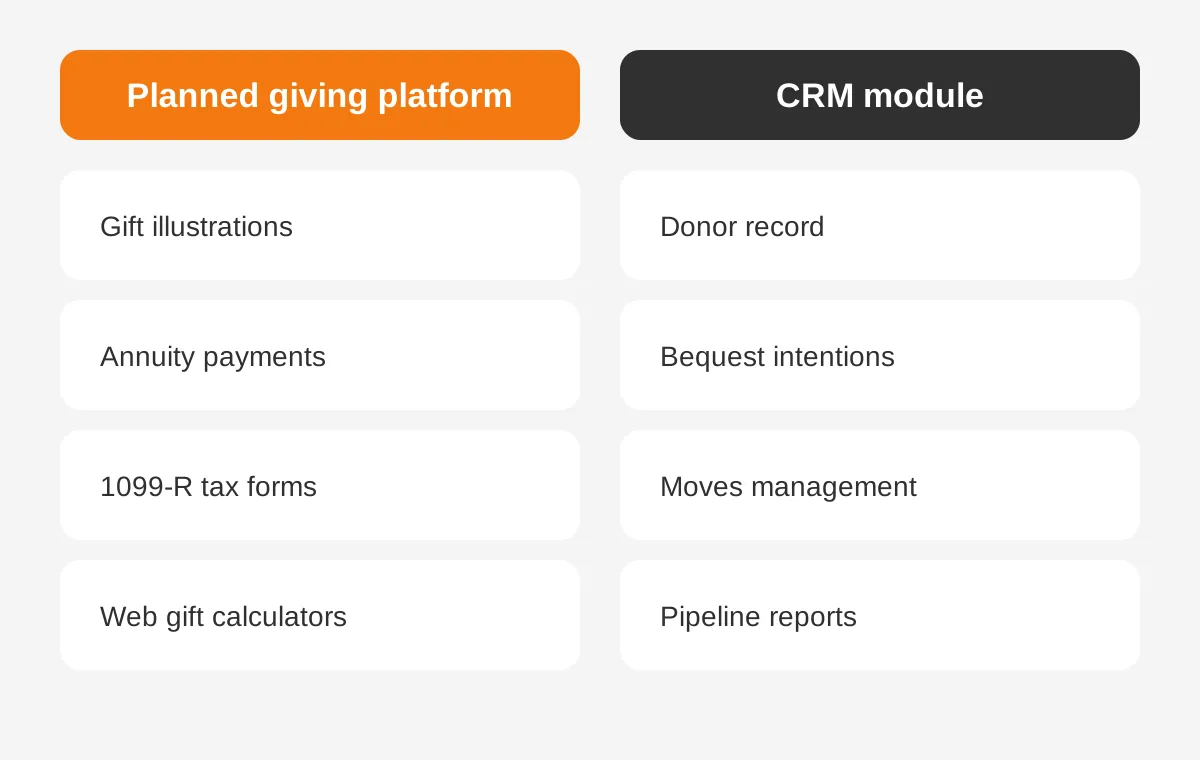
Bequest programs sit closer to the middle. A will-based gift needs no payments until the estate settles, so a CRM covers most of the daily work. The planned giving platform earns its cost once a team issues annuities or manages trusts.
Which Gift Types Need Dedicated Planned Giving Software?
Gifts that create payment duties or tax reporting need dedicated planned giving software. Gifts that only promise a future transfer usually do not.
Charitable Gift Annuities
A charitable gift annuity is a contract. The donor transfers cash or securities, and the charity pays a fixed amount for life. The American Council on Gift Annuities publishes suggested maximum rates, effective January 1, 2024.
Charitable gift annuity rates rise with the donor's age. Under that schedule, a 70-year-old donor's suggested rate is 6.3% and an 80-year-old donor's is 8.1%. Rates for donors aged 90 and above are capped at 10.1%. A planned giving platform applies the right rate by age and produces the illustration.
Annuity payments also create tax reporting. The IRS guidance on Form 1099-R lists charitable gift annuities among the payments that require the form. A charity with 30 annuitants needs 30 accurate forms each year.
PG Calc lists state registration and annual filing among its gift annuity services. That shows issuing annuities brings state compliance work, not only fundraising work.
Charitable Remainder Trusts and Pooled Income Funds
A charitable remainder trust pays the donor or other beneficiaries an income stream. The charity receives what remains when the trust ends. A pooled income fund mixes gifts from a group of donors into one fund. Each donor receives a share of the income.
Trusts are usually set up with the donor's own attorney or financial advisor. The charity may serve as trustee or may only be the named remainder beneficiary. That role decides how much administration falls on the charity's staff and its planned giving platform.
Trusts and pooled income funds both need valuations, payout calculations and trust accounting. Planned giving software or an outside administrator handles that work. The CRM only records that the gift exists and who stewards it.
Bequests and Beneficiary Designations
A bequest is a gift written into a will or living trust. A beneficiary designation names the charity on an IRA, 401(k) or life insurance policy. Neither creates payments before the donor's death.
The work here is relationship tracking: confirming the intention, estimating the value and stewarding the donor for years. A nonprofit CRM handles that well. Estate settlement can take years, too. The NonProfit Times reported that the Paul Allen estate took seven years to clear before its $3.1 billion bequest counted.
Bequest records also need upkeep. Donors revise wills, sell assets and change beneficiaries. A yearly stewardship call confirms that an intention still stands and that its estimated value is still realistic.
How Do Salesforce and Other CRMs Store Planned Gifts?
Most CRMs store planned gifts in one of two ways. One is a special donation record type, and the other is a custom object. The choice decides how clean your reports will be.
Cloud for Good, a Salesforce consultancy, compares both designs in its guide to tracking planned gifts in Salesforce.
The first design adds a planned gift record type to the donation (opportunity) object. It is quick to configure and shows planned gifts on the contact. Close date and amount are required fields, so both become guesses.
Some officers dislike entering a date that implies a death date. A placeholder date avoids that, but it breaks any report sorted by expected close.
That design also pollutes reporting. Every pipeline forecast and donor total must filter out planned gifts, or a $250,000 estimate distorts this year's numbers.
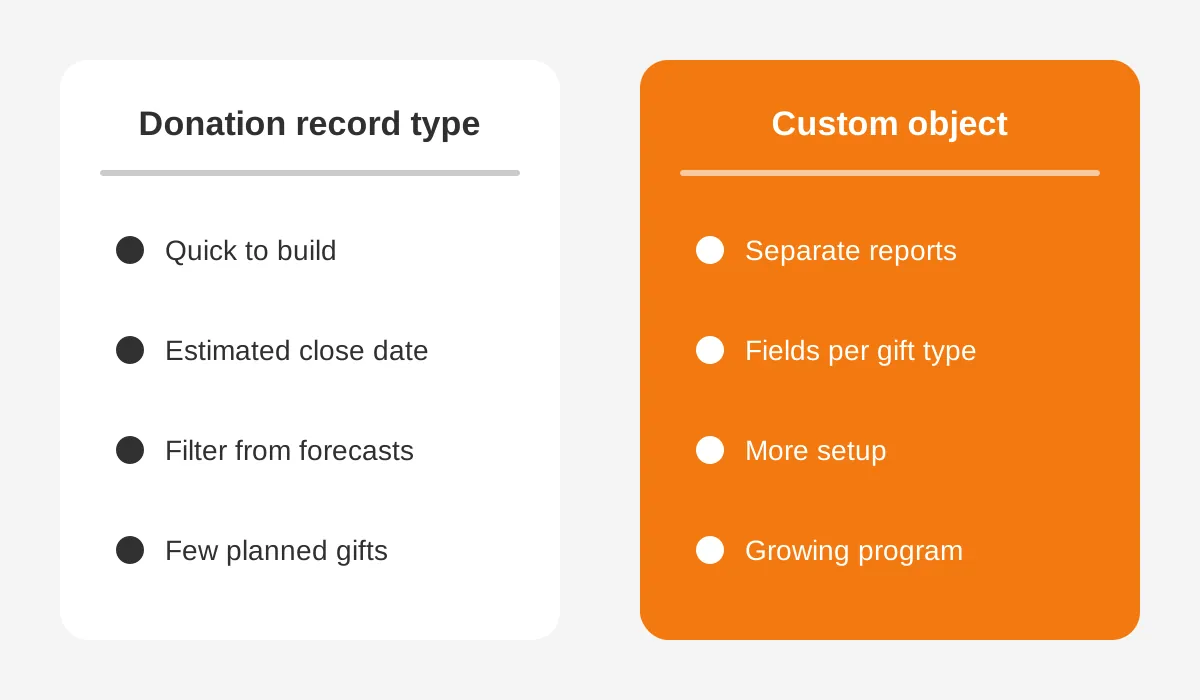
The second design creates a custom planned gift object. Record types then separate bequests, annuities and property gifts, each with its own fields. Reports and roll-up fields stay apart from the donation pipeline. The cost is more setup, ongoing admin work and some double entry when the gift finally arrives.
Cloud for Good's advice is practical. Start with the donation record type if planned gifts are infrequent. Move to a custom object as the program grows. The same logic applies in HubSpot, where custom objects hold planned gift data, and in Dynamics 365.
Unboxx's Salesforce Nonprofit Cloud consulting team builds this model during setup. Planned gift tracking stays separate from the annual fund from day one.
When Is a CRM Module Enough for Planned Giving?
A CRM module is enough when the program is mostly bequests and beneficiary designations, with nothing to administer. In that case, a planned giving platform adds cost without adding much value.
Use this decision rule. If your charity issues no gift annuities and manages no trusts, keep planned giving in the CRM. Add a web calculator or will-writing tool if marketing needs a boost.
Consider a worked example with assumed figures. A regional food bank knows of 40 bequest intentions and 12 beneficiary designations. It issues no annuities. One gift officer spends part of each week on legacy stewardship.
That team needs four things from the CRM:
- A planned gift object with type, estimated value, confidence level and document status.
- A legacy society flag that triggers an annual thank-you and an event invitation.
- A dashboard of confirmed versus unconfirmed intentions by stewardship stage.
- A task series that reminds the officer to contact each legacy donor every quarter.
Every one of those items is standard configuration in Salesforce, HubSpot or Dynamics 365. None needs a planned giving platform. Unboxx compares general-purpose and donor-focused systems in its nonprofit CRM software comparison.
When Should a Nonprofit Add a Planned Giving Platform?
A nonprofit should add a planned giving platform when it issues gift annuities, manages trusts or needs illustrations in volume. Those are the jobs a CRM cannot do.
Watch for these five signs:
- The board approves a charitable gift annuity program, or the charity already has annuitants.
- Gift officers build illustrations by hand or wait days for an outside calculation.
- Annuity payments and 1099-R forms run from spreadsheets kept by one finance person.
- Auditors ask for actuarial reserve reports the finance team cannot produce.
- Donors ask for a gift calculator on the website, and none exists.
Size alone is not the trigger. A small charity with ten gift annuities needs planned giving software more than a large one with 500 bequest intentions. The gift type, not the donor count, drives the choice.
Outsourcing is a third route. Charities can hand gift annuity administration to an outside administrator and keep only the CRM in-house. That keeps compliance with specialists while the CRM still drives stewardship.
How Do You Market Planned Gifts From Each Tool?
Planned gift marketing works best when the CRM picks the audience and the planned giving platform supplies the offer. Each system does the half it was built for.
The CRM holds the signals that predict a legacy gift. Segments worth testing include donors who have given for ten or more years, monthly donors and long-serving volunteers. Age data, where donors share it, helps too. The CRM builds those lists and sends the mailings and emails.
The planned giving platform supplies the content behind the message. A web gift calculator lets a donor test an annuity at home. A personal illustration shows the income and deduction in writing. A legacy page explains each gift type in plain language.
A simple quarterly cycle ties the two together:
- Pull a segment of loyal donors from the CRM and exclude anyone already in the legacy society.
- Send a letter or email that links to the gift calculator on the planned giving platform.
- Log every calculator request or reply in the CRM as an activity on the donor record.
- Assign follow-up tasks to the gift officer for each donor who responded.
- Report responses, meetings and confirmed intentions by segment each quarter.
Without step three, only the planned giving platform knows who asked for an illustration. The gift officer misses the warmest leads. Marketing automation in the CRM can run steps one, two and four, which frees the officer for visits.
Charities without a planned giving platform can still run this cycle. A will-writing link or a downloadable bequest language sheet replaces the calculator, and the CRM does the rest.
How Should a Planned Giving Platform Connect to CRM?
A planned giving platform should connect to the CRM in two directions. Donor data flows out, and gift details flow back. The CRM stays the system of record for people, and the platform stays the system of record for gift mechanics.
A clean planned giving data design follows four rules:
- Create donors in the CRM first, then send them to the platform with the CRM record ID.
- Send gift summaries back to the CRM: gift type, value, start date and status.
- Keep payment schedules and tax data in the platform only, because staff do not need them in the CRM.
- Run a monthly reconciliation that matches every active gift in both systems.
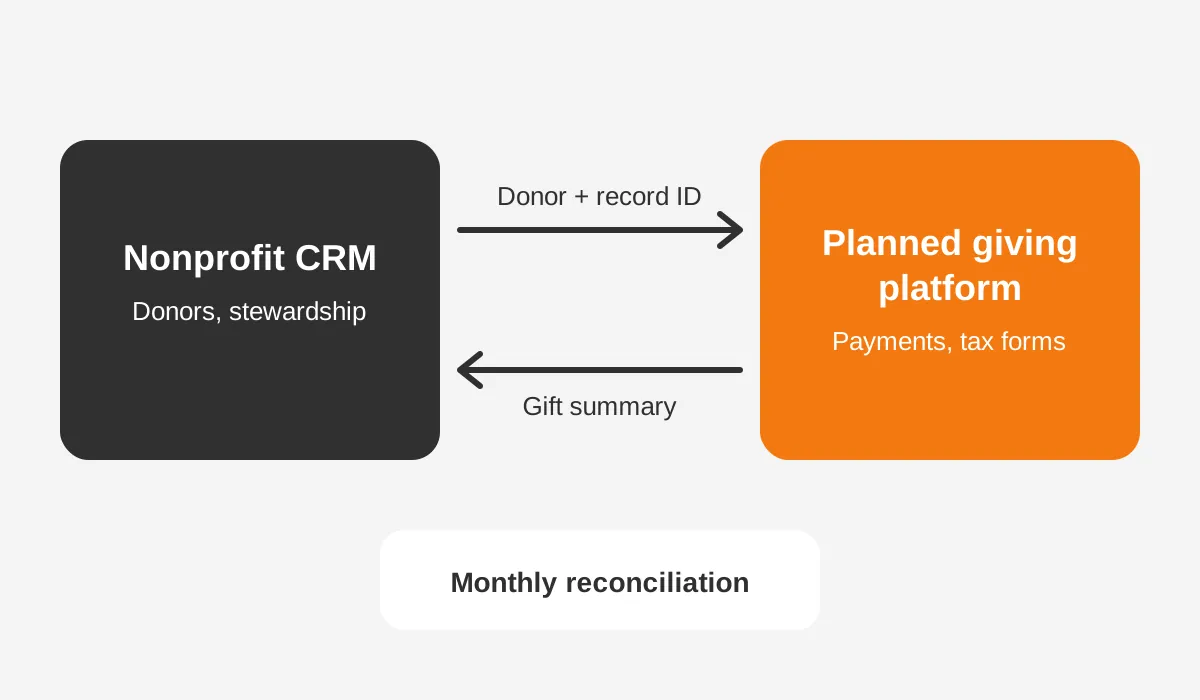
The record ID is the link that keeps both systems in step. Store it in a dedicated field on both sides, never in a notes field.
The ID matters most during matching. Without it, staff match donors by name, and a widow listed under two surnames becomes two people.
Integration can be a native connector, a scheduled file export or a middleware flow. The right method depends on gift volume and on the APIs each vendor offers. Unboxx's CRM integration services scope the connection, map the fields and build the reconciliation report.
Moving historic planned gift data needs the same care as any donor migration. Clean the records before import, and map each gift type to the right fields. The steps match those in Unboxx's guide to moving donor data into a nonprofit CRM.
Who Owns Planned Giving Data in a Nonprofit?
Planned giving data has three owners: the planned giving officer, the finance team and the CRM administrator. Each owns a different part, and gaps appear where nobody owns the handoff.
The planned giving officer owns the relationship record: intentions, stewardship notes, legacy society status and estimated values.
Finance owns the gift contract, meaning annuity payments, trust accounting, reserve reports and tax forms. All of it lives in the planned giving platform or with an administrator.
Fields, record types, reports and the integration belong to the CRM administrator.
Write the handoffs down. When an estate notice arrives, the officer updates the CRM and finance opens the estate file. The admin confirms that the realized gift closes the expectancy.
A one-page process document prevents a $500,000 gift from appearing twice in board reports. Review it each year, and again whenever a role changes hands.
A review of the current nonprofit CRM setup is a sensible place to begin. The CRM for nonprofits page explains how Unboxx structures fundraising data, planned gifts included.
Frequently Asked Questions
Can a nonprofit CRM replace a planned giving platform?
A nonprofit CRM can replace a planned giving platform only for bequest-focused programs. It tracks intentions, stewardship and estimates well. It cannot calculate annuity rates, schedule annuity payments or produce 1099-R forms. Charities with gift annuities or trusts still need dedicated software or an administrator.
What is a planned giving management tool?
A planned giving management tool is software that supports deferred gifts from first conversation to final settlement. Depending on the product, it produces gift illustrations, hosts web calculators, administers annuity payments and tracks bequests through estate settlement. It usually connects to the charity's donor CRM for contact data.
How do you track bequest intentions in a CRM?
Track bequest intentions in a CRM with a planned gift record. It stores the gift type, estimated value, confidence level and document status. Link it to the donor and flag legacy society members. Keep it out of the annual pipeline so estimates never distort current-year reports.
Why do charities report planned gifts separately?
Charities report planned gifts separately because bequest intentions are revocable and their timing is unknown. A bequest estimate can change or disappear before the donor dies. Mixing estimates with cash pledges inflates the pipeline, so boards see planned giving as a separate long-term figure.
Who needs planned giving software in a small nonprofit?
In a small nonprofit, the development director and finance lead need planned giving software once the charity issues gift annuities. Without annuities, the development director can run a bequest program from the CRM. A low-cost will-writing or calculator tool can support donor marketing.
Which Planned Giving Platform Setup Fits Your Team?
The right setup depends on the gifts you accept. A bequest program runs well inside the CRM. Gift annuities and trusts call for a planned giving platform connected to it. Either way, the CRM stays the home of the donor relationship.
Unboxx designs planned gift tracking, integrations and reporting for Salesforce, HubSpot and Dynamics 365. Weighing a planned giving platform against your CRM module? Schedule a consultation and get a clear recommendation for your program.
Let's create something out of this world together.
Have a project in mind? Contact us for expert design and development solutions. Let's discuss how we can help grow your business.
Ready to Unboxx Your Potential?
Build smarter systems. Automate faster. Scale confidently.