
A gift officer's portfolio is only as good as the list behind it. The Fundraising Effectiveness Project (GivingTuesday, April 2026) found donor counts fell 3.6% in 2025, even as dollars rose 5.0%. With fewer donors giving, each major gift prospect carries more weight.
Yes, a nonprofit can buy AI donor prospecting software separately and keep its current CRM. Most tools sit beside the CRM and score every record. They write those scores back into fields your gift officers already use. The CRM stays the system of record, and the daily workflow barely changes.
Key Takeaways
- AI donor prospecting software usually works as a scoring layer that syncs results into your existing CRM.
- Confirm the integration method, the fields it writes back and the refresh schedule before you sign.
- A 90-day pilot on one gift officer portfolio shows whether the scores change real decisions.
Can You Buy AI Donor Prospecting Software Separately?
You can buy AI donor prospecting software as a standalone subscription, and most vendors expect that. They sell to nonprofits running Raiser's Edge NXT, Salesforce, Bloomerang, Virtuous or Microsoft Dynamics 365. Replacing the CRM is not a condition of the purchase.
The reason is simple economics for the vendor. A prospecting tool that only worked inside one CRM would cap its market. So the larger vendors build connectors to the donor management system you already run.
DonorSearch by EverTrue states it integrates with more than 40 nonprofit CRMs and fundraising platforms. It names Salesforce, Blackbaud, Bloomerang, Virtuous and Microsoft Dynamics 365. Its page also says scores and profiles sync automatically, without manual exports.
BWF's Donor AI Essentials package takes the same approach. BWF says its scores are delivered through the partner platforms an organization already uses. It names Raiser's Edge NXT and the Salesforce Nonprofit Success Pack, plus Slate for Advancement through an API.
Buying separately does carry one trade-off. The AI sees your data through a connector, so freshness depends on how often that connector runs.
Separate purchase also suits nonprofits that are not ready for a CRM migration. A migration takes months and touches every report and workflow. Adding AI donor prospecting software to the current CRM delivers ranked lists in weeks instead.
So the real choice concerns the integration model. Match it to your team, your data quality and your budget for fundraising AI. Then judge AI donor prospecting software on that basis.
What Does AI Donor Prospecting Software Score?
AI donor prospecting software scores each record on capacity, likelihood to give and timing. Capacity comes from wealth screening. Likelihood comes from predictive donor scoring trained on giving history and engagement data.
Wealth screening matches your records against outside data such as real estate, business affiliations and stock holdings. The result is an estimate of what a person could give. It says nothing about whether the person wants to give to you.
Propensity scores cover the other half. A donor propensity model looks at your own giving history, event attendance, email opens and recurring gifts. It ranks who is most likely to respond to a specific ask in a specific period.
Vendors package these scores in different ways. EverTrue lists three DonorSearch tiers:
- Core: one national model, the Most Likely to Raise score, built on 800+ data points.
- Enhanced Core: five national models covering Acquisition, Retention, Sustainer, Upgrade and Major Gift Potential.
- DonorSearch Ai: custom models trained on your own data, layered on 850+ data points.
Dataro focuses on propensity scores for appeals, recurring giving propensity and gifts in wills. Its ProspectAI product scores new people and organizations worth outreach. BWF trains its Donor AI models on each organization's own data and updates them monthly.
For a major gift officer, the most useful output combines both views. High capacity with low affinity is a cultivation project. High affinity with modest capacity may be a strong mid-level or planned giving prospect.
Planned giving prospects often hide in this group. Loyal donors who give small amounts for ten years rarely show high capacity. AI donor prospecting software that scores legacy propensity can surface them for a planned giving conversation.
Vendor accuracy claims need testing. EverTrue reports 81% prediction accuracy in donor retention for DonorSearch Ai, but the page gives no method or sample. Ask any vendor how accurate AI donor scoring is on a holdout set of your own past donors.
The test is straightforward. Score donors as they looked two years ago, then compare scores with who gave since. Good AI donor prospecting software should rank past major donors near the top of that list.
How Do Scores Reach Your Current CRM?
Scores reach your current CRM through one of three routes: a native app, an API sync or a file import. The route decides how fresh the scores are and how much admin work they create.
- Native app or managed package: the vendor installs fields and objects inside the CRM, such as a Salesforce package. Scores land on the contact record directly.
- API integration: the vendor pulls records, scores them and pushes results back on a schedule. BWF connects to Slate for Advancement this way.
- CSV import: your team exports records, the vendor returns a scored file, and someone imports it. This is the slowest route.
The Blackbaud ENGAGE blog (November 2026) names the weakness of separate tools. It says such tools connect through periodic exports, imports or refresh cycles. A score refreshed quarterly can miss a donor who gave last week.
Get the data sync details in writing from every vendor. Which fields does it read? Which fields does it write? How often does the job run, and who sees an error when it fails?
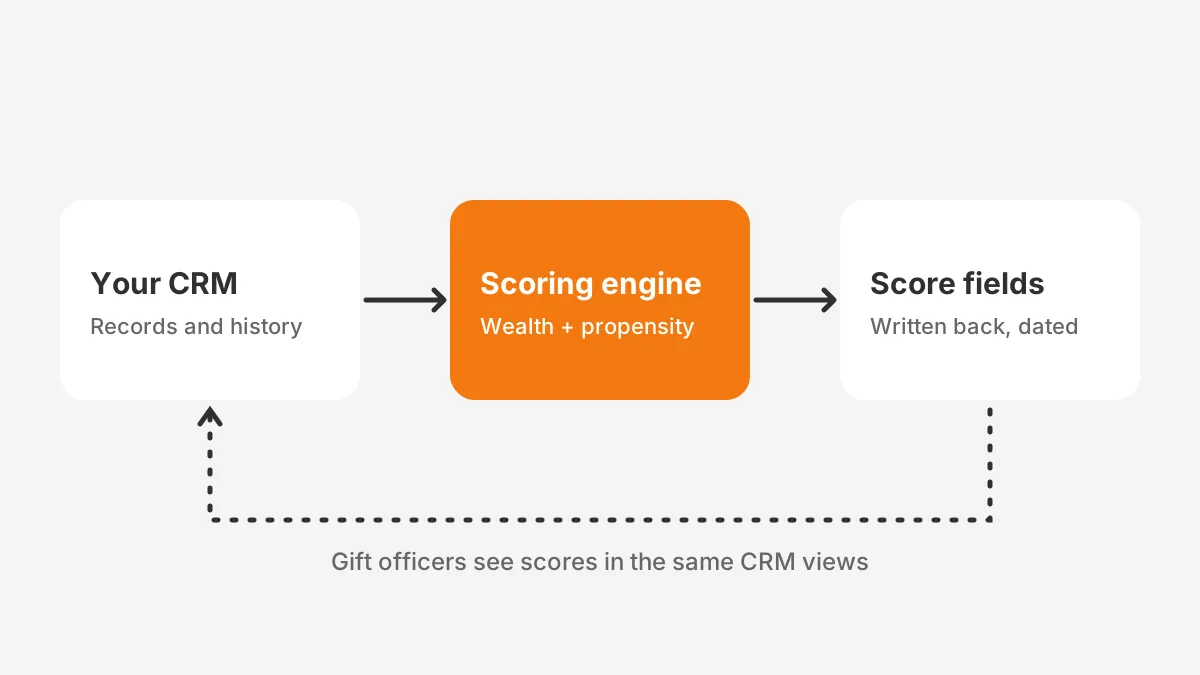
A clean write-back puts each score in its own custom field with a date stamp. That lets you filter views, build reports and track score changes over time. It also keeps the CRM as the single source of truth.
Plan the field names before the first sync. A naming pattern such as "AI Capacity Score" and "AI Score Date" keeps reports readable. It also makes clear which values came from AI donor prospecting software and which came from staff.
Clean the data before any sync starts. Duplicate records and old addresses lower match rates for wealth screening. The Unboxx guide to moving donor data into a nonprofit CRM covers the cleanup steps worth doing first.
Which CRMs Do Prospecting Tools Connect With?
Prospecting tools connect with the major nonprofit CRMs, but depth varies by pair. A vendor may list your CRM and still offer only a file import for it. Check the specific connector, not the logo on a website.
The table below summarizes what each vendor page stated when fetched in November 2026. It is a starting point for your own questions, not a ranking.
| Vendor | CRMs named on its page | How results arrive | Model basis |
|---|---|---|---|
| DonorSearch by EverTrue | Salesforce, Blackbaud, Bloomerang, Virtuous, Microsoft Dynamics 365 | Automatic sync, no manual exports | National models plus custom models |
| BWF Donor AI Essentials | Raiser's Edge NXT, Salesforce NPSP, Slate for Advancement | Delivered into partner platforms; Slate by API | Trained on your own data, monthly updates |
| Dataro | Salesforce, Blackbaud, Microsoft Dynamics, HubSpot (logos) | Pushes outputs back into the workflow | Propensity models and ProspectAI |
| Blackbaud Development Agent | Raiser's Edge NXT only | Built inside the CRM | Native agent, no exports |
Three patterns stand out. DonorSearch claims the widest CRM integration list. BWF names Raiser's Edge NXT and the Nonprofit Success Pack directly. Blackbaud's agent works only inside its own CRM.
HubSpot users have fewer named options. Dataro shows a HubSpot logo, but most prospect research tools list Salesforce and Blackbaud first. A HubSpot nonprofit should ask for a live demo on a HubSpot portal. The demo should show which property stores each score and whether workflows can trigger on it.
Raiser's Edge NXT users face the native-versus-separate choice most directly. Blackbaud now offers its own agent, while BWF and DonorSearch both integrate with the platform. A Raiser's Edge shop can compare both routes on the same donor data.
Salesforce users have the most choice. Salesforce also markets its own Agentforce subagents for Nonprofit Cloud, including prospect research. That gives Salesforce shops a native path alongside third-party AI donor prospecting software.
If you are still choosing the CRM itself, compare platforms first. The Unboxx nonprofit CRM software comparison covers general and donor-specific systems side by side.
How Do Gift Officer Workflows Stay the Same?
Gift officer workflows stay the same when scores appear inside the views officers already use. The officer opens the same portfolio, the same contact record and the same task list. The difference is a ranked order and a reason to call.
Moves management does not change either. Identification, qualification, cultivation, solicitation and stewardship stay in the CRM. AI donor prospecting software only feeds the identification and qualification stages with better lists.
A typical weekly rhythm looks like this:
- Monday: the officer filters the portfolio by top propensity score and recent score changes.
- Midweek: the officer runs a quick manual screen on new names before any outreach.
- Friday: the prospect management lead reviews additions and removals with the officer.
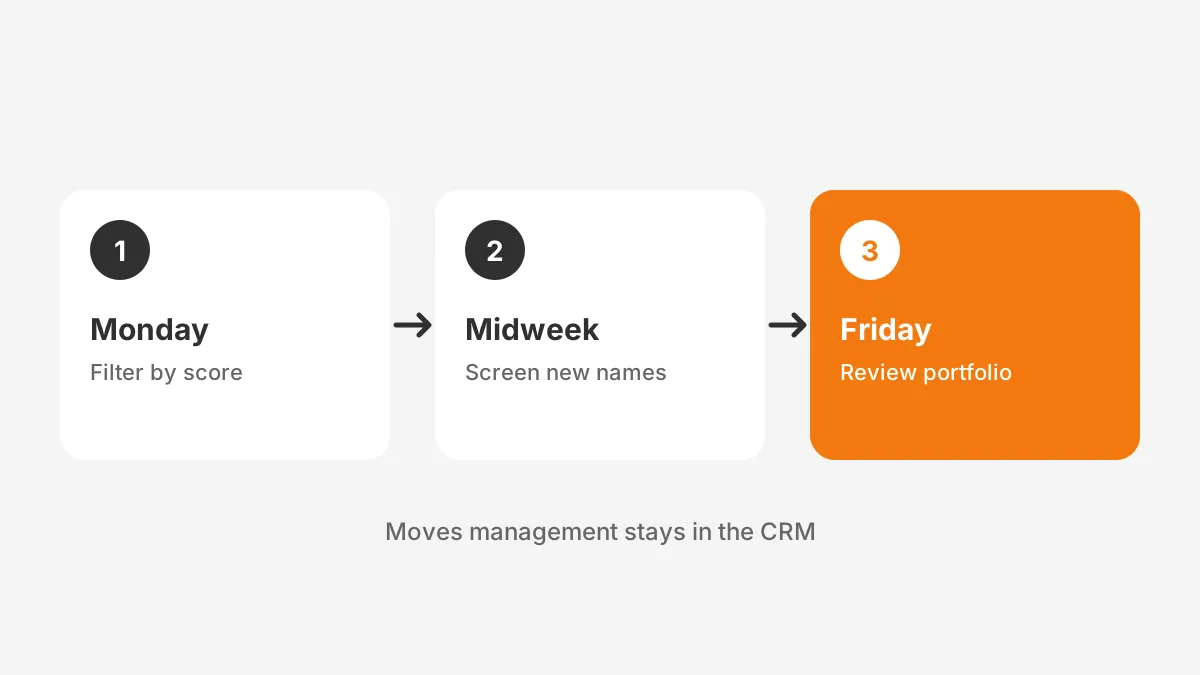
A DonorSearch guest post on the Virtuous blog recommends this order of work. It advises starting with AI-generated lists, then running a quick manual screen to confirm them. The officer keeps judgment; the software narrows the search.
Portfolio size is a real constraint. Blackbaud notes that some tools cap portfolios around 1,000 prospects per agent. Check that cap against your largest portfolio before you buy.
Development operations staff carry the hidden load. They map fields, schedule the sync, and fix records the vendor cannot match. Budget their hours into the project, not only the license.
Who Should Own AI Donor Prospecting Software Internally?
The development operations lead should own AI donor prospecting software, with the major gifts director as the business sponsor. Operations owns the data and the sync. The gifts director owns how scores shape portfolios.
Shared ownership fails when nobody checks the sync. A clear split of duties avoids that problem:
- Development operations: field mapping, sync schedule, error checks and data hygiene.
- Major gifts director: portfolio rules, score thresholds and quarterly portfolio review.
- Prospect researcher: manual screens, briefing profiles and score disputes.
- Gift officers: outreach, contact reports and feedback on score quality.
Write these duties into a one-page operating note before the contract starts. The note should name who approves a new score field and who can change a threshold. It should also say how a gift officer flags a score that looks wrong.
Prospect management rules need one update. Decide whether a high score alone can move a name into a portfolio. The alternative is researcher approval first. Starting with researcher approval, then relaxing it after the pilot, limits the risk.
Small shops may have one person in every role. In that case, AI donor prospecting software should save research hours, not add admin hours. If the sync needs weekly fixing, the software costs more time than it returns.
The major gift tracking setup in your CRM shapes ownership too. Stages, contact reports and proposal records give the scores a place to drive action.
When Does a Native CRM Agent Make More Sense?
A native CRM agent makes more sense when your CRM vendor ships one. It fits best when all your data lives in that CRM. In that case, separate AI donor prospecting software adds a sync job without adding much insight.
Blackbaud's case for native AI rests on three points from its blog. Native tools need no exports and have no sync delays. They log engagement directly in the CRM. Its Development Agent runs inside Raiser's Edge NXT, with Enterprise Fundraising CRM support expected mid-2027.
That argument has merit, and it comes from a vendor selling the native option. Separate AI donor prospecting software still wins in these cases:
- Your CRM has no native prospecting agent yet.
- You need outside wealth screening data the native agent lacks.
- You plan to change CRMs and want scores that survive the move.
- You want a second opinion on the native agent's rankings.
Cost belongs in this decision too. Native agents may be tied to platform licensing by user or edition. Ask whether standalone AI donor prospecting software is priced by records screened; none of the vendor pages reviewed listed prices.
Some teams weigh AI inside the CRM against a bolt-on layer. The AI-native CRM solutions Unboxx designs start with that question. The right answer depends on where your data lives today.
What Should You Check Before Signing a Contract?
Check five things before signing for AI donor prospecting software. They are integration depth, data use terms, model transparency, security and exit rights. Each one protects the CRM you are keeping.
Start with integration depth. Request the list of fields read and written, the refresh schedule and the error log location. Find out whether the vendor or a third party built the connector.
Then read the data use terms. Confirm whether your donor data trains models used for other clients. Check donor privacy promises on your website and make sure the contract matches them.
Model transparency means the vendor can explain why a score is high. A gift officer will not call a prospect on a number alone. Ask for the top factors behind each score.
Pricing terms deserve the same scrutiny. Find out how donor prospecting software pricing scales as the database grows. Check whether rescreening the whole file costs extra each year.
Security should be documented, not described. DonorSearch states it is SOC 2 Type II certified. Ask every vendor for its current SOC 2 compliance report rather than a summary.
Donor privacy deserves a written answer as well. AI donor prospecting software processes personal and financial details about real people. The vendor should explain where data is stored, who can see it and how long it is kept.
Exit rights matter because scores live in your CRM. Confirm you keep historical scores after cancelling. Confirm the vendor deletes your uploaded records within a stated period. A final export of every score with its date keeps trend reports working after the contract ends.
A short scoring sheet keeps the comparison honest. Rate each vendor from one to five on these five checks, plus price and support. Teams that ran a formal nonprofit CRM selection can reuse that scoring format here.
How Do You Run a 90-Day Pilot?
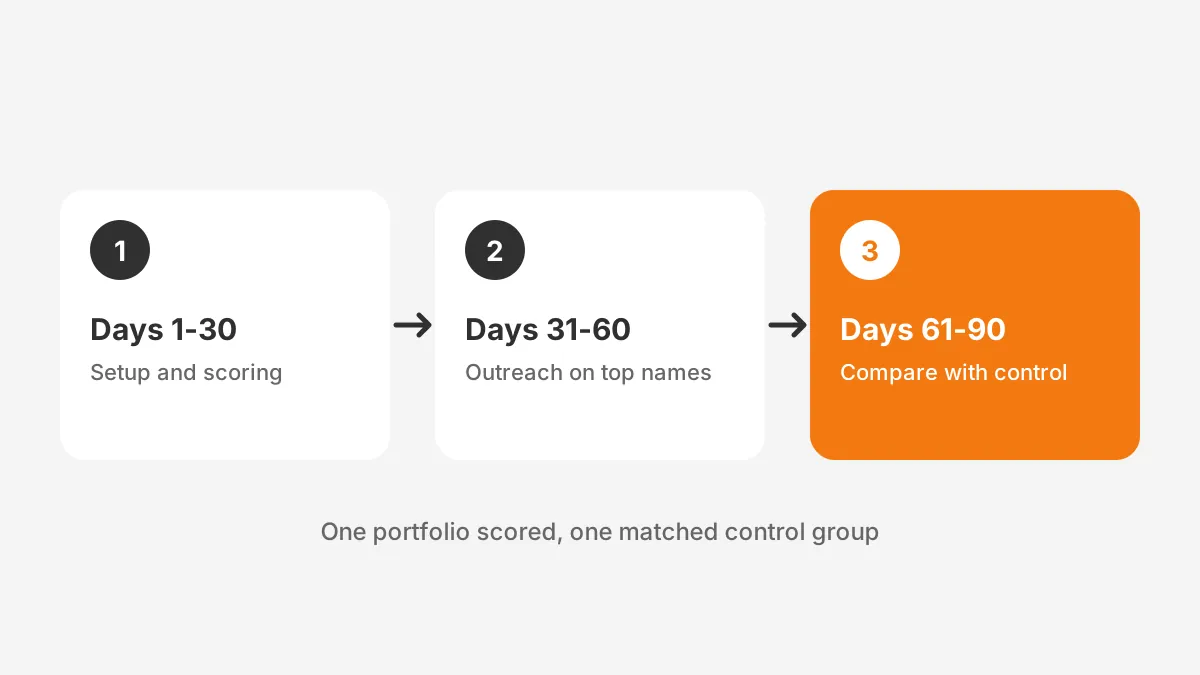
Run a 90-day pilot by scoring one portfolio, acting on the top names and comparing results with a control group. Thirty days of setup, thirty of outreach and thirty of review is a workable split.
Days 1 to 30 cover setup. Clean the records, map fields, connect the sync and score the database. Pick one gift officer portfolio and a matched group the officer does not change.
Days 31 to 60 cover outreach. The officer contacts the top-scored names first and logs every touch in the CRM. The control group follows the usual plan.
Days 61 to 90 cover review. Compare meetings booked, proposals made and gifts closed between the two groups. Ask the officer whether the scores changed who got the first call.
Write the success measure down before day one. A pilot of AI donor prospecting software without a target invites a vague verdict. One clear goal, such as twice the meeting rate, keeps the review honest.
Here is a worked example with assumed figures, for illustration only. A nonprofit scores 40,000 records and gives one officer 150 top-scored prospects. If 12 of those book meetings versus 6 in the control group, the pilot shows a clear signal.
Major gift pipeline results take longer than 90 days. Treat meetings and proposals as the early measures. Track closed gifts and donor retention over the following year.
Retention gives the longer view. The Fundraising Effectiveness Project put overall donor retention at 43.3% in 2025, up from 43.1%. Compare your scored group against your own baseline, not only the sector figure.
The pilot also tests the connector. If the sync fails twice in 90 days, that is a finding. It predicts the admin load a full rollout of AI donor prospecting software would bring.
Frequently Asked Questions
Is AI prospecting worth it for small nonprofits?
It can be, with enough giving history for a model to learn from. Someone also has to act on the scores. Donor prospecting software for small nonprofits pays off through better first calls. Without staff time for outreach, scores sit unused in the CRM.
What is wealth screening?
Wealth screening matches donor records against outside data to estimate giving capacity. Typical sources include property, business affiliations and public stock holdings. It shows what a person could give. Propensity scores from your own data show how likely that person is to give to your organization.
How does donor prospecting software integrate with a CRM?
Donor prospecting software integrates through a native app, a scheduled API connection or a CSV file exchange. The best connectors read records, score them and write results into custom fields. Ask each vendor how often the sync runs and where errors appear.
Do gift officers need training on AI scores?
Gift officers need a short training session on what each score means and what it ignores. They should know which data feeds the model. They should also know to confirm every new name with a quick manual check before reaching out.
Can AI tools replace prospect researchers?
AI tools for major gift officers shorten research time, but they do not replace prospect researchers. Researchers still verify identities, read context and write briefing profiles. The software ranks large lists quickly, so researchers spend their hours on the names that matter most.
Is AI Donor Prospecting Software Right for Your Nonprofit?
AI donor prospecting software is right for your nonprofit under three conditions. Your CRM data is clean, a gift officer will act on the scores, and the vendor proves a solid sync. You keep the system of record and gain a ranked view of who to call next.
Unboxx helps nonprofits connect scoring tools to Salesforce, HubSpot and other CRMs through its CRM for nonprofits work. To plan a pilot of AI donor prospecting software on your current CRM, schedule a consultation with the Unboxx team.
Let's create something out of this world together.
Have a project in mind? Contact us for expert design and development solutions. Let's discuss how we can help grow your business.
Ready to Unboxx Your Potential?
Build smarter systems. Automate faster. Scale confidently.