
How Insurance Producers Use CRM for Renewals and Cross-Sell
A renewal date sits in the agency management system. The producer only notices it when the client calls about a cheaper quote. In Vertafore research reported by PropertyCasualty360 (2020), nearly 48% of independent agencies lost 15% to 20% of renewals each year.
The fix is a working insurance renewal pipeline. Insurance producers use CRM to turn each expiring policy into a renewal opportunity. Each one gets a stage, an owner and a due date. The same records show which clients hold one policy, so cross-sell starts from the existing book of business.
Key Takeaways
- Insurance producers use CRM to track renewals per policy, starting 60 to 120 days before each X-date.
- Single-policy clients renew less often than multi-policy clients, so monoline accounts form the first cross-sell list.
- The AMS stays the system of record, and the CRM reads policy data from it through a two-way sync.
How Do Insurance Producers Use CRM Day to Day?
Insurance producers use CRM as a daily work queue for the existing book, as well as for new prospects. The CRM shows which policies expire soon, which clients have coverage gaps and which tasks are overdue. The agency management system (AMS) still issues policies and holds the accounting.
A typical morning shows how insurance producers use CRM in four steps, each tied to one view or report.
- Review the renewal queue: policies expiring in the next 120 days, sorted by premium.
- Work open cross-sell opportunities on households with one line of business.
- Log calls and emails, so the customer service representative (CSR) sees the same history.
- Check the pipeline report for renewals stuck in one stage too long.
This routine matters because the existing book carries most agency revenue. Insurance Thought Leadership (2026) reported that about half of the average firm's customers hold a single policy. Those clients renew at roughly 77%, against about 85% for clients with five or more policies.
When insurance producers use CRM this way, renewal and cross-sell work stop depending on memory. The CRM for insurance agents guide covers platform choice. This article covers the daily workflow after the platform is chosen.
What does a good renewal queue show?
A good renewal queue shows the policy, the client, the X-date, the premium and the current stage on one line. A list view sorted by days left, then premium, is how insurance producers use CRM for this. The highest-value renewal with the least time left sits at the top.
The queue should also flag accounts with an open claim or a recent complaint. Those clients are more likely to shop, so the producer calls them first. A CSR can add the flag, and the producer sees it the next morning.
Why Does a Renewal Pipeline Need Its Own Stages?
A renewal pipeline needs its own stages because a renewal is a different sale from new business. The client already knows the agency, and the carrier has priced the risk. The main threat is a competitor's quote. Stages such as Qualified and Proposal do not describe that work.
Separate stages also make retention measurable. The same Vertafore data put median agency retention at 82%, with half of agencies between 74% and 86%. An agency cannot tell where it sits in that range unless each renewal ends with a clear outcome.
A practical renewal pipeline uses five stages:
- Upcoming: the policy is inside the renewal window, and no one has acted yet.
- Review: the producer checks claims, exposure changes and the carrier's renewal offer.
- Remarket: the premium rose sharply or coverage changed, so the producer shops other carriers.
- Client decision: the client has the recommendation and a decision date.
- Closed: renewed, rewritten with another carrier, or lost with a reason code.
Stage history is where insurance producers use CRM data to find stalled renewals. A renewal that sits in Review three weeks before the X-date is a risk. A lost renewal with a reason code, such as price or service, shows what to fix next season.
How do commercial and personal lines renewals differ?
Commercial renewals need more lead time than personal lines renewals. A commercial account may need updated payroll, revenue, vehicle schedules and loss runs before a carrier will quote. A personal auto renewal often needs only a check on drivers and vehicles.
The pipeline can stay the same for both, while the timing changes. A line-of-business field sets the start date of each renewal opportunity. One pipeline report then covers the whole agency, with commercial and personal lines filtered apart. Insurance producers use CRM record types for this split.
How Should a CRM Track Every Policy's X-Date?
A CRM should track the X-date on each policy record, not once on the client record. The X-date is the expiration date of a policy. A household with auto, home and umbrella coverage has three X-dates, and each one needs its own renewal opportunity.
Rework's 2026 insurance CRM buying guide makes the same point. Its checklist asks for automated alerts by policy rather than by client, starting 60 to 90 days out. A single date field on the account hides two of those three renewals.
Each policy record needs a short list of fields. These fields drive the renewal queue, the reports and the cross-sell views.
| Field | Why it matters | Source system |
|---|---|---|
| Policy number | Links the CRM record to the AMS and to commission data | AMS |
| Line of business | Shows coverage gaps for cross-sell | AMS |
| Carrier | Supports remarketing decisions | AMS |
| Effective and expiration dates | Set the renewal window | AMS |
| Annual premium | Ranks renewals by value | AMS |
| Producer and CSR | Assign ownership | CRM |
| Renewal stage | Shows pipeline status | CRM |
| Lost reason | Explains churn | CRM |
Most of these fields come from the AMS, so producers should not rekey them. Rekeyed dates drift, and a wrong X-date means a missed renewal. The guide to migrating insurance client data into a CRM explains how to map these fields during setup.
Household grouping is the other half of the data model. Each policy links to a person or business, and each person links to a household. Reports then roll up premium, policy count and open renewals.
With households in place, insurance producers use CRM rollups to see the whole relationship before a call.
What Belongs in a Renewal Pipeline Workflow?
A renewal workflow belongs in the CRM as a timed sequence that starts well before the X-date. Applied Systems documents one model in its Opportunity Automation help page. Administrators set criteria such as policy type, premium range and days prior to expiration.
Applied's automation then creates renewal opportunities for expiring policies. Each one lands in the producer's My Opportunities queue ahead of expiration. The default lead time is 30 days, and the schedule can run daily, weekly or monthly.
Thirty days is short for commercial lines or for accounts that need remarketing. A tiered workflow gives the producer time to act:
- 120 days out: create the renewal opportunity for commercial and large personal accounts.
- 90 days out: review claims, payroll or vehicle changes with the client.
- 60 days out: request carrier renewal terms and decide whether to remarket.
- 30 days out: present options and confirm the decision date.
- 7 days out: escalate any open renewal to the agency principal.
NetSuite's 2026 guide to CRM for insurance describes renewal reminders at 60 and 30 days. The tiers above extend that model for accounts where remarketing takes longer. Smaller personal lines policies can start at 60 days.
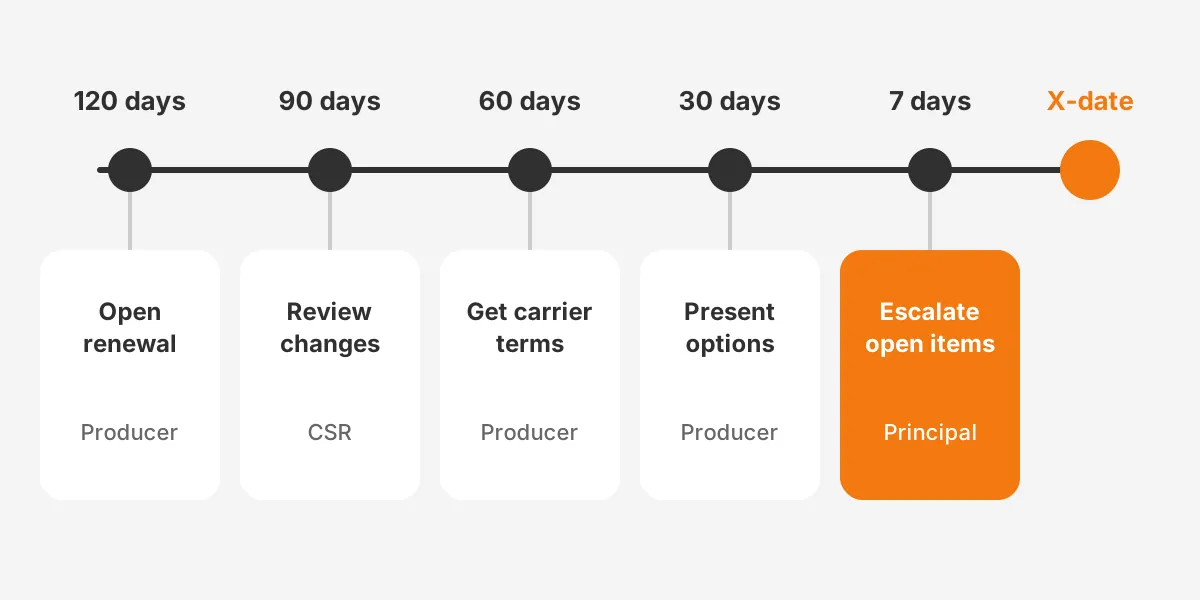
Each checkpoint becomes a task or an email template, which is how insurance producers use CRM to hold the timeline. The CSR can handle the 90-day data request, while the producer owns the 60-day decision. Clear ownership keeps the renewal from bouncing between two inboxes.
What should the renewal review call cover?
The renewal review call should cover changes, coverage and price, in that order. The template below is how insurance producers use CRM to keep every renewal call on the same checklist:
- Confirm changes to drivers, property, payroll, revenue or locations.
- Walk through current limits and any gaps the producer sees.
- Present the carrier's renewal terms and any remarketed options.
- Ask about other coverage the client holds elsewhere.
The answers go into structured fields, not only into notes. A field for coverage held elsewhere feeds the cross-sell gap matrix directly. Free-text notes cannot feed a report.
How Do Insurance Producers Use CRM for Cross-Selling?
Insurance producers use CRM for cross-selling by filtering the book for coverage gaps. The simplest filter is the monoline account, a client with one policy. The Insurance Thought Leadership figures above show why this list comes first. Single-policy clients renew less often than clients with five or more policies.
Account rounding is the industry term for adding lines to an existing client. A CRM supports account rounding with three views:
- Gap matrix: each household as a row and each line of business as a column, with empty cells marked.
- Life-event triggers: a new vehicle, a new home, a new hire or a new business location.
- Renewal pairing: a cross-sell conversation scheduled inside the renewal review.
NetSuite gives a concrete example of a trigger. The CRM prompts an agent to suggest home insurance once the client's auto policy takes effect. The same logic works for umbrella coverage after a second vehicle, or cyber coverage when a business client adds staff.

Pairing cross-sell with the renewal review works because the producer already has the client on a call. The review covers changes in the client's life or business. Those changes are the natural opening for a new line of coverage.
Here is a worked example with assumed figures, not industry data. An agency has 1,000 households, and 500 of them hold one policy. The producer team rounds 10% of those monoline households each year.
That adds 50 multi-policy clients a year, and each one moves into the higher-retention group. Gains like this explain why insurance producers use CRM on the existing book as well as on new leads.
Which cross-sell triggers should the CRM automate?
Automate the triggers that come from data the agency already holds. A new vehicle added by endorsement, a home purchase date or a business adding employees all appear in policy changes. Each change can create a task for the producer with a suggested line of coverage.
Keep the trigger list short at the start. Three triggers that producers act on beat twelve that fill the task list. When insurance producers use CRM triggers that fire too often, they start to ignore them.
What Software Helps Agencies Manage Renewals More Proactively?
Agencies manage renewals more proactively with one of four software setups. Each setup puts the renewal queue in a different place. The right choice depends on agency size, lines of business and how much custom workflow producers need. Each option changes where insurance producers use CRM tools during the day.
| Setup | Examples | Strength | Limit |
|---|---|---|---|
| AMS with pipeline tools | Applied Epic, Vertafore AMS360, HawkSoft | Policy data is native | Limited custom workflow |
| Combined AMS and CRM | EZLynx, AgencyBloc | Built for agency processes | Less flexible outside insurance |
| Insurance CRM layer | InsuredMine, GloveBox | Adds automation on top of an AMS | Another subscription and sync |
| General CRM with AMS integration | Salesforce, HubSpot | Full control of stages, reports and AI | Needs integration and admin work |
The examples follow Rework's 2026 grouping of agency software. A useful decision rule follows from the table. If producers need custom stages, territory rules or AI scoring, a general CRM is the stronger fit. If they need only reminders, the AMS tools may be enough.
Unboxx sets up CRM for insurance agencies on Salesforce and HubSpot, with the AMS kept as the system of record. That setup suits agencies whose producers sell across commercial and personal lines.
Whatever the setup, insurance producers use CRM software well only when the renewal queue is the default screen. A tool that hides renewals behind three clicks will not change daily habits. Test that during the demo with a real producer, not only with the agency principal.
How Should the CRM Connect to the AMS?
The CRM should connect to the AMS through a two-way sync. The AMS stays the system of record for policies. Rework describes the AMS as the system that binds coverage, processes endorsements and generates ACORD forms. The CRM handles the sales and relationship work around those policies.
NetSuite describes the result of a working sync. When a policy takes effect or is canceled in the AMS, the change shows in the CRM. Producers then never work from a stale renewal list.
Test the sync on one producer's book before go-live. Compare the CRM renewal queue with the AMS expiration report for the next 90 days. Every policy should appear once, with the same X-date and premium. Fix each mismatch before automated tasks switch on.
A clean integration moves data in two directions:
- AMS to CRM: clients, policies, lines of business, carriers, premiums and expiration dates.
- CRM to AMS: renewal decisions, new opportunities that become quotes, and activity notes.
- Commission data: tied to the policy number, so producer reports match accounting.
With this split, insurance producers use CRM screens for selling, and service work stays in the AMS.
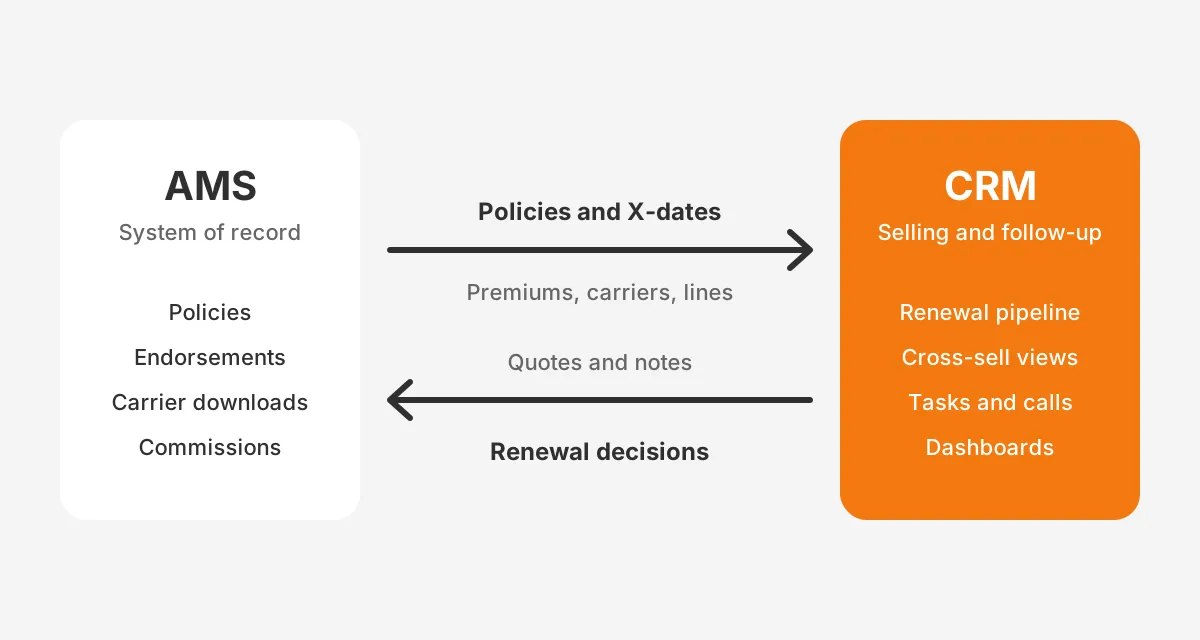
The Unboxx CRM integration services team plans these field maps before any data moves. A policy number is the safest match key, because client names repeat and change. Applied's own automation sets opportunity defaults so that each new opportunity syncs back to Applied Epic.
Carrier downloads belong in the AMS, not the CRM. The AMS receives policy changes from carriers, and the sync passes them on. When insurance producers use CRM records fed this way, the X-dates match what the carrier issued.
Which Reports Show Renewal and Cross-Sell Health?
Five reports show whether renewal and cross-sell work is healthy. Insurance producers use CRM dashboards to review them weekly, and agency owners review them monthly.
- Retention rate by producer: renewed policies divided by policies up for renewal in the period.
- Renewals by stage: open renewals in each stage, with days left to the X-date.
- Lost renewals by reason: price, service, coverage or the client's business closing.
- Policies per household: the average count, and the share of monoline households.
- Cross-sell pipeline: open rounding opportunities by line of business and expected premium.
The monoline share is the leading indicator. If it falls each quarter, retention should follow, based on the single-policy and multi-policy figures above. The insurance sales CRM reporting guide shows how agency owners can lay out these dashboards.
Keep each report tied to an action. Insurance producers use CRM alerts for this, not a weekly export. A renewal with fewer than 30 days left and no stage change should create a task for the producer's manager. A report that triggers nothing becomes a screen nobody opens.
Can AI predict which renewals are at risk?
AI can rank renewals by risk when the CRM holds enough clean history. The Vertafore research cited earlier came from its RiskMatch retention prediction work, built on data from 3,700 agencies. It sorted policies into high, elevated and low risk groups.
Inside a general CRM, a risk score can use premium change, claims, policy count and recent service cases. Insurance producers use CRM risk scores to decide which renewals get a call before the carrier offer arrives. The score supports the producer's judgment and does not replace it.
What Mistakes Stall Renewal and Cross-Sell Programs?
Four common mistakes stall renewal and cross-sell programs, and each one has a direct fix.
- One X-date per client: create one renewal opportunity per policy instead.
- Rekeyed policy data: sync from the AMS, and lock the synced fields.
- No lost reasons: make the reason field required when a renewal closes as lost.
- Cross-sell as a separate campaign: build it into the renewal review instead.
A fifth issue is journey design across marketing and service. Some agencies add a separate orchestration tool too early. The comparison of a journey orchestration platform versus a CRM explains when the CRM alone is enough.
With these fixes in place, the pipeline reflects the real book, and insurance producers use CRM queues they trust. Managers can then coach from data instead of anecdotes.
Frequently Asked Questions
How far ahead should producers start a renewal?
Producers should start commercial renewals about 120 days before the X-date and personal lines renewals about 60 days before. The extra time covers exposure reviews and remarketing. A CRM workflow can create the renewal opportunity automatically at the right lead time for each line of business.
What is account rounding in insurance?
Account rounding means adding lines of coverage for an existing client. An example is home, umbrella or life insurance for an auto client. It raises premium per household and ties the client to the agency through more policies. A CRM finds rounding candidates by flagging monoline accounts.
Can a CRM replace an agency management system?
A CRM usually does not replace an agency management system. The AMS handles policy administration, endorsements, ACORD forms, billing and carrier downloads. The CRM manages pipelines, tasks, outreach and reporting. Most agencies connect the two, so the CRM reads policy data and the AMS stays the record.
Should the producer or the CSR own a renewal?
The producer should own the renewal outcome, and the CSR should own the preparation tasks. The CSR gathers exposure changes and carrier terms. The producer reviews them, decides whether to remarket and talks to the client. The CRM records both sets of tasks on one opportunity.
How long should a renewal pipeline be?
A renewal pipeline works well with four to six stages. A common set is Upcoming, Review, Remarket, Client Decision and Closed. Fewer stages hide where renewals stall. More stages add clicks without adding insight, so producers stop updating them and the reports lose accuracy.
How Can Unboxx Help Insurance Producers Use CRM Better?
Unboxx designs renewal pipelines, cross-sell views and AMS integrations on Salesforce and HubSpot for independent agencies and brokers. The work starts with the policy data model. Every X-date and line of business is checked before automation goes live.
In some agencies, insurance producers use CRM only for new business. A short review shows what the renewal side would need. Schedule a CRM consultation to map the renewal pipeline and cross-sell process.
Let's create something out of this world together.
Have a project in mind? Contact us for expert design and development solutions. Let's discuss how we can help grow your business.
Ready to Unboxx Your Potential?
Build smarter systems. Automate faster. Scale confidently.