
LP Data Migration: Support Options for a Fund CRM Switch
A fund CRM switch looks simple on a slide. Then the export lands. Six hundred investor entities arrive with split contacts, stale commitments and side letters stored as loose PDFs. Ark PES notes that legacy platforms still quote six to nine months for a fund systems switch (Ark PES, 2026).
LP data migration moves limited partner records, commitments, contacts and documents into a new fund CRM. Done well, investor reporting never breaks. Support for LP data migration comes from three places. They are the vendor's onboarding team, an implementation partner and your own staff.
Key Takeaways
- LP data migration support usually comes from the vendor onboarding team, an implementation partner and an internal data owner.
- Commitments, capital account balances and investor entities need reconciliation against the old system before cutover.
- A cutover at a quarter close with a planned parallel run protects LP reporting during the fund CRM switch.
What Is LP Data Migration?
LP data migration is the transfer of every limited partner record a general partner relies on into a new CRM. It covers who the investors are, what they committed, how to reach them and what they signed.
A fund CRM switch happens for 3 common reasons. The old private equity CRM cannot hold fund-level data. The firm outgrew spreadsheets in Microsoft Excel. Or a new investor portal needs cleaner inputs.
The scope differs from a sales CRM project. A sales team can lose an old lead and recover. A GP that loses a side letter term or a commitment amount can misreport to an investor. That is why LP data migration sits closer to fund operations than to marketing.
LP data also lives in more places than one system. Investor records sit in the old CRM. Capital accounts sit with the fund administrator. KYC documents often sit in a shared drive. The LP data migration plan has to name each source before anything moves.
Platforms such as Salesforce Financial Services Cloud, Intapp DealCloud and Affinity all accept LP data. Each one models it differently. The data model of the target decides how much reshaping the records need.
A venture capital CRM, for example, often centers on deal flow and founders. A private equity CRM adds fund vehicles and co-investors. Moving between the two means rebuilding relationships between records, not only copying rows.
What Support Is Available for LP Data Migration?
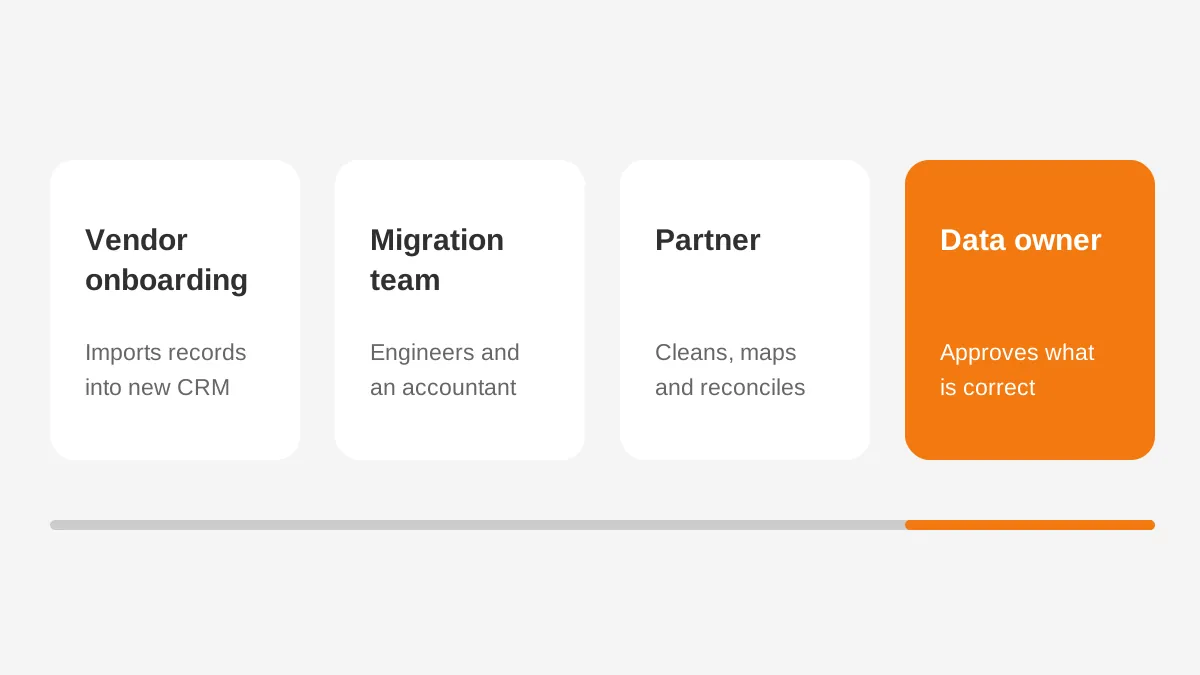
Support for LP data migration comes in 4 forms. They are vendor onboarding, a platform migration team, an implementation partner and internal staff. Most firms combine two or three of them.
Vendor onboarding teams
Most fund CRM vendors include onboarding in the subscription. Affinity says contacts, companies, deals and notes move in week 1. That work comes with dedicated support from its onboarding team (Affinity, 2026). Onboarding teams know their own import tools well. They rarely clean or reconcile the source data for you.
Platform migration teams
Fund platforms that also run administration go further. AngelList describes a dedicated migration team with product and engineering leads plus a dedicated accountant (AngelList). Its scope is narrow: US-domiciled venture capital funds with audited financials.
AngelList also lists the files it asks for. They include LPAs, financial statements, LP records, fund formation documents and access to the current administrator's systems. That list is a useful starting inventory for any LP data migration.
Implementation partners
An implementation partner works for the GP, not the vendor. The partner maps fields, writes transformation rules, runs test loads and checks the numbers. Affinity puts consultant rates for legacy CRMs at $150 to $400 per hour. A partner earns that fee on messy, multi-fund data.
A good partner also brings migration support for more than one platform. That matters when LP data comes from a CRM, an investor portal and an administrator at once.
Internal data owners
No outside team knows which investor contact is current. An internal data owner signs off each record set. That person usually sits in investor relations or fund operations. Without that owner, the migration team guesses.
Which LP Records Need to Move?
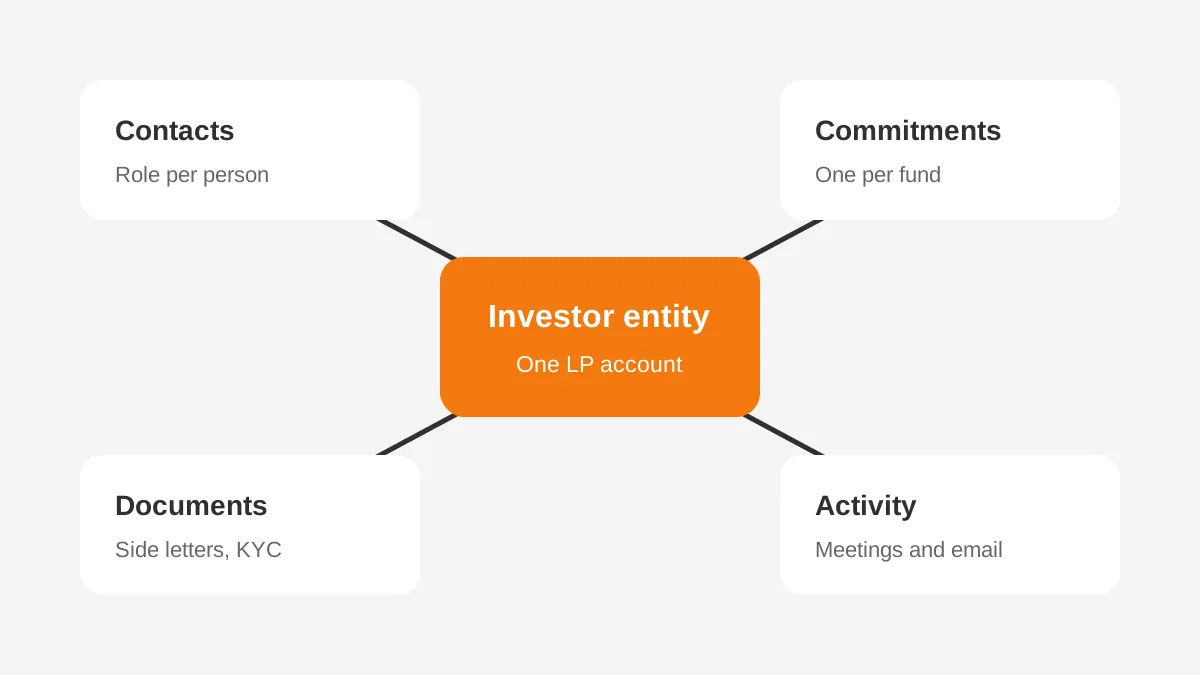
The LP records that must move are investor entities, contacts, commitments, balances, documents and interaction history. Leaving any group behind creates a gap that investor relations will feel first.
- Investor entities: the legal investing vehicle, its type, tax status and parent relationships.
- Contacts: signatories, relationship owners, assistants and reporting recipients, each with a role.
- Capital commitments: amount, fund, close date and any transfer history.
- Capital account balances: contributions, distributions and the current balance by fund.
- Documents: subscription documents, side letters, KYC documents and the LPA version each investor signed.
- Interaction history: meetings, calls, email threads and notes from the fundraising pipeline.
Ark PES lists the fund-side core as historical transactions, LP commitments, capital account balances and investment records. A CRM holds the relationship layer on top of those numbers. Both layers must agree after LP data migration.
Give custom fields their own inventory. Old systems collect fields that nobody uses, such as legacy rating scores. Review each custom field and decide to keep, merge or archive it before mapping starts.
Reporting preferences travel with each LP. An investor may want quarterly reporting through a named contact, in a set format, through the investor portal. Lose that rule and the next report goes to the wrong person.
Fundraising history is easy to skip and costly to lose. Notes from past closes show which LPs passed, why they passed and who introduced them. That context shapes the next raise, so move it with the rest of the LP data migration.
Limited partner records also carry consent and access rules. Some LPs restrict who may see their commitment size. Carry those permissions into the new fund CRM before any user logs in.
How Long Does a Fund CRM Migration Take?
A fund CRM migration takes between 2 weeks and 12 months. Platform, data quality and fund count decide where a project lands. Vendor claims vary, so plan from your own data.
Ark PES says standard implementations take two to four weeks for most mid-sized managers. Affinity says its typical implementation timeline is 60 days or less. Affinity also estimates 6 to 12 months for DealCloud and 3 to 6 months for Salesforce.
Those figures come from vendors describing themselves and rivals. Treat them as ranges, not promises. The real crm migration timeline depends on 3 inputs. Those are record count, number of source systems and the volume of duplicate records.
| Platform | Stated timeline | Source |
|---|---|---|
| Ark PES (fund operations) | 2 to 4 weeks for mid-sized managers | Ark PES, 2026 |
| Affinity | 60 days or less | Affinity, 2026 |
| Salesforce | 3 to 6 months | Affinity estimate, 2026 |
| Intapp DealCloud | 6 to 12 months | Affinity estimate, 2026 |
| Legacy fund platforms | 6 to 9 months | Ark PES quote, 2026 |
Here is a worked example with assumed figures. A GP with 3 funds, 420 investor entities and 1,100 contacts plans 10 weeks. Discovery takes 2 weeks and data cleansing takes 3. Test loads take 3 more, and the parallel run takes 2.
The same GP with clean, single-source data could finish in 5 weeks. The difference sits almost entirely in cleansing and reconciliation, not in the import itself.
Budget internal time as well. In this example, the data owner spends about 6 hours a week on reviews. Partners spend 2 hours a week on decisions. Those hours are part of the LP data migration cost.
How Do You Plan LP Data Migration?
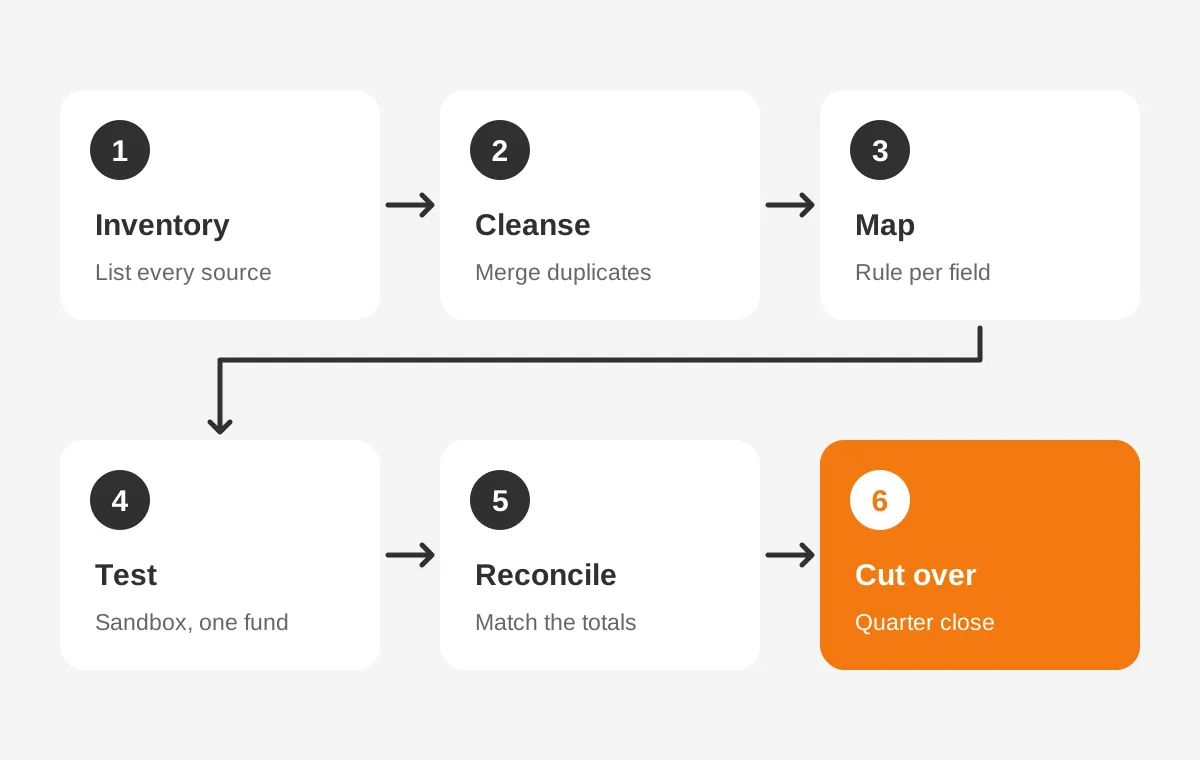
Plan LP data migration in 6 steps: inventory, cleanse, map, test, reconcile and cut over. Each step needs an owner and a sign-off before the next starts.
- Inventory every source: the old fund CRM, the fund administrator, the investor portal, Excel trackers and shared drives.
- Cleanse the data: merge duplicate records, close dead contacts and fix missing investor entity types.
- Map each field: match old fields to new objects and write a rule for every transformation.
- Test in a sandbox: run a sandbox migration with one fund, then check counts and totals.
- Reconcile the numbers: compare commitments and balances against the fund administrator.
- Cut over: freeze the old system, load the final data and start the parallel run.
Intapp advises firms to back up before and audit after every data migration (Intapp, 2019). A dated data backup of the old system is the only safe way back if a load corrupts records.
Intapp also recommends interviewing users from analyst to managing director about the data they need. That step stops a migration team from dropping fields that one partner relies on every quarter.
An LP data migration checklist should list each step, its owner, its exit test and its date. Keep it in the project tracker, not in an inbox.
Freeze rules belong in the plan too. Decide the hour the old system becomes read-only. Tell every user in advance, so nobody logs a new commitment in the wrong place.
Assign a single migration lead. That person runs the weekly status call, tracks open issues and escalates blocked decisions. On a small GP, that lead may also be the data owner.
Plan test loads in rounds. The first round proves the structure. The second proves the numbers. The third proves that real users can do their work in the new fund CRM.
How Do You Map Investor Entities and Contacts?
Map investor entities first, then attach people and commitments to them. Investor crm data mapping fails most often when a person and an entity share one record.
Old systems often store "Smith Family Office" as a contact with a company field. The new fund CRM may expect an account for the entity. It then needs a contact per person and a commitment record per fund. Field mapping has to split those records cleanly.
| Old record | New object | Mapping rule |
|---|---|---|
| Contact with company name | Account plus contact | Create the entity, link the person |
| Commitment in a notes field | Commitment record | Parse amount, fund and close date |
| Side letter PDF in a drive | File on the entity | Attach and tag the key terms |
| Email history | Activity timeline | Reconnect email sync after go-live |
Decide early what happens to email history. Affinity says email and calendar capture starts once users connect Gmail or Outlook. Platforms that sync email can rebuild recent history, so you may migrate only older notes.
Write every mapping rule in one sheet. Name the source field, the target field, the transformation and the approving data owner. That sheet becomes the audit trail for the whole LP data migration.
Decide how to handle co-investors and feeder funds early. One LP can invest through a main fund, a parallel vehicle and a co-investment vehicle. Each vehicle needs its own commitment record linked to the same investor entity.
Standardize values before mapping. Fund names, investor types and country codes should each follow one list. Free-text values such as "Fund II", "Fund 2" and "F2" break reports later.
How Do You Validate Commitments and Capital Accounts?
Validate commitments and capital accounts by reconciling totals against the fund administrator's records. Data validation is the step that proves the LP data migration worked.
Ark PES defines validation as matching numbers between the new and old systems over a set period. Run that check at 3 levels: fund totals, investor totals and individual transactions.
- Fund level: total commitments per fund match the fund administrator to the dollar.
- Investor level: each LP's commitment and capital account balance match the latest statement.
- Record level: a random sample of 25 investors matches field by field, including side letters.
User acceptance testing comes next. Ask investor relations to run real tasks in the sandbox. They should find an LP, pull a commitment and prepare a quarterly reporting list. Any failure goes back to the mapping sheet.
Reporting format is the last check. The ILPA Reporting Template v2.0, released in January 2025 (ILPA), standardizes fee, expense and carried interest reporting. If your LPs expect it, confirm the new system can supply those inputs.
Check documents as carefully as numbers. Open 10 migrated side letters at random. Confirm each file opens, sits on the right entity and carries the right fund tag. A missing side letter is a compliance gap, not a cosmetic one.
Repeat the reconciliation after the final load. Test data and production data are never identical. The last check must run on the records LPs will see after LP data migration.
Log every reconciliation difference with its cause and fix. A short log of 10 resolved breaks gives auditors and LPs more comfort than a claim that everything matched.
What Risks Should GPs Watch During the Switch?
The biggest risks in a fund CRM switch are poor data quality, undocumented customizations and slow decisions. Ark PES names all three, and each one delays LP reporting.
Data quality leads the list. Duplicate records, outdated contacts and hand-typed commitments slow reconciliation. Data cleansing before the first test load costs less than fixing records after go-live.
Undocumented customizations come second. An old private equity CRM may hold workflows, formula fields or reports that nobody wrote down. List them during inventory, or they disappear at cutover.
Decision bottlenecks come third. Ark PES observes that stalls usually come from decision-making, not technical problems. Name one executive sponsor who can settle field and process disputes within a day.
Timing adds a fourth risk. Ark PES recommends a clean cutover at year-end or a quarter close. AngelList also takes funds live at a clean quarter break, so the next report comes from the new system.
Ark PES offers one blunt test. Confused LP support emails in the first two weeks mean the migration was not well run. Track investor communications during the parallel run and fix each issue at its source.
Which Support Model Fits Your Firm?
The right support model depends on fund count, data quality and in-house skills. A single clean fund can rely on vendor onboarding. A multi-fund GP with years of Excel trackers needs an implementation partner.
| Support model | Best fit | Main limit |
|---|---|---|
| Vendor onboarding team | 1 to 2 funds, clean exports | Loads data; rarely cleans it |
| Platform migration team | Funds the platform also administers | Strict eligibility rules |
| Implementation partner | Multi-fund, multi-source data | Added fee per hour or project |
| In-house team | Firms with a CRM admin | Competes with daily work |
Intapp reports over 400 data migrations from generic CRMs and over 300 from spreadsheets. Vendor teams with that volume know their own import tools. They still need your data owner to decide what is true.
Ask every vendor 4 questions before you sign. Who cleans the data? Who reconciles commitments? How long does the parallel run last? Who answers LP questions in week one?
Who handles crm data migration is a contract question as much as a technical one. Put the answer in the statement of work, with named roles and exit criteria.
A blended model works for most mid-sized GPs. The vendor loads data, the partner owns LP data migration quality, and the data owner approves results. Each party then knows where its work ends.
What Should the Statement of Work Include?
The statement of work for LP data migration should name scope, roles, acceptance tests and the cutover date. A vague contract leaves the hardest work unassigned.
Start with scope. List every source system, every fund and every record type that will move. State which records stay behind, such as closed prospects older than 5 years.
Next, assign roles. Name who exports data, who cleans it, who maps it and who loads it. Name who signs off each fund. If the vendor only loads data, the contract should say so.
Write the reconciliation rules as pass or fail acceptance tests. For example, fund commitment totals must match the administrator, and zero investor entities may lack a type.
Finally, agree how long the migration team stays on call after cutover. Two to four weeks of hypercare covers the first LP questions and the first quarterly reporting cycle.
A clear statement of work also protects the budget. Change requests then cover new scope, not gaps that the first LP data migration plan missed.
Frequently Asked Questions
What support exists for LP data migration?
Support for LP data migration comes from vendor onboarding, a platform migration team, a partner and your data owner. Vendor teams handle imports. Partners handle cleansing, mapping and reconciliation. Your data owner approves which investor records are correct before cutover.
Who should own LP data inside the firm?
Investor relations or fund operations should own LP data, with one named person accountable. That data owner approves field mapping, signs off reconciled totals and answers migration team questions. Shared ownership across partners slows decisions, which Ark PES lists as a major cause of migration delays.
Can you migrate LP data from Excel?
Yes, you can migrate LP data from Excel into a fund CRM. Intapp reports over 300 migrations from spreadsheets. Clean the sheets first: one row per investor entity, one column per field, consistent fund names and dates. Then load a sample and check totals before the full import.
Why run the old and new CRM in parallel?
A parallel run lets the team compare outputs from both systems before the old one closes. Affinity notes that firms often run both systems during the first weeks. Set exit criteria in advance, such as matching commitment totals and zero open issues, so the run ends cleanly.
When should a GP schedule the cutover date?
Schedule the cutover date at a quarter close or year-end, after the last report from the old system goes out. Ark PES and AngelList both favor a clean quarter break. That timing gives the new CRM a full reporting period to prove its numbers.
How Can Unboxx Help With LP Data Migration?
Unboxx plans and runs LP data migration for private equity and venture capital firms, from inventory to reconciled cutover. The team works across Salesforce, HubSpot and Dynamics 365. See the approach on the CRM for private equity and CRM for venture capital pages.
Related reading: IT support for a fund CRM, why VC firms need a CRM and CRM data cleansing. One client story shows a CRM modernized without data loss. To scope your LP data migration, schedule a consultation.
Let's create something out of this world together.
Have a project in mind? Contact us for expert design and development solutions. Let's discuss how we can help grow your business.
Ready to Unboxx Your Potential?
Build smarter systems. Automate faster. Scale confidently.