
In the fourth quarter of 2025, investors bought 18% of U.S. homes sold, according to Redfin's March 2026 investor report. That came to nearly 50,000 purchases in one quarter. Each deal started as a lead, an owner conversation and an offer that someone had to track.
A real estate investor CRM keeps that work in one system. It holds sellers, properties, offers, lenders and the people who fund your deals.
This guide covers what to track, how to build the pipeline and which rules shape outreach. It also compares purpose-built tools with platforms such as Salesforce, HubSpot and Odoo.
Key Takeaways
- A real estate investor CRM tracks properties, owners, offers and capital partners as linked records, not as loose contacts.
- Purpose-built tools win on lead generation, while configured platforms win on custom data, reporting and integrations.
- Outreach and fundraising rules, such as Rule 506(b), belong inside the CRM as fields and automations.
What Is a Real Estate Investor CRM?
A real estate investor CRM is customer relationship management software built around deals, properties and the people tied to them. It records every owner, offer and funding source. It also schedules the follow-up that turns a cold lead into a signed contract.
A standard sales CRM tracks one buyer moving toward one purchase. Investing works the other way around. The investor is the buyer.
The people to win over are property owners, wholesalers, agents, lenders and equity partners. A real estate investor CRM models each of those roles and links them to the property they concern.
In daily use, a real estate investor CRM is where an acquisitions manager logs a call with a motivated seller. It shows the last offer, the comparable sales and the next follow-up date.
On the same screen, it shows which private lender has funds ready for that price range. That view keeps deal flow moving, because funding is lined up before the contract is signed.
The term covers three groups of buyers. Wholesalers and house flippers need lead generation and fast follow-up. Landlords need property and tenant history.
Syndicators and fund managers need investor relationship management for commitments, updates and distributions. A good real estate investment CRM can serve more than one of these groups. It rarely serves all three without configuration.
Why Do Investors Need a Different CRM Than Agents?
Investors need a different CRM because agents nurture clients for years. Investors work high volumes of owners toward one transaction. An agent CRM such as Follow Up Boss is built around buyer and seller clients. An investor CRM is built around properties and offers.
Three differences matter most in practice:
- Lead volume: an investor may mail thousands of owners to find a handful of motivated seller leads.
- Record structure: one property can link to an owner, an heir, a tenant, a lender and a buyer.
- Money side: investors also manage capital partners, which agent tools do not model at all.
Generic platforms close that gap through configuration. A real estate investor CRM built on Salesforce or HubSpot gets custom objects for properties and offers. Purpose-built tools ship with those objects already in place, but with less room to change them.
Whether real estate investors need a CRM depends on volume. A spreadsheet works for one or two deals a quarter. Past that point, the CRM vs spreadsheet question for real estate investors comes down to follow-up.
A spreadsheet does not remind anyone to call back. It cannot show response rates by lead source either, so marketing spend gets judged by memory.
What Should a Real Estate Investor CRM Track?
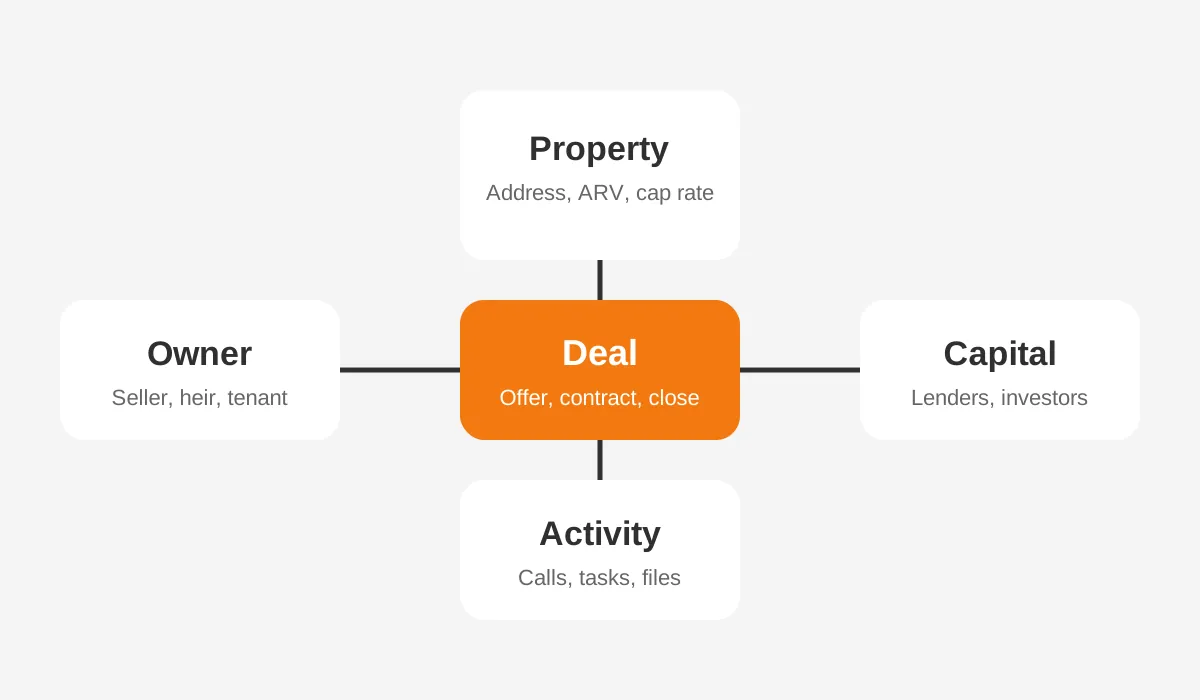
A real estate investor CRM should track four linked record types: properties, people, deals and capital. Each record type answers a different question about the business. Together they show where every deal stands and who can fund it.
- Properties: address, parcel number, property records, condition, estimated repair cost, after-repair value, cap rate and net operating income (NOI).
- People: owners, heirs, agents, wholesalers, contractors, title companies and attorneys, each with a role on the property.
- Deals: offer amount, offer date, contract status, due diligence deadlines and closing date.
- Capital: private money lenders, equity partners and accredited investors, with their criteria and commitments.
Lead source tracking belongs on every person record. Tag each lead with its channel: direct mail campaigns, cold calling, driving for dollars, a referral or a website form. After three months, the CRM can show cost per contract by channel. That report decides where the next marketing dollar goes.
The real estate investor CRM features that save the most time sit around those records. Skip tracing fills in missing phone numbers and emails. Follow-up automation creates the next task when a call ends without an answer. Document storage keeps purchase agreements and inspection reports on the deal.
Commercial investors add more detail on the property side. The CRM for commercial real estate setups Unboxx builds include square footage, zoning, cap rate, NOI and lease terms. A commercial real estate CRM also tracks tenants and lease expiry dates. A renewal can change the value of a building.
Which Features Matter for Each Investor Type?
Each strategy puts weight on different features. Match the real estate investor CRM to the strategy that brings in most of the revenue.
- A CRM for wholesalers needs list stacking, skip tracing, a dialer and a buyer list for assignments.
- A CRM for house flippers needs repair estimates, contractor records and a rehab schedule on each deal.
- A CRM for landlords needs unit records, tenant history, lease dates and maintenance requests.
- A CRM for syndicators needs investor profiles, commitments, offering records and scheduled investor updates.
Running two strategies at once makes the choice harder. A flipper who also holds rentals needs both deal and unit records. In that case, a configured real estate investor CRM usually fits better than two separate tools with duplicate contacts.
How Should You Build the Deal Pipeline?
Build the real estate deal pipeline around the decisions your team makes, with one stage per decision. Each stage needs an entry rule, an owner and a time limit. A deal that sits past its limit should raise a task automatically.
A typical acquisition pipeline for off-market deals has six pipeline stages:
- New lead: the owner record exists, with a lead source.
- Contacted: someone has spoken with the owner at least once.
- Appointment: a walkthrough or call is booked.
- Offer made: the offer amount and date are recorded.
- Under contract: the purchase agreement is signed and due diligence starts.
- Closed or lost: the deal funds, or the team records the loss reason.

Tracked this way, off-market deals do not get lost between calls. The pipeline counts the offers that are out and the contracts that are pending. It also shows which acquisitions manager owns each one. A real estate acquisition CRM should report conversion between every pair of stages.
Real estate investor lead management needs a second, separate pipeline for nurture. Most owners are not ready to sell on the first call. Move them into a long-term follow-up stage. Set a reminder every 30, 60 or 90 days, based on their stated timeline.
Keep disposition separate too. Wholesalers who assign contracts need a buyer list with criteria such as area, price range and property type. When a deal goes under contract, the real estate investor CRM can match it to buyers whose criteria fit.
Which Reports Should the Pipeline Produce?
Four reports cover most acquisition decisions. Build them in the first month, before the data gets messy.
- Leads, contacts and contracts by lead source, with cost per contract.
- Conversion rate between each pair of stages, by acquisitions manager.
- Deals past their stage time limit, sorted by age.
- Offers made per week against the weekly target.
These reports turn the real estate investor CRM into a management tool. A drop in the contact rate points to bad phone data. A drop in offers per week points to a capacity problem on the acquisitions team.
How Does a CRM Manage Capital Partners and Lenders?
A CRM manages capital partners by giving each lender or investor a record. It holds lending criteria, commitments and contact history. That record links to every deal they funded. It shows at a glance who has capital available for the next purchase.
To track private lenders, record each lender's maximum loan, preferred rate, target areas and current exposure. When a new deal goes under contract, filter for lenders whose criteria fit. The CRM then logs every call and term sheet against that deal.
Syndicators need deeper investor relationship management. Platforms such as Agora's investor CRM keep commitments, distributions and documents in one profile. They also offer an investor portal. A CRM for real estate fund managers often connects to software like this rather than replacing it.
A CRM for capital raising should also store accreditation status and the date it was confirmed. It should record how each investor relationship started, because offering rules depend on it.
Firms that raise from institutions often run a model close to a CRM for private equity. That model adds fund, commitment and capital call records.
Investor updates belong in the CRM as well. A quarterly email template, a list of current investors and a log of who opened it make reporting repeatable. A real estate investor CRM turns that update into a scheduled task instead of a scramble at quarter end.
Which Compliance Rules Affect Investor Outreach?
Two sets of rules affect most investor outreach: telemarketing rules for calling owners and securities rules for raising money. A real estate investor CRM can enforce both through required fields, suppression lists and automations. Treat this section as general information, not legal advice.
Cold calling compliance starts with the National Do Not Call Registry. The FTC's Q&A on the Telemarketing Sales Rule sets the timing. Sellers must sync call lists with the registry at least every 31 days. A company must also honor any request to stop calling.
The same FTC guidance describes an established business relationship exception. A company may call for up to 18 months after a consumer's last purchase, delivery or payment. After an inquiry or application, the window is three months. A CRM can store those dates and block calls once the window closes.
Fundraising has its own rules. Under the SEC's guidance on Rule 506(b), an offering cannot use general solicitation. It can sell to no more than 35 non-accredited investors in any 90-day period. A Form D filing is due within 15 days after the first sale.
Those rules translate into CRM fields. Store the relationship start date, the accreditation status and the offering each investor joined. Count non-accredited investors per offering with a report. Set a task for the Form D deadline when the first subscription closes.
Should You Buy Purpose-Built or Configure a Platform?
Buy a purpose-built tool when lead generation is the main job. Configure a platform when custom data, reporting or integrations matter more. The best CRM for real estate investors depends on deal volume and team size. It also depends on how much of the process is unique to the firm.
| Factor | Purpose-built investor CRM | Configured platform |
|---|---|---|
| Examples | REsimpli, Invelo, DealMachine, REISift, InvestorFuse | Salesforce, HubSpot, Odoo, Microsoft Dynamics 365 |
| Lead generation | Built in: skip tracing, list stacking, driving for dollars | Added through integrations |
| Data model | Fixed objects for leads and properties | Custom objects and fields |
| Capital partners | Limited, or a separate product | Modeled alongside deals |
| Reporting | Standard dashboards | Custom reports across every object |
| Setup effort | Days | Weeks, with a defined plan |
Purpose-built real estate investor CRM software suits a small wholesaling team. These tools bundle the lead lists, dialers and mailers that a wholesaler needs. Ascendix's 2025 list names 17 options, including FreedomSoft, SyndicationPro and Propertyware.

Salesforce for real estate investors fits firms with two or more strategies, a capital team and reporting needs. HubSpot for real estate investors makes sense for teams that run heavy email marketing from the CRM.
Odoo for real estate investors works for firms that also want accounting, maintenance or project tools there. One database then covers the deal, the rehab budget and the books.
Check the plan before choosing a platform. According to HubSpot's knowledge base, custom objects require an Enterprise subscription. A property object therefore changes the HubSpot tier a firm must buy. Write these needs into your CRM requirements before any demo.
Some teams search for the best free CRM for real estate investors. A free tier works for a solo investor testing a process. It rarely includes automation, custom objects or call logging at volume, so plan the upgrade path before the data grows.
How Much Does a Real Estate Investor CRM Cost?
A real estate investor CRM costs a monthly subscription per user or per account, plus add-ons, setup and data migration. The subscription is often the smallest line in year one. Vendors change prices often, so confirm current pricing on each vendor's own page.
Budget for five cost lines before comparing quotes:
- Subscription: per user or per account, monthly or annual.
- Usage credits: skip tracing, texting minutes, direct mail postage and data lists.
- Integrations: phone systems, email, e-signature and accounting software.
- Implementation: data model design, automation and user training.
- Data migration: cleaning and loading spreadsheets or a previous CRM.
Usage, more than the license, decides how much a real estate investor CRM will cost in the end. A wholesaler who skip traces thousands of records each month can spend more on credits than on seats. A syndicator with four users pays more for setup than for usage.
Data migration is the line teams underestimate most often. Old spreadsheets hold duplicate owners, missing parcel numbers and dead phone numbers. Run a CRM data cleansing pass before import, so the new system starts with records the team can trust.
Ask each vendor three questions before signing. What does a fourth user cost? Which features need a higher tier? What does it cost to export all data if the firm leaves? The answers show the real cost of a real estate investor CRM over three years.
How Do You Set Up the CRM?
Set up the CRM in six steps, from strategy to training. Each step should end with a sign-off before the next one starts.
- Define the strategy: list the deal types, markets and roles the CRM must support.
- Design the data model: create property, deal and capital partner records with their fields.
- Build the pipelines: acquisition, nurture, disposition and capital, each with stage rules.
- Migrate the data: clean, deduplicate and import contacts, properties and history.
- Automate follow-up: set tasks, reminders, Do Not Call suppression and lead routing.
- Train the team: run short sessions by role, then review usage after 30 days.
A written CRM implementation plan lets a team set up a CRM for real estate investing without rework. It assigns an owner and a date to each step. It also keeps the scope fixed while the first pipeline goes live.
Moving from another system adds risk. Map every field in the old CRM to a field in the new one, and run a test import first. The CRM migration guide covers the checks to run before, during and after the move.
Which Integrations Should You Connect First?
Connect the tools that create activity before the tools that report on it. Email and phone come first, because every owner conversation should land on the right record.
Gmail or Outlook sync logs emails against contacts. A phone system logs calls and recordings on the deal. E-signature tools attach signed purchase agreements to the contract stage. Accounting software comes last and carries closed deals into the books.
Each integration should write to the real estate investor CRM, not around it. If a call or contract lives only in another tool, the pipeline reports will be wrong.
Measure the result after 90 days. Compare contacts per lead, offers per week and contract rate by lead source with the numbers before launch. A real estate investor CRM that does not change those numbers needs a configuration review, not more users.
Frequently Asked Questions
What is the best CRM for real estate investors?
The best CRM depends on the strategy. Wholesalers often choose purpose-built tools such as REsimpli or Invelo for skip tracing and mail. Firms with capital teams and two or more strategies often configure Salesforce, HubSpot or Odoo. Compare both types against a written list of requirements before booking demos.
Does HubSpot work as a real estate investor CRM?
Yes. HubSpot works as a real estate investor CRM when deals, contacts and companies are set up for property work. A separate property object needs custom objects, which require an Enterprise subscription. Smaller teams often store property details as deal properties instead.
How long does investor CRM setup take?
A purpose-built investor CRM can run within days, because its objects and pipelines come ready. A configured platform usually takes four to twelve weeks. That time covers data model design, pipeline setup, data migration, automation and training. Larger data sets and more integrations push the timeline toward the upper end.
Should a CRM track accredited investors?
Yes. A CRM for capital raising should store each investor's accreditation status and the date it was confirmed. It should also record how the relationship started. Rule 506(b) offerings limit non-accredited investors to 35 in any 90-day period. A report on those fields keeps each offering inside the limit.
What features should a real estate investor CRM have?
Core features include property records, linked owner contacts, a deal pipeline, follow-up automation and lead source tracking. Skip tracing, direct mail and dialer integrations help acquisition teams. Firms that raise capital also need investor records, commitment tracking and scheduled investor updates in the same system.
Is Your Real Estate Investor CRM Ready to Scale?
A real estate investor CRM is ready to scale when every property, owner, offer and capital partner is linked. Follow-up should run on rules, and reports should show cost per contract by channel.
If the current setup cannot do that, the data model needs work before the team grows.
Unboxx designs and implements investor and commercial real estate CRMs on Salesforce, HubSpot and Odoo, from data model to migration. Book a CRM consultation to review your pipeline and capital tracking with an Unboxx consultant.
Let's create something out of this world together.
Have a project in mind? Contact us for expert design and development solutions. Let's discuss how we can help grow your business.
Ready to Unboxx Your Potential?
Build smarter systems. Automate faster. Scale confidently.