
A marketing agency signs its tenth local client and its tools start to strain. Every client needs forms, texts, booking and a pipeline, and each new login adds cost.
A B2B sales team faces a different strain. It has long deals, four or five buyers per account and board-level reports. Both teams end up researching GoHighLevel vs HubSpot, often typed as GHL vs HubSpot or Go High Level vs HubSpot.
The short answer to GoHighLevel vs HubSpot is a question of business model. GoHighLevel is a flat-priced, white-label platform built for agencies and local service businesses. HubSpot is a seat-priced CRM platform built for B2B marketing, sales and service teams.
Pricing, CRM depth, automation, AI, compliance and migration all follow from that split. Every list price below was checked on the vendors' own pricing pages in November 2026.
Key Takeaways
- GoHighLevel suits agencies and local businesses that want texting, booking and funnels at one flat monthly price.
- HubSpot suits B2B teams that need company records, deal reporting and room to grow by seat and hub.
- Year-one cost depends on usage fees for GoHighLevel and on seats plus onboarding fees for HubSpot.
What Is the Difference in GoHighLevel vs HubSpot?
The core difference in GoHighLevel vs HubSpot is who the platform serves first. GoHighLevel serves agencies that resell marketing to clients. HubSpot serves companies that run their own marketing, sales and service teams.
What is GoHighLevel? It is an all-in-one marketing platform launched in 2018, sold by HighLevel LLC. Its unit of work is the sub-account. An agency creates one sub-account per client, each with its own contacts, pipelines, calendars, funnels and phone numbers.
What is HubSpot? It is a CRM platform founded in 2006, as WebDew noted in its 2026 comparison. Its unit of work is the company account. Products called hubs sit on one shared CRM: Marketing Hub, Sales Hub, Service Hub and others.
That design choice shapes every GoHighLevel vs HubSpot decision below. A GoHighLevel agency account holds one small business per client. A HubSpot portal behaves like one business with marketing, sales and service teams inside it.
The pricing logic follows the same split. GoHighLevel charges per agency, with unlimited contacts and users. HubSpot charges per seat and per marketing contact tier, and adds onboarding fees on higher plans.
How Does GoHighLevel vs HubSpot Pricing Compare?
GoHighLevel vs HubSpot pricing differs in structure more than in headline numbers. GoHighLevel sells three published agency plans at flat monthly prices. HubSpot sells each hub in Free, Starter, Professional and Enterprise editions.
The table below uses list prices from the HighLevel pricing page (2026) and the HubSpot Marketing Hub pricing page (2026).
| Plan | List price | What the price covers |
|---|---|---|
| GoHighLevel Starter | $97 per month | Core features, 3 sub-accounts, unlimited contacts and users |
| GoHighLevel Unlimited | $297 per month | Unlimited sub-accounts, white-label desktop app, basic API access |
| GoHighLevel Founder | $497 per month | Everything in Unlimited plus SaaS mode for reselling |
| HubSpot Free CRM | $0 | Free for up to 2 users |
| HubSpot Starter | From $7 per seat per month | Standard price $20 per seat per month, 500 HubSpot Credits |
| Marketing Hub Professional | From $800 per month | 3 core seats, 2,000 marketing contacts, $3,000 onboarding |
| Marketing Hub Enterprise | From $3,600 per month | 5 core seats, 10,000 marketing contacts, $7,000 onboarding |
The GoHighLevel starter plan fits one business or an agency with up to three clients. The GoHighLevel unlimited plan removes the sub-account cap, which is the main reason agencies upgrade. GoHighLevel SaaS mode sits in the $497 Founder plan and lets an agency resell the software under its own brand.
GoHighLevel pricing also has a usage layer. HighLevel bills Conversation AI, Voice AI, Reviews AI, email, SMS and calling by usage. WebDew reported that agencies budget an extra $60 to $100 a month for a typical client load.

HubSpot pricing grows along three lines: seats, marketing contacts and hub edition. HubSpot Starter starts at $7 per seat per month on the HubSpot CRM pricing page (2026). HubSpot Professional adds a required one-time onboarding fee. The HubSpot onboarding fee is $3,000 for Marketing Hub Professional and $7,000 for Enterprise.
Additional core seats start at $45 a month on Professional and $75 a month on Enterprise. WebDew also notes that HubSpot moved to seat-based pricing in 2024. Older comparison posts that quote 2023 prices are therefore out of date.
What Does Year One Cost in a Worked Example?
Year-one cost is the fairest GoHighLevel vs HubSpot measure, because both vendors charge beyond the list price. The example below uses assumed team sizes and the list prices above. It is an illustration, not a quote.
Example A is an agency with 10 local clients. It chooses the GoHighLevel unlimited plan at $297 a month, which is $3,564 a year. It adds the AI Employee add-on at $50 per sub-account per month for all 10 clients. That adds $6,000 a year.
Assume usage fees of $100 a month, the top of WebDew's range. That adds $1,200. The agency's year-one software cost is $10,764, or about $90 per client per month. The agency can resell that access at its own margin.
Example B is a B2B company with a 3-person marketing team. It chooses Marketing Hub Professional at $800 a month, or $9,600 a year. The required onboarding adds $3,000. The year-one cost is $12,600 before any added contacts or seats.
The two totals sit close together, yet they buy different things. Example A buys tools for 10 small businesses. Example B buys deep marketing automation for one company, on a CRM shared with sales.
This is why the total cost of ownership answer to "is GoHighLevel cheaper than HubSpot" depends on the model. Per client, GoHighLevel costs agencies far less. Per company, HubSpot Starter can cost less than any GoHighLevel plan for a small team.
Budget for setup work as well. WebDew estimated that GoHighLevel onboarding can take 40 hours or more. HubSpot's onboarding fee covers vendor-led setup on Professional and Enterprise. The guide to CRM implementation cost breaks down the partner work that sits on top of either platform.
How Do CRM and Pipeline Features Compare?
HubSpot has the deeper CRM, while GoHighLevel has the broader front-office toolkit per client. The GoHighLevel CRM stores contacts and opportunities inside pipelines and stages for each sub-account. Custom fields extend the contact record.
The HubSpot CRM links contacts to companies, deals and tickets. That structure suits a B2B sales team where five people from one account join the same deal. Reports can then roll activity up to the company, the deal and the sales pipeline stage.
In a GoHighLevel vs HubSpot test, try the same scenario in both demos. Load one company with three contacts and two open deals. Then ask each platform for revenue by stage and by account owner.
GoHighLevel vs HubSpot reporting shows the difference clearly. GoHighLevel reports serve a local business owner who wants leads, booked calls and closed jobs. HubSpot reports serve a revenue team that tracks pipeline, forecast and campaign attribution.
GoHighLevel adds tools HubSpot does not lead with. These include a funnel builder, appointment booking calendars, two-way SMS and membership sites. HubSpot covers landing pages and meetings links, but its strength is the shared record across hubs.
Integrations show the same GoHighLevel vs HubSpot gap. HubSpot lists 1,500+ integrations, according to WebDew's 2026 count. GoHighLevel runs an App Marketplace for agency and sub-account use.
Feature depth is where a GoHighLevel vs HubSpot shortlist usually narrows to one. Before choosing, list the reports leadership needs each month. The CRM requirements checklist helps turn those reports into fields, objects and permissions to test.
Which Platform Handles Automation and Messaging Better?
GoHighLevel offers more automation per dollar, and HubSpot offers more control over complex B2B workflows. GoHighLevel includes its Workflow Builder and Campaign Builder on every plan, including Starter.
That matters for workflow automation in a local service business. A missed call can trigger a text back, a booking link and a reminder sequence. All of it runs inside one sub-account, with SMS marketing and email marketing in the same tool.
HubSpot Starter includes up to 50 workflows with restricted triggers and actions, per the HubSpot CRM pricing page. Full marketing automation sits in Marketing Hub Professional and above. There, workflows can draw on company and deal data from the shared CRM.
GoHighLevel vs HubSpot automation is aimed at different buyers. GoHighLevel automates conversations with consumers and small buyers. HubSpot automates lead nurturing across a long B2B cycle, with sales and marketing on one record.
GoHighLevel vs HubSpot email marketing costs scale in different ways. GoHighLevel bills sending through its usage layer. HubSpot ties email limits to the marketing contacts tier, so a growing list pushes the plan price upward.
Messaging volume is the cost to watch. A GoHighLevel review of last year's invoices should include texts and calls, not only the plan. On HubSpot, estimate the marketing contact count the database will hold in 12 months.
B2B teams already running campaigns can read the Pardot vs HubSpot comparison. It sets HubSpot automation against a Salesforce-native tool.
How Do the AI Features Compare?
Both platforms now sell AI agents, and the GoHighLevel vs HubSpot AI split mirrors the pricing split. Agencies pay per client account for AI that talks to customers. HubSpot builds Breeze AI into its CRM and charges through a shared pool of HubSpot Credits.
GoHighLevel's Conversation AI answers chats and texts, and Voice AI answers calls. Reviews AI drafts replies to online reviews. The AI Employee add-on costs $50 or $97 per sub-account per month on the HighLevel pricing page.
HubSpot Starter includes 500 HubSpot Credits per month, Professional includes 3,000 and Enterprise includes 5,000. The HubSpot pricing pages also list Agent Builder from the Starter tier. Breeze AI agents draw on the shared CRM record, including company and deal data.
The practical GoHighLevel vs HubSpot difference in AI is where the agents work. GoHighLevel AI handles front-line conversations for each client business. HubSpot's Breeze AI supports marketers and sellers who work long accounts inside one company.
Test AI with real data before paying for it. Feed each platform 20 recent inquiries and score the replies. Then check the cost per conversation at the volume the team expects.
How Do Support, Security and Compliance Compare?
Support and compliance options differ in a GoHighLevel vs HubSpot review, and both carry price tags. GoHighLevel includes chat and phone support on its Starter plan. Premium support costs $500 a month extra on the HighLevel pricing page.
HubSpot ties support to the edition. WebDew reported that phone support comes with HubSpot Professional and Enterprise. Teams on Free or Starter should confirm which support channels their edition includes before they sign.
Compliance is the bigger gap for regulated businesses. HighLevel lists HIPAA compliance as a $297 monthly add-on, and includes it in the Enterprise plan. A clinic or therapy practice must budget for that before storing patient data in GoHighLevel.
The HubSpot pricing pages reviewed for this guide list no HIPAA add-on. Buyers in healthcare, finance or legal services should ask each vendor for its signed agreement and required tier.
Access control also matters as teams grow. GoHighLevel separates clients by sub-account, so one client never sees another client's data. HubSpot separates users by team, role and record permission inside one portal.
A GoHighLevel vs HubSpot security review therefore asks different questions. GoHighLevel walls off businesses from each other. HubSpot controls what each employee sees inside one business, so role design matters more.
Ask three questions in every security review. Who can export the full database? Where is an audit log of record changes? How quickly can an admin remove a leaver's access?
Which Fits Agencies, Local Businesses or B2B Teams?
The fit question has a clear rule: choose by who owns the customer relationship and how long the sale takes. GoHighLevel fits short, local sales. HubSpot fits long B2B sales with three or more decision makers.
GoHighLevel vs HubSpot for agencies favors GoHighLevel when the agency runs marketing for 5 or more small clients. Unlimited sub-accounts and a white label CRM make the agency model profitable. GoHighLevel white label options include a branded desktop app on the Unlimited plan.
GoHighLevel vs HubSpot for small business depends on the type of business. A dental practice, home service firm or gym gains from texting, booking and reviews in one tool. A 10-person B2B software firm gains more from HubSpot's company and deal records.
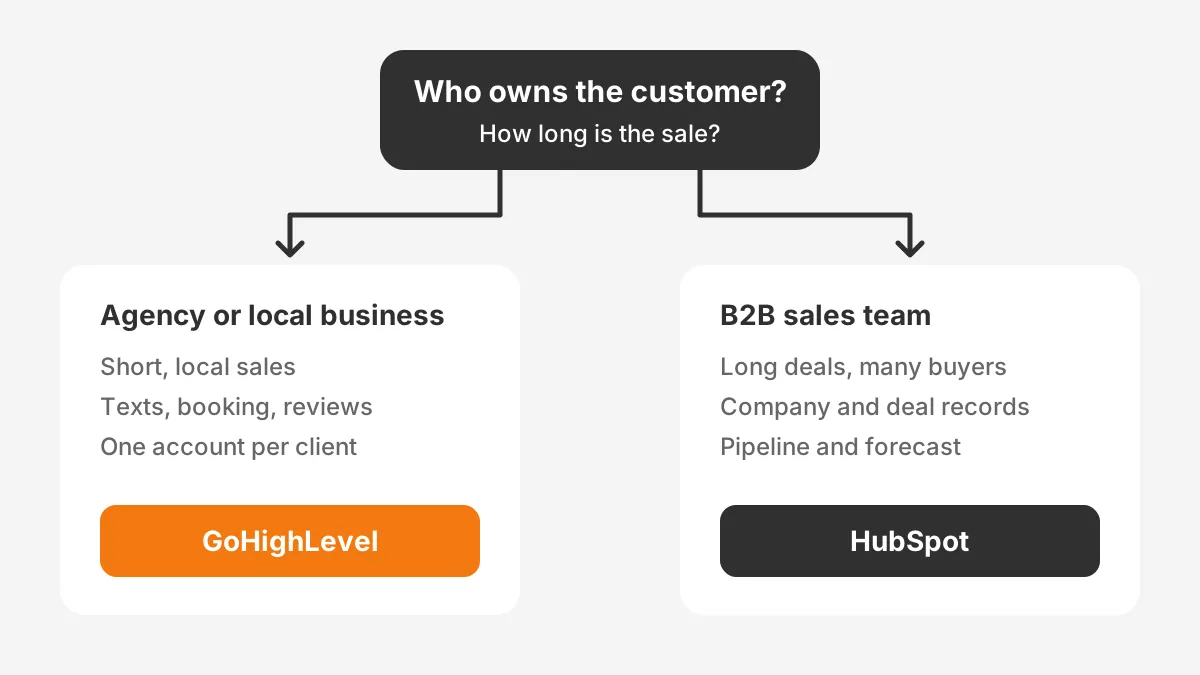
GoHighLevel vs HubSpot for B2B favors HubSpot in most cases. Account-based reporting, sales sequences and a shared marketing and sales record matter more than SMS. HubSpot also uses the same company, contact and deal pattern as Salesforce, which helps if the team moves later.
Can GoHighLevel replace HubSpot? It can for a local business that uses HubSpot for forms, email and a basic pipeline. It rarely can for a B2B team that relies on company records, deal forecasts and attribution.
A neutral CRM consultant can test both against real processes before a contract is signed. The CRM selection guide sets out a scoring method, and Unboxx CRM consulting services run that evaluation for B2B teams.
How Hard Is Migration Between the Two?
Moving records is quick, but rebuilding automation is the real work in any GoHighLevel vs HubSpot CRM migration. The two platforms do not share a data model, so every object needs a map before data moves.
To migrate from HubSpot to GoHighLevel, HighLevel offers a One-Click Importer. WebDew reported that it brings over contacts, pipelines, stages and custom fields, plus some email templates. Workflows and email sequences must be rebuilt by hand.
To migrate from GoHighLevel to HubSpot, plan for a structural change. GoHighLevel contacts often hold company names as plain text. HubSpot expects separate company records, so a cleanup step must create companies and link contacts to them.
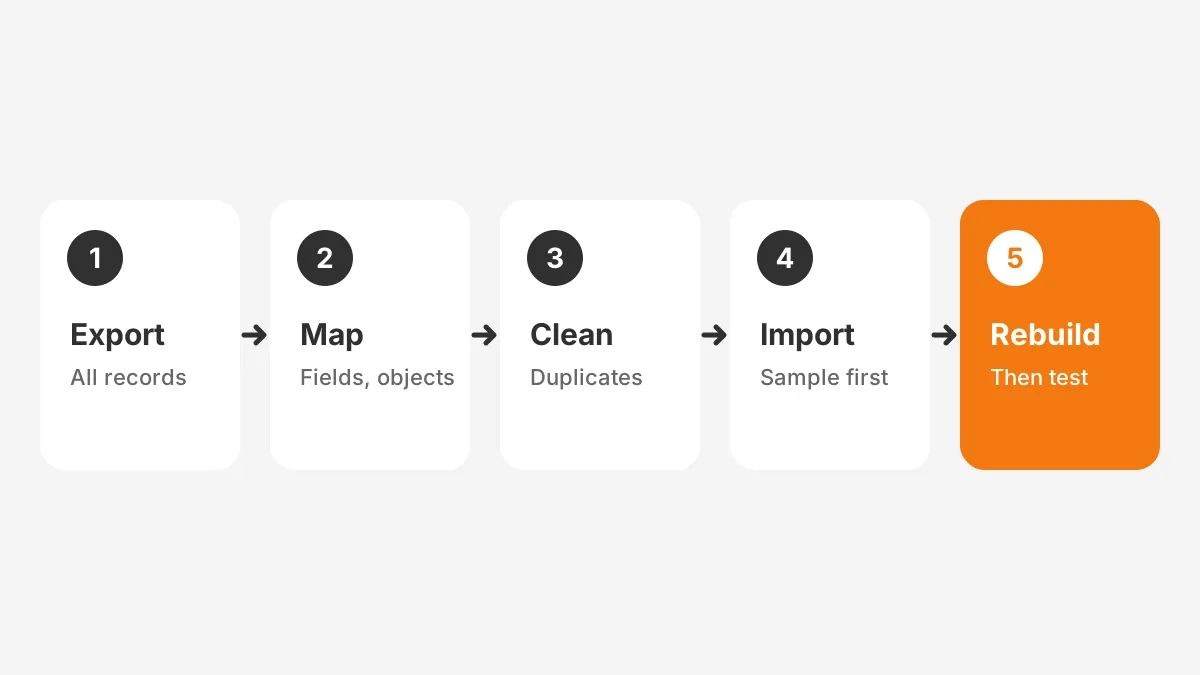
A safe migration follows five steps:
- Export contacts, opportunities or deals, notes and custom fields.
- Map each field and object to its target, including company records.
- Clean duplicates and fix formats before import.
- Import a sample, check it, then import the full set.
- Rebuild workflows, forms and templates, then test each one.
Does GoHighLevel integrate with HubSpot? There is no native sync between them. Teams that run both use a connector tool such as Zapier to pass new leads across. That works for a trial period, not as a long-term setup.
For a full checklist, see the HubSpot CRM migration guide. It covers data mapping, cutover and adoption after go-live.
What Should a GoHighLevel vs HubSpot Demo Test?
A GoHighLevel vs HubSpot demo is only useful when it runs on the buyer's own scenarios. Vendor demos show the best path. A scripted test shows where each platform needs workarounds.
Run these seven tests in both trials, using the same sample data:
- Create a lead from a web form and route it to the right owner.
- Send an automated text and email within five minutes of the form.
- Book a meeting from a link and confirm the reminder sequence.
- Move a deal through each pipeline stage and log every touch.
- Link three contacts to one company and report on that account.
- Build a monthly report of revenue by source and by owner.
- Export the full database and check that every field arrives intact.
Agencies should add an eighth test. Clone a finished client setup into a new sub-account and time how long the copy takes. That speed decides how fast the agency can onboard new clients.
B2B teams should test the HubSpot Sales Hub sequence tools against GoHighLevel campaigns. Sales reps send one-to-one follow-ups, not bulk blasts, so the tool must log replies to the deal.
Score each test from 1 to 5 and weight the scores by business value. A GoHighLevel vs HubSpot scorecard built this way settles debates faster than a feature list. It also gives a CRM implementation partner a clear brief.
Record who ran each test and on which date. Keep the test notes after the decision. They become the acceptance checklist for go-live. The team then signs off on the scenarios that drove the choice.
Frequently Asked Questions
Is GoHighLevel better than HubSpot?
GoHighLevel is better for agencies and local businesses that need texting, booking and funnels at a flat price. HubSpot is better for B2B teams that need company records, deal reporting and shared marketing and sales data. The right choice depends on the business model, not on a feature count.
Is HubSpot or GoHighLevel easier to learn?
HubSpot is usually the easier start, because each hub covers one job and setup follows that job. GoHighLevel packs more tools into one account, so setup takes longer. WebDew estimated GoHighLevel onboarding at 40 hours or more for an agency starting out.
Does GoHighLevel have a free trial?
Yes, the GoHighLevel free trial lasts 14 days, and plans run month to month with no long-term contract. GoHighLevel has no free plan. HubSpot offers a permanent free CRM for up to 2 users. That suits small teams testing a CRM first.
Can you use GoHighLevel and HubSpot together?
Yes, though no native sync exists between the two platforms. Some agencies run GoHighLevel for client messaging and keep HubSpot as the main CRM. A connector tool such as Zapier passes leads across. Two systems double the data upkeep, so most teams settle on one.
What is a good GoHighLevel alternative for B2B teams?
HubSpot is a strong GoHighLevel alternative for B2B teams, because it links contacts, companies and deals. Salesforce suits larger sales teams with complex processes. A HubSpot alternative for local businesses is GoHighLevel itself, which bundles texting, booking and reviews at one flat agency price.
GoHighLevel vs HubSpot: Which Should You Choose?
The GoHighLevel vs HubSpot choice comes down to business model. Agencies and local service businesses get more for less from GoHighLevel. B2B teams with long sales cycles get a stronger CRM, cleaner reporting and room to grow from HubSpot.
Unboxx helps B2B teams test both platforms against real processes, price the first year and plan the migration. Schedule a consultation to compare GoHighLevel vs HubSpot for your sales and marketing team.
Let's create something out of this world together.
Have a project in mind? Contact us for expert design and development solutions. Let's discuss how we can help grow your business.
Ready to Unboxx Your Potential?
Build smarter systems. Automate faster. Scale confidently.