
Tailor Communications to Private Investors With CRM Data

A fund manager sends one quarterly letter to a pension plan, a family office and a retired surgeon. Each reader looks for different numbers, and two stop reading. The SS&C Intralinks LP survey polled over 280 institutional investors. It found 23% frustrated by limited access to analytics from their GPs.
Firms tailor communications to private investors by storing each investor's commitments, preferences and engagement history in a CRM. That data then picks the content, channel and timing of every message.
This guide shows the fields, segments, triggers and checks that make it work. It is general information, not legal or investment advice.
Key Takeaways
- To tailor communications to private investors, a CRM needs four data layers: identity, commitments, preferences and engagement.
- Segments built from commitment size, investor type and stated preferences decide what each investor receives and how often.
- Every tailored message still passes a compliance review and leaves an audit trail inside the CRM record.
How Do Firms Tailor Communications to Private Investors?
Firms tailor communications to private investors by turning CRM data into rules about content, channel and timing. The CRM holds who the investor is, what they committed and what they asked for. The communication team then writes a small set of message variants and lets the data pick one.
The work splits into three jobs. First, the firm captures the right CRM data on every investor record. Second, it groups investors into segments that share needs. Third, it automates the sends that repeat, such as capital call notices and quarterly investor letters.
The pressure to get this right is growing. Carta reported in 2026 that the median number of LPs fell to 47 in 2024. That figure sits nearly 50% below 2022. With fewer limited partners, each relationship carries more weight in the next raise.
Smaller investor bases also raise expectations. A family office that commits $10 million expects the partner to know its reporting format. The firms that meet that expectation do it from data, not memory.
The firms that tailor communications to private investors well share one habit. Every outbound message runs through the investor CRM. Nothing goes out from a personal inbox without being logged against the investor record.
Investor segmentation sits at the centre of this process. Without it, a firm can only tailor communications to private investors one email at a time. With it, one approved template can serve hundreds of records correctly.
What CRM Data Do You Need About Each Investor?
You need four layers of CRM data about each investor: identity, commitments, preferences and engagement. Missing any one layer forces the team to guess, and guessing is how generic letters get sent. Each layer maps to custom fields in the data model.
Identity covers the legal entity, investor type, decision makers, advisers and KYC documents. Investor type separates limited partners such as pensions and endowments from family offices. It also flags high net worth investors and accredited investors who invest as individuals.
Commitments cover commitment size, funds held, capital called, distributions received and re-up history. Check size is a clear signal of how much attention a relationship needs. Fund performance data linked to the record lets the team quote the numbers each investor holds.
Preferences cover communication preferences, report format, language, time zone and topics of interest. Record them as picklists, not free text, so segmentation rules can read them. Consent tracking and opt-out status belong in this layer too.
Ask for preferences at investor onboarding and confirm them once a year. A short form inside the investor portal works well. The answers let the team tailor communications to private investors from the first capital call onward.
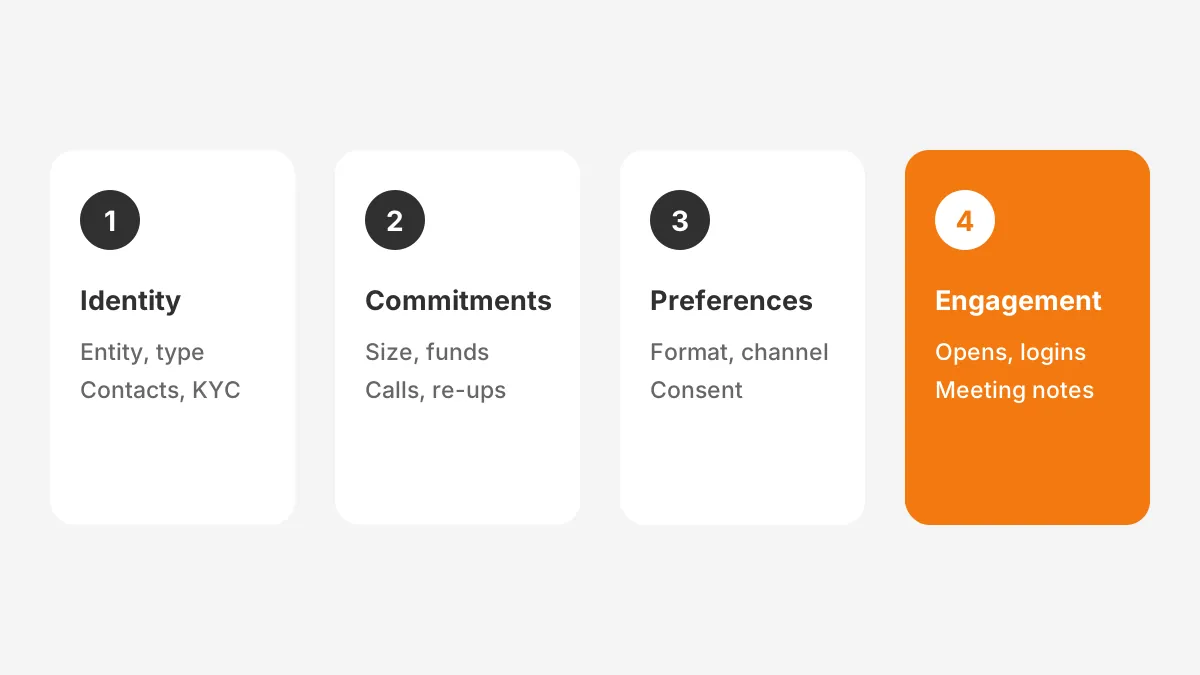
Engagement covers activity history: emails opened, documents downloaded from the investor portal, meetings held and investor meeting notes. Email engagement tracking from Outlook or Gmail sync fills most of this layer without manual entry.
Once all four layers exist, the team can tailor communications to private investors without asking the same questions twice. A partner preparing for a call sees commitments, open questions and the last three emails on one screen.
Data hygiene decides whether any of this works. Duplicate contacts and stale advisers send letters to the wrong people. The CRM data cleansing runbook covers deduplication and field standards before segmentation starts.
How Should You Segment Private Investors in a CRM?
Segment private investors in a CRM by investor type, commitment size and stated preferences, in that order. Those three fields predict what an investor reads, how much detail they want and how they want it delivered.
This is the step that lets a lean team tailor communications to private investors at scale. Without segments, every letter becomes a one-off edit.
Start with five or six segments, not twenty. Each segment needs its own message variant, and every variant needs review. A typical starting set looks like this:
- Institutional LPs with large commitments, such as pensions and endowments.
- Family offices with a direct relationship to a partner.
- High net worth investors who invest through a feeder vehicle.
- Co-investors who want deal-level updates on co-investment opportunities.
- Prospects in the fundraising pipeline who have not yet committed.
- Lapsed investors who did not re-up into the latest fund.
Write segmentation rules as filters on fields, never as hand-picked lists. A rule such as "investor type equals family office and commitment size above five million" updates itself. A static list goes stale the week after it is built.
Add a simple investor engagement score on top of the segments. Score recent opens, portal logins and meetings over the last 90 days. The score flags quiet investors inside each segment early. Waiting until the next fundraise leaves no time to rebuild the relationship.
The CRM for private equity setup Unboxx builds stores these segments as list views and reports. Investor relations staff can then see who sits in each group and why.
Review the segments every quarter. Investors change type, advisers leave and commitment size grows with each re-up. A quarterly review keeps the rules that tailor communications to private investors aligned with the real investor base.
Which Communications Should Change by Investor Segment?
Four things should change by investor segment: depth of reporting, channel, frequency and who signs the message. The facts stay identical for everyone. Only the framing, level of detail and delivery change.
The table below shows one way to tailor communications to private investors across the starting segments. Treat it as a template, then adjust it to the fund's own investor base.
| Segment | Reporting depth | Channel | Frequency | Sender |
|---|---|---|---|---|
| Institutional LPs | Full data pack in the ILPA reporting template | Investor portal plus email notice | Quarterly, plus ad hoc requests | IR lead |
| Family offices | Summary letter plus fund performance data | Email and a partner call | Quarterly, plus two calls a year | Relationship partner |
| High net worth investors | Two-page letter in plain language | Email with portal link | Quarterly | IR team |
| Co-investors | Deal-level updates | Email and secure data room | Event driven | Deal lead |
| Prospects | Approved fund materials only | Email and meetings | Monthly during the raise | Partner or IR lead |
Institutional limited partners often ask for data in a standard layout. ILPA released an updated Reporting Template and a new Performance Template in 2025. Storing those fields in the CRM makes the quarterly pack faster to assemble.
High net worth investors usually want the opposite. A short letter that shows how the investment is doing beats a forty-page pack. Personalized investor updates for this group lead with the investor's own capital account, then the fund story.
Prospects need the most care. Every message to a prospect counts as marketing material. Firms that tailor communications to private investors use only approved email templates here. The CRM records which version each prospect received.
How Do Triggers Tailor Communications to Private Investors?
Triggers tailor communications to private investors by sending a message when a CRM field changes, not when someone remembers. A capital call record moving to "issued" can send the notice and log it. The same step creates a follow-up task.
Trigger-based emails suit the messages that repeat on a fixed pattern. Good candidates include capital call notices, distribution notices, investor onboarding steps, KYC document renewals and annual general meeting invitations. Each one has a clear start event and a clear owner.
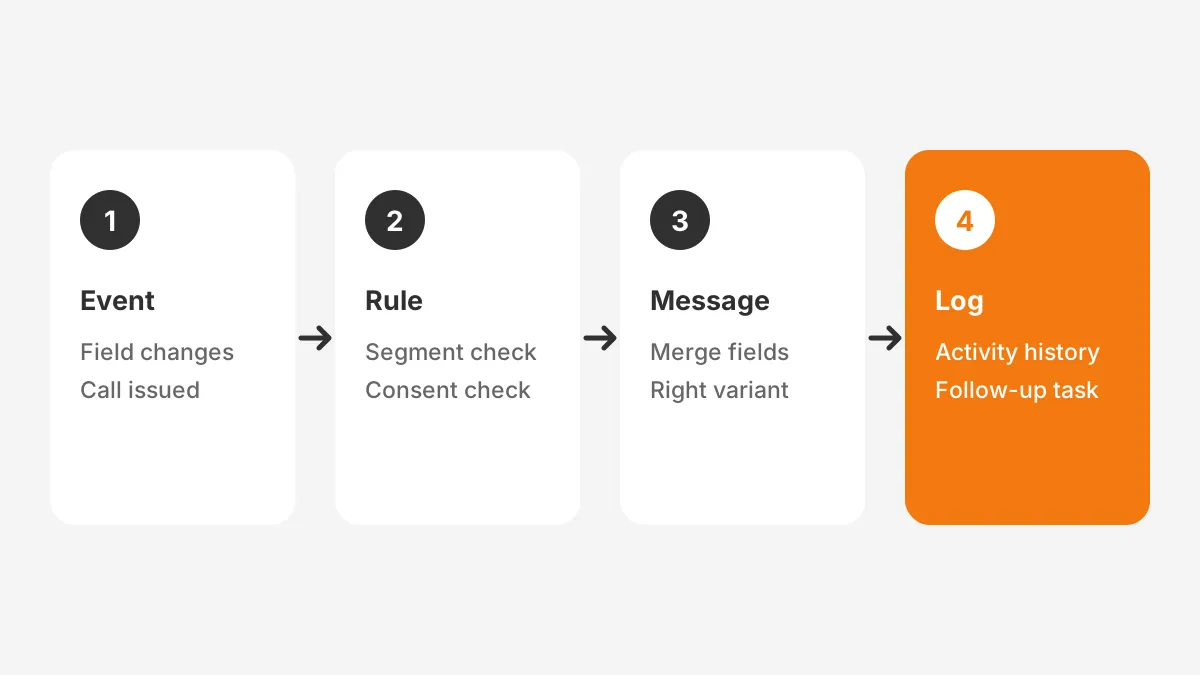
Build each trigger from four parts: the event, the rule, the message and the log. The event is a field change. The rule checks segment and consent. The message pulls merge fields such as name, commitment and amount due. The log writes the send to the activity history.
Here is a worked example with assumed figures. A fund issues a capital call for 10% of commitments. The trigger reads each investor's commitment size and calculates the amount due. A family office with a $5 million commitment receives a notice for $500,000, signed by its relationship partner.
The same event sends a different variant to high net worth investors. Their notice explains the wire steps in plain language and links to the investor portal. Institutional LPs receive the notice in the format their operations team expects.
One event produces three variants with no manual edits. That is how a small investor relations team can tailor communications to private investors across hundreds of records.
Workflow automation also handles response time. If an investor emails a question, a rule can create a task due within one business day. The guide to portfolio check-ins shows the same task logic applied to portfolio companies.
What Platforms Can Tailor Communications to Private Investors?
Both general CRMs and purpose-built investor CRMs can tailor communications to private investors. The right choice depends on deal volume, existing systems and the size of the investor relations team.
General platforms include Salesforce Financial Services Cloud, HubSpot CRM and Microsoft Dynamics 365. They offer flexible custom fields, strong workflow automation and mature email tools. They need configuration to model funds, commitments and capital accounts.
Purpose-built options include Affinity, 4Degrees, Juniper Square and DealCloud. They keep investor records and deal tracking in one system. Most ship with fund objects and relationship intelligence that maps who knows whom. They can be harder to extend outside the investment workflow.
| Factor | General CRM | Purpose-built investor CRM |
|---|---|---|
| Fund and commitment data model | Built through custom objects | Included |
| Workflow automation | Flexible, needs an admin | Set patterns, less flexible |
| Marketing email tools | Mature templates and tracking | Varies by vendor |
| Links to finance and ERP | Wide connector choice | Narrower connector choice |
| Best fit | Firms that also run sales or service in the CRM | Firms focused only on deals and LPs |
Email volume is one reason firms move off spreadsheets. Affinity data from 2026 showed firms sent and received 17% more emails in Q4 year over year. Tracking that activity by hand stops scaling quickly.
Either route can tailor communications to private investors if the data model is right. Pick the platform the team will keep updated. A well-fed general CRM beats a specialist tool that nobody opens.
Venture firms face the same choice with a different data model. The article on why VC firms need a CRM compares relationship data models. The CRM for venture capital page covers that build.
What Compliance Rules Limit Investor Personalization?
Compliance rules limit investor personalization mainly through marketing, privacy and recordkeeping requirements. The CRM should make each requirement a field or a step, so a busy team cannot skip it.
For registered advisers in the United States, the SEC Marketing Rule governs advertisements to investors. The SEC issued it in December 2020, and it took effect on May 4, 2021. It merged the older advertising and cash solicitation rules.
The practical effect for a CRM is simple. A tailored message can change framing and detail, but performance figures must follow the firm's approved presentation. Store approved email templates in the CRM and lock the performance blocks.
Consent tracking is the second control. Record how each investor agreed to receive email and which topics they accepted. Honour every opt-out at once, and keep the opt-out on the record even after the contact changes jobs.
Recordkeeping is the third control. The audit trail should show who sent what, to whom and from which template. Email sync that logs messages automatically makes this a by-product of normal work rather than a separate task.
Firms should confirm these controls with their own compliance counsel. Rules differ by registration status, investor location and fund structure.
Build the controls before the automation, not after. To tailor communications to private investors safely, put approved templates, consent fields and logging in place on day one.
How Do You Measure Whether Tailored Communications Work?
Measure tailored communications with four numbers: open rate by segment, portal logins, response time and re-up rate. Each one comes straight from CRM data the team already captures.
Open rate by segment is the quickest read on whether each message variant fits its reader. Low opens in one segment point to the rule that needs work.
Suppose institutional LPs open the portal notice but family offices ignore it. The family office variant then needs a shorter subject line or a partner signature.
Portal logins show whether investors use the reporting. The Intralinks survey found 86% of LPs already use AI or similar tools to monitor investments. Investors who download data packs are reading the numbers, not the cover letter.
Response time tracks how fast the team answers investor questions. Set a target, such as one business day, and report misses weekly. Slow answers damage trust faster than a late quarterly report.
Re-up rate is the lagging measure that matters most. Compare re-up rates for investors with high and low engagement scores. The fund CRM support guide explains who owns these reports once the system is live.
Build these four numbers into one dashboard. The investor relations lead can then show partners whether the effort to tailor communications to private investors pays off.
The same Intralinks survey found 93% of LPs rate their GP relationships as good or excellent. Measurement shows which investors sit in the remaining group before they decline to re-up.
What Does a 90-Day Rollout Plan Look Like?
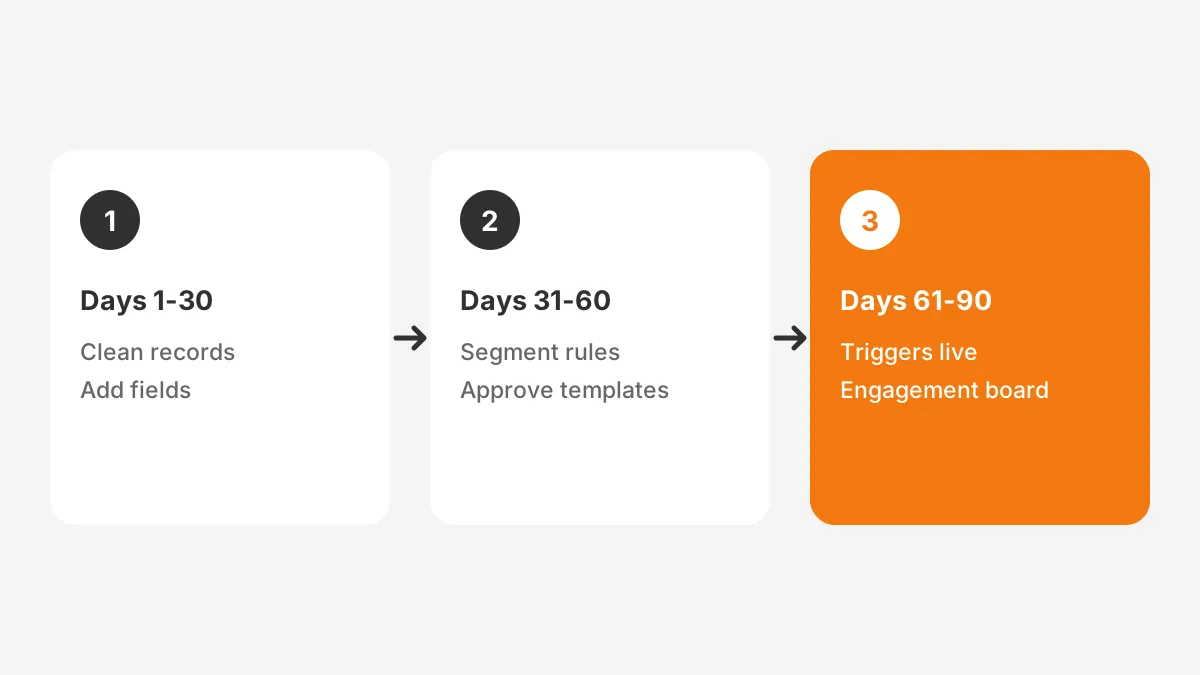
A 90-day rollout plan has three 30-day phases. The team cleans the data, builds segments and templates, then switches on triggers. Each phase ends with a check before the next one starts.
- Days 1 to 30: audit investor records and merge duplicates. Add custom fields for the four data layers and import commitment data.
- Days 31 to 60: write segmentation rules, draft email templates per segment and get compliance approval for each one.
- Days 61 to 90: switch on trigger-based emails one at a time, starting with capital call notices. Then build the engagement dashboard.
Triggers carry the most risk when firms tailor communications to private investors. Add them one at a time.
A wrong merge field in a capital call notice reaches every investor at once. Test each trigger against five real records in a sandbox before it touches a live list.
Plan the rollout around the fund calendar. Avoid launching new templates in the weeks before a quarterly report or an annual general meeting. The team will be too busy to check the first sends.
What Mistakes Weaken Tailored Investor Communications?
Five mistakes weaken attempts to tailor communications to private investors. They are excess segments, free-text preferences, untested merge fields, missing consent records and personal inboxes. Each one is easy to prevent inside the CRM.
Excess segments create more variants than the team can review. Keep the count low and add a segment only when a group behaves differently for two quarters in a row.
Free-text preferences cannot drive rules. A note that says "prefers short updates" helps one partner but no automation. Convert it into a picklist value that segmentation rules can read.
Untested merge fields produce the most visible errors. A letter that opens "Dear FirstName" or quotes another investor's commitment damages trust at once. Test every template against real records before each send.
Missing consent records expose the firm to complaints. Store the date, method and scope of consent on each contact. Firms that tailor communications to private investors at scale need this field filled for every recipient.
Personal inboxes hide the history. When a partner emails an investor outside the CRM, the next message may repeat or contradict it. Email sync closes that gap and keeps the audit trail complete.
Frequently Asked Questions
What is an investor CRM?
An investor CRM is a customer relationship management system set up to track limited partners, prospects and co-investors. It stores commitments, preferences, meetings and emails on each record. Investor relations teams use it to run fundraising, reporting and every outbound message from one place.
How often should private investors receive updates?
Most funds send a quarterly letter and report, plus notices for capital calls and distributions. Family offices and large LPs often expect calls between reports. Prospects in an active raise may hear monthly. Ask each investor and store the answer as a communication preference.
Can HubSpot CRM handle investor relations?
HubSpot CRM can handle investor relations once it has custom objects for funds and commitments. Its email templates, sequences and tracking suit tailored updates. Firms with complex capital accounts usually connect it to fund administration data rather than storing every transaction inside HubSpot.
Is it legal to personalize performance figures for investors?
Personalizing an investor's own capital account figures is standard practice. Changing how fund performance is presented for marketing purposes is restricted for SEC-registered advisers under the Marketing Rule. Keep performance blocks in approved templates and confirm specific cases with compliance counsel.
Who should own investor communication data in the CRM?
The investor relations lead should own investor communication data, with a named CRM administrator keeping fields and rules clean. Partners add relationship notes after every investor call. Finance owns commitment and capital account figures, which flow into the CRM from fund administration systems.
How Can Unboxx Help Tailor Communications to Private Investors?
Unboxx sets up Salesforce, HubSpot and Dynamics 365 so firms can tailor communications to private investors from clean CRM data. The work covers the four data layers, segment rules, approved templates and trigger-based notices, built around the fund calendar.
The CRM consulting team can review the current investor records and map a 90-day plan. Schedule a consultation to see how your firm could tailor communications to private investors without adding headcount.
Let's create something out of this world together.
Have a project in mind? Contact us for expert design and development solutions. Let's discuss how we can help grow your business.
Ready to Unboxx Your Potential?
Build smarter systems. Automate faster. Scale confidently.