
A B2B buyer who downloads a guide today rarely signs a contract this quarter. Gartner research on the B2B buying journey puts a typical buying group at six to 10 decision makers. Each one moves at a different speed. A lead that gets one call and no follow-up goes cold.
B2B lead nurturing keeps those buyers engaged with useful, stage-specific contact until they are ready for sales. This guide ties nurture tracks to CRM lifecycle stages and sets score thresholds for the sales handoff. It also covers cadence, buying groups and the metrics that show pipeline.
Key Takeaways
- B2B lead nurturing works best when every nurture track maps to one CRM lifecycle stage with a clear exit rule.
- A written lead score threshold, agreed by marketing and sales, decides when a lead leaves nurture for a sales call.
- Measure B2B lead nurturing by pipeline created and stage conversion rate, not by email opens.
What Is B2B Lead Nurturing?
B2B lead nurturing is a planned series of contacts that moves a business buyer toward a sales call. Each contact answers the question the buyer has at that stage. Every response lands in the CRM, so sales sees the full history.
Lead nurturing vs lead generation is a common point of confusion. Lead generation captures a contact through a form, an event or an ad. B2B lead nurturing starts after that capture. It continues until the buyer becomes a sales qualified lead or opts out.
Most databases need it. Adobe, citing Marketo Engage data, states that half of the leads in a system are not ready to buy. Without a lead nurturing program, those contacts sit in a database until they forget the company.
A working lead nurturing process has four parts:
- A lifecycle stage on every contact record, so each lead has a known position.
- A lead scoring model that adds points for fit and for engagement.
- Nurture tracks with content, cadence and exit rules for each stage.
- A handoff rule that routes the lead to a named sales rep at the right score.
Most B2B lead nurturing runs through marketing automation platforms such as HubSpot, Salesforce Account Engagement and Marketo Engage. Email carries most touches. Retargeting ads, LinkedIn, webinars and sales development calls carry the rest.
Why Do B2B Buyers Need Longer Nurture Tracks?
B2B buyers need longer nurture tracks because the purchase involves more people, more risk and more approval. Gartner reports that 77% of B2B buyers called their latest purchase very complex or difficult. A complex purchase takes time, and B2B lead nurturing fills that time with useful contact.
Buyers also spend little of that time with vendors. Gartner found that buyers spend only 17% of the buying journey meeting potential suppliers. When they compare three or four vendors, one sales rep may get 5% or 6% of their time.
B2B lead nurturing covers the other 83%. A nurture email, case study or webinar reaches the buyer when sales cannot. It keeps the company in the internal discussion without forcing an early meeting.
Speed matters at the start of the track. A 2011 Harvard Business Review study, The Short Life of Online Sales Leads, examined online inquiries. Oldroyd, McElheran and Elkington found that most companies were not responding nearly fast enough.
Lead response time is the first touch in any B2B lead nurturing strategy, so automate an acknowledgement within minutes. Lead nurturing for long sales cycles also needs patience rules. A track that sends five emails in ten days and stops will miss a buyer whose budget opens next quarter.
How Do CRM Lifecycle Stages Shape B2B Lead Nurturing?
CRM lifecycle stages shape B2B lead nurturing by giving every contact a position, and every position its own track. Without a lifecycle stage, one email goes to the whole database. With one, a new subscriber gets education while a marketing qualified lead gets proof.
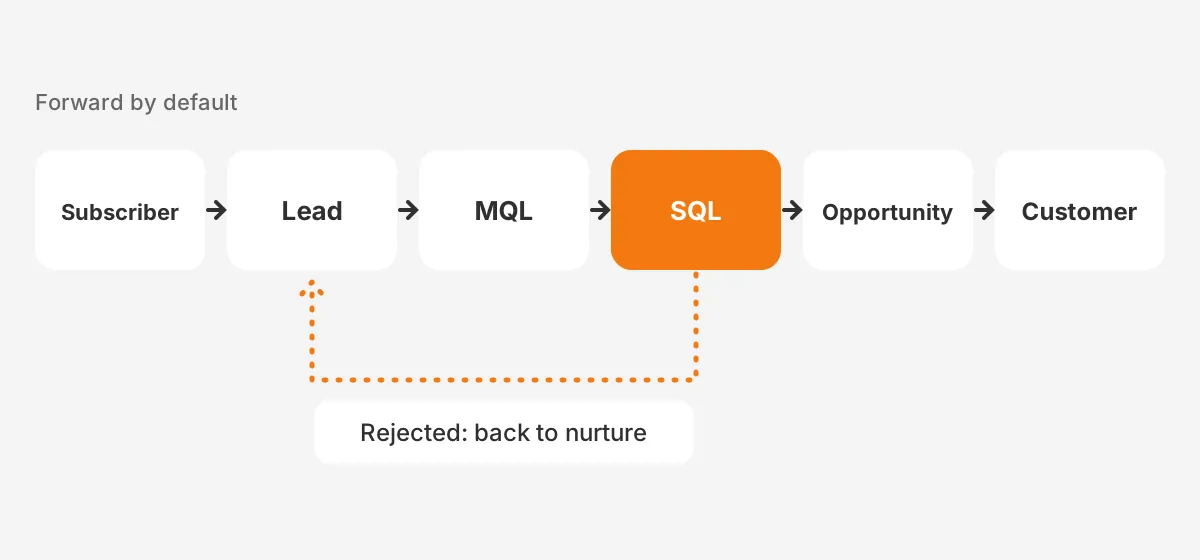
HubSpot ships seven default lifecycle stages, in a fixed order. The HubSpot knowledge base article on lifecycle stages lists them. They are Subscriber, Lead, Marketing Qualified Lead, Sales Qualified Lead, Opportunity, Customer and Evangelist.
Two HubSpot rules matter for B2B lead nurturing design. Automatic updates only move the lifecycle stage forward. To send a lead back to nurture, the value must be cleared manually or by a workflow first. Workflows that set the property need a Professional or Enterprise account.
HubSpot also records the date a record entered and exited each stage, plus cumulative time in stage. Nurture reporting rests on those properties. They show how long leads sit in each stage before they convert or stall.
Salesforce uses a different model. Leads and contacts carry a status field, and Account Engagement (formerly Pardot) tracks prospect score and grade. Some Salesforce teams add a custom lifecycle field so marketing and sales read one stage value.
Whichever platform runs B2B lead nurturing, write three rules for each stage. The entry rule says what moves a lead in. The exit rule says what moves it out. The recycle rule says where a rejected lead goes, and it should always point to a recycle track.
Which Lead Scores Should Trigger a Sales Handoff?
A lead score should trigger a sales handoff when it shows both strong fit and recent buying intent. Fit points come from firmographic data such as industry, company size and job role. Engagement points come from actions such as a pricing page visit or a demo request.
Salesforce Trailhead ranks prospect responses by value. A form submission is the most valuable response. A link click is less valuable, and an email open is the least valuable. A lead scoring model should weight points the same way.
The model below is a worked example with assumed point values. It shows the shape of a scoring model for B2B lead nurturing, not a benchmark to copy.
| Signal | Example points | Why it counts |
|---|---|---|
| Job title in the buying group | +15 | The contact can influence the decision |
| Company in a target industry and size | +15 | The account fits the ideal customer profile |
| Webinar attended | +10 | The buyer gave 45 minutes of attention |
| Case study downloaded | +10 | The buyer is checking proof |
| Pricing page visited twice in 7 days | +20 | Strong sign of active evaluation |
| Demo or contact form submitted | +40 | Direct request for sales contact |
| No engagement for 30 days | -10 | Interest is fading |
In this example, a lead below 30 points stays in early nurture. From 30 to 59 points it becomes a marketing qualified lead with a proof-focused track. At 60 points, or on any demo request, it becomes a sales qualified lead.

Decide when to hand off leads to sales together with the sales team. Pull the last 50 closed-won deals and check the score each contact reached before the first meeting. If most crossed 60 points, the threshold holds. If they crossed at 45, lower it.
The HubSpot lead scoring setup guide covers points and thresholds. The Salesforce lead scoring options for Einstein, Pardot and Flow cover Sales Cloud. Once a lead crosses the line, lead routing rules and models decide which rep receives it.
How Do You Build a B2B Lead Nurturing Program?
A B2B lead nurturing program is built in seven steps, from buyer research to a quarterly review. Each step produces a written output that the next step needs. Skipping early steps is the usual reason a program sends emails but creates no pipeline.
- Interview five recent customers about how they bought. Record who joined the decision, which questions slowed it and what content helped.
- Define the lifecycle stages and write entry, exit and recycle rules for each one.
- Build the lead scoring model with fit and engagement points, then agree the handoff threshold with sales.
- Map content to each stage. Use guides early, case studies and comparisons in the middle, and pricing detail late.
- Write the nurture sequence for each track: the touches, the wait between them and the exit triggers.
- Build the workflows in the marketing automation platform and test them with internal contacts.
- Launch, then review stage conversion rates every quarter and retire content that no one engages with.
Teams cut corners on step one, and it costs them later. Customer interviews reveal the real objections, such as security review, integration risk or a budget cycle. Those objections become B2B lead nurturing emails that answer questions buyers will not ask a rep.
For step six, write a test plan. Enroll three internal contacts, give each a different score, and confirm each one lands in the right track. Check that a demo request exits the nurture sequence at once.
Add suppression rules before launch. Exclude current customers from prospect tracks, and exclude open opportunities and any lead a rep is working. A buyer in a live sales conversation who gets a generic guide email sees two teams that do not talk.
The marketing automation implementation guide covers the platform build in more detail. Unboxx builds each lead nurturing campaign through its AI growth marketing services. That work connects campaign strategy, marketing automation and revenue reporting.
What Cadence and Content Fit Each Nurture Stage?
Cadence should be faster near the start of a nurture track and slower as the track ages. A new lead expects a quick reply, while a lead who has ignored four emails needs space. The table below uses assumed intervals as a starting point.
| Stage | Example cadence | Lead nurturing content | Exit trigger |
|---|---|---|---|
| New lead | Reply within minutes, then day 3 and day 7 | The asset requested, a related checklist | Score reaches 30 |
| Early nurture | Every 10 to 14 days | Guides, benchmarks, webinar invites | Score reaches 30 or 90 days silent |
| Marketing qualified lead | Every 7 days for 5 weeks | Case studies, comparisons, ROI examples | Score reaches 60 or demo request |
| Recycled by sales | Every 21 to 30 days | Product updates, new case studies | Fresh pricing or demo activity |
| Customer | Monthly | Onboarding tips, adoption guides, renewal notes | Renewal or expansion talk |
Salesforce Trailhead gives similar timing in its Engagement Studio program strategies. Its 3-2-1 example waits 7 days, then a longer 10 days. It recommends a long wait step before the end step, and shows a 60-day buffer.
The lead nurturing email cadence also depends on the sales cycle. A four-week cycle supports weekly touches. A nine-month cycle needs slower gaps and more channels, so the buyer does not tire of email.
Count nurture campaign touchpoints across every channel, not only email. A webinar invite, a retargeting ad and an SDR call each count as a touch. Plan seven to ten touches for a mid-sized deal, then adjust from your own data.
Lead nurturing content works best when it answers one question per touch. Use these lead nurturing examples as a test for each email:
- Early stage: "What does a CRM data cleanup cost for a team of 40 users?"
- Middle stage: "How did a manufacturer with three plants cut quote time by half?"
- Late stage: "What does week one of the implementation look like?"
Each email in a B2B nurture campaign should carry one call to action. A second, different offer splits attention and makes the click data harder to read. With one offer per email, each touch stays easy to measure. Every other B2B lead nurturing tactic depends on that clean data.
How Do You Nurture an Entire Buying Group?
To nurture an entire buying group, build a role-based nurture track for each role. Tie the tracks together at the account level. Each role cares about different risks. A champion wants proof of success, finance wants cost certainty and IT wants integration answers.
Gartner names six buying jobs that every buying group completes. They are problem identification, solution exploration, requirements building, supplier selection, validation and consensus creation. B2B lead nurturing content should help the champion finish each job, especially consensus creation.
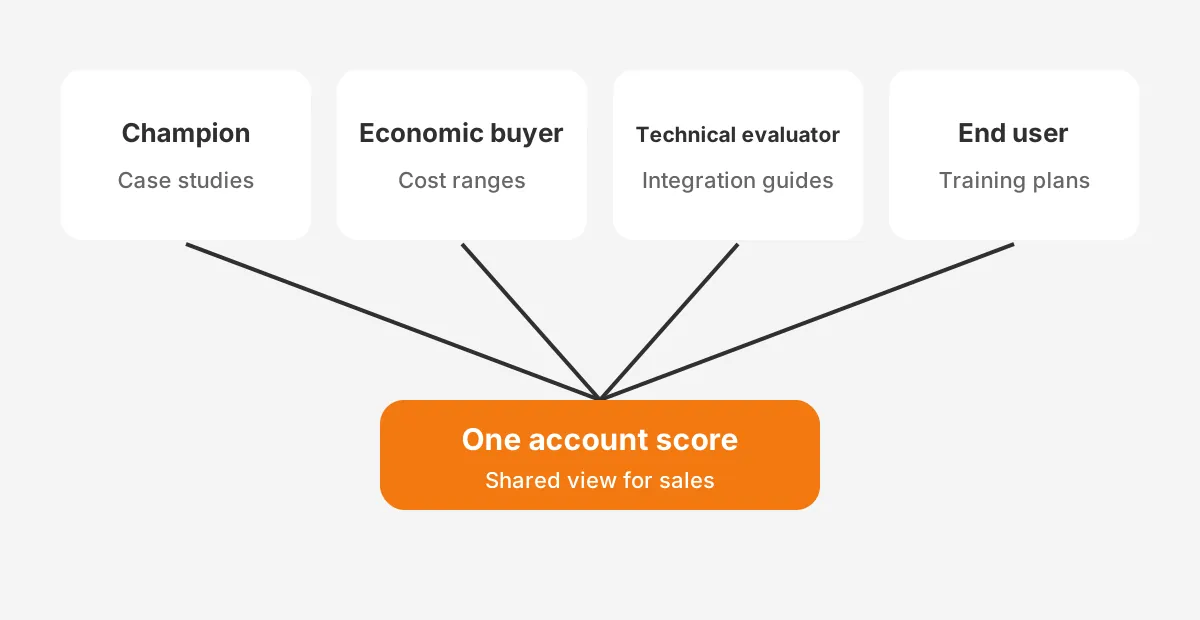
Four role tracks cover most B2B lead nurturing for mid-sized deals:
- Champion: case studies, internal pitch templates and project plans.
- Economic buyer: cost ranges, payback examples and contract terms.
- Technical evaluator: integration guides, security notes and data migration steps.
- End user: short demos, training plans and adoption checklists.
Account nurturing adds an account-level score on top of the contact scores. Suppose three contacts at one company engage in the same month. The account score rises even if no single contact crosses the threshold, which often signals an active evaluation.
Account-based marketing teams take this further with ads aimed at named accounts. Retargeting and LinkedIn ads reach buying group members who never opened an email. Sales development reps then call the account with context from every recorded touch.
Sales stays involved from first touch to handoff. Give reps a weekly list of accounts with rising scores. Let them add personal notes to the next email, because a note from a known rep often gets a reply.
How Do HubSpot and Salesforce Handle Nurture Workflows?
HubSpot runs nurture through workflows and sequences, while Salesforce runs it through Account Engagement and Engagement Studio. Both can deliver a full B2B lead nurturing strategy. The difference lies in where the data lives and how much setup each platform needs.
| Factor | HubSpot | Salesforce with Account Engagement |
|---|---|---|
| Nurture builder | Workflows (Professional and Enterprise) | Engagement Studio programs |
| Stage field | Default lifecycle stage property | Lead status plus a custom lifecycle field |
| Scoring | HubSpot lead scoring tool | Prospect score and grade |
| Sales follow-up | Sequences and tasks | Tasks, Flow and sales engagement tools |
| Data model | One CRM for marketing and sales | Account Engagement syncs with Sales Cloud |
HubSpot workflows fit teams that want marketing and sales in one database. A workflow can enroll contacts by lifecycle stage, wait, send an email, check a score and branch. The Lead Status property then tracks the sales side with values such as Connected and Bad Timing.
Engagement Studio is the natural choice for teams already on Sales Cloud. A program uses actions, triggers and rules on a visual canvas. Wait steps control cadence, and end steps stop the program. Scores and activity then sync to the Salesforce lead or contact record.
Lead nurturing automation needs clean data on either platform. Duplicate contacts split engagement history and lower scores. Before launch, merge duplicates and fill in industry and company size, because the fit score depends on them.
A small team can run a manual nurture sequence from CRM tasks for 30 or 40 leads. It breaks once volume grows, because reps forget follow-ups and no score updates on its own. At that point, a lead nurturing workflow in a platform costs less than the missed deals.
How Should You Measure B2B Lead Nurturing Results?
Measure B2B lead nurturing by the pipeline it creates and the speed at which leads move between stages. Email opens and clicks show whether content lands. They do not show revenue, so treat them as health checks rather than goals.
Track these lead nurturing metrics every month:
- Stage conversion rate, such as the share of marketing qualified leads that become sales qualified leads.
- Time in stage, from the date-entered and date-exited properties on each record.
- Pipeline created from nurtured leads, in deal value.
- Pipeline velocity, which combines deal count, win rate, deal size and cycle length.
- Sales acceptance rate, the share of handed-off leads that sales accepts.
- Unsubscribe and recycle rates for each track.
Here is a worked example with assumed numbers. A track enrolls 400 leads in a quarter. Forty reach marketing qualified lead, 16 reach sales qualified lead and 4 close. A low first conversion points to weak early content. A low last conversion points to sales follow-up.
A holdout group shows the real effect. Keep 10% of new leads out of the track for one quarter. Then compare their stage conversion rate with the nurtured group.
Revenue attribution models assign credit across touches once deals close. For B2B lead nurturing, a multi-touch model gives fairer credit than last touch. The final demo request rarely tells the full story.
Speed to follow-up is usually the first number worth fixing. One Unboxx success story shows how automated HubSpot lead follow-up stops leads going cold. Timed responses give every new inquiry a place in a B2B lead nurture track from day one.
Frequently Asked Questions
How long does lead nurturing take?
Lead nurturing takes as long as the buying cycle, which ranges from four weeks to over a year in B2B. A track should run until the lead converts, opts out or goes silent for 90 days. Then it moves to a slower recycle track instead of stopping.
How does lead nurturing differ from lead generation?
Lead generation captures a new contact through a form, event or ad. Lead nurturing begins after that capture and builds the relationship until the buyer is ready for sales. Generation fills the database, while nurturing turns those contacts into sales qualified leads and pipeline.
Can you nurture leads without marketing automation?
Yes, a small team can nurture leads with CRM tasks, templates and a weekly review. That works for 30 or 40 active leads. Beyond that volume, follow-ups get missed and scores stop updating, so marketing automation becomes the cheaper option for the team.
Who should own the lead nurturing process?
Marketing should own the lead nurturing process, from content to workflows, while sales shares the handoff rules. A revenue operations lead often manages the CRM fields, scoring and reports. Shared ownership of the threshold keeps both teams accountable for the same pipeline number.
What lead nurturing best practices suit small teams?
Start with one track for new leads and one for marketing qualified leads. Write a clear handoff threshold, keep one call to action per email and review conversion every quarter. Add role-based tracks only after the first two produce pipeline and the data is clean.
Where Should Your B2B Lead Nurturing Program Start?
Your B2B lead nurturing program should start with the CRM, not the email copy. Define the lifecycle stages, agree the score threshold with sales and clean the contact data. Then build two tracks, measure stage conversion and expand from there.
Unboxx sets up B2B lead nurturing in HubSpot and Salesforce, from lifecycle fields and scoring to workflows and reporting. To review your current setup with a specialist, schedule a consultation with Unboxx.
Let's create something out of this world together.
Have a project in mind? Contact us for expert design and development solutions. Let's discuss how we can help grow your business.
Ready to Unboxx Your Potential?
Build smarter systems. Automate faster. Scale confidently.