
CRM Strategy: Why Large Organizations Re-Evaluate It
A CFO asks for next quarter's forecast, and three dashboards return three different numbers. Sales leaders trust their own spreadsheets more than the CRM. Forrester reported in 2023 that CRM adoption is high but satisfaction is low, in its CRM market insights post.
Large organizations re-evaluate their CRM strategy when the system no longer matches how they sell, serve and report. Common triggers are mergers, new leadership, low adoption, poor data and rising license costs.
The harder question is what to do next. Some problems need a new platform, but most need better process, cleaner data and a named owner.
Key Takeaways
- Large organizations re-evaluate their CRM strategy when growth, mergers or new leaders change how revenue teams work.
- Most CRM strategy problems come from process, data and ownership gaps, so a platform switch is not always the fix.
- A structured CRM strategy review with clear owners shows whether to optimize, consolidate or replace the platform.
What is a CRM strategy for a large organization?
A CRM strategy is the plan for how a company uses customer data, processes and software. Its purpose is to win and keep revenue. It covers goals, owners, data rules, integrations and the platform itself. The software is one part of the CRM strategy, not the whole of it.
An enterprise CRM strategy adds layers that a small team never meets. Large companies run 3 or more business units, regions and product lines. Each unit wants its own pipeline stages, reports and fields.
A customer relationship management strategy at this scale usually covers six areas:
- Revenue goals that the CRM must measure, such as win rate, renewal rate and forecast accuracy.
- A CRM operating model that says who owns data, process changes and releases.
- CRM governance rules for fields, record ownership, access and change requests.
- System integration with ERP, billing, marketing automation and support tools.
- Compliance requirements such as GDPR, CCPA and data residency rules.
- A CRM roadmap that sequences new features, AI readiness and retirements.
Salesforce, HubSpot and Microsoft Dynamics 365 can all support this work. What separates a good setup from a poor one is the set of decisions around the platform. A CRM strategy written once at launch and never revisited drifts out of date as the business changes.
Size changes the problem from configuration to coordination. A 20-person sales team can agree on stage names in one meeting. A 2,000-person company with partners, service desks and regional finance teams cannot.
Every shared definition needs a written rule, an owner and a way to change it.
If the real question is how to build a CRM strategy from scratch, requirements come first. That early stage is covered in the Unboxx guide to CRM selection for B2B teams.
Why do large organizations re-evaluate their CRM strategy?
Large organizations re-evaluate their CRM strategy because the business changes faster than the CRM does. A system built for one sales model, one region and one product line rarely fits five years later.
Process misalignment is the most cited barrier. Forrester's 2025 State of RevOps survey found that 58% of B2B companies cite process misalignment as their primary growth barrier. The figure is reported in Salesmate's guide to enterprise CRM strategy.
The pressure usually comes from one of five directions:
- Structural change, such as a merger, an acquisition or a new business unit.
- Leadership change, where a new CRO or CIO brings new metrics and forecasting methods.
- Poor user adoption, where reps log in but keep real work in shadow spreadsheets.
- Data quality decline, where duplicates and missing fields break pipeline visibility.
- Cost pressure, where license and customization costs rise faster than the value the CRM returns.
AI has become a sixth trigger. Agents such as Salesforce Agentforce and HubSpot Breeze need clean, connected data to work. A company planning an AI rollout often finds its CRM data is not ready. The AI project then turns into a wider review.
Inertia works against these pressures. A 2012 DestinationCRM viewpoint, Re-evaluating Your CRM Technology, named four reasons large companies resist change. These were existing investment, technical debt, business reactivity and a lack of sponsorship. Those four still explain why reviews start late.
So the decision to re-evaluate CRM strategy is usually reactive. A failed forecast, a lost renewal or an audit finding forces the question. The review then runs under deadline pressure.
What signs show a CRM strategy has stopped working?
The clearest sign is behavior: people stop trusting the data and work around the system. The evidence shows up in reports, in daily habits and in the IT ticket queue.
A 2017 CIO article listed 10 signs your CRM system needs an overhaul. The list included brittle in-house systems, reports that take days and add-ons that break after updates. Nearly a decade later, those signs still hold.
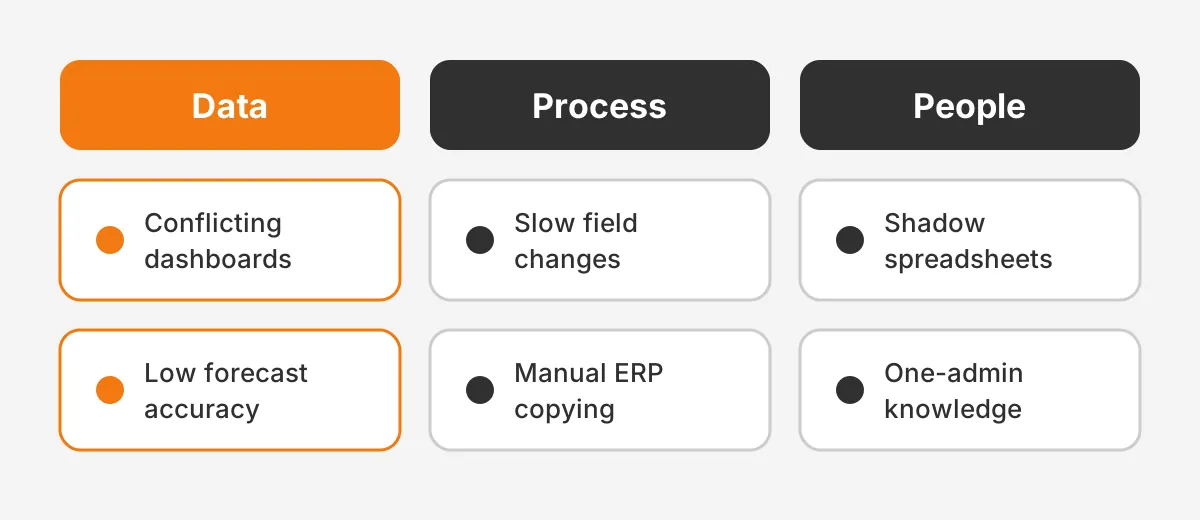
Use these signs your CRM needs an overhaul as a quick health check:
- Forecast accuracy stays low, and leaders adjust numbers by hand before board meetings.
- Reps keep shadow spreadsheets because the CRM does not match their process.
- Dashboards from sales, marketing and finance show conflicting revenue figures.
- Simple field changes wait weeks in an IT queue.
- Customizations break after each vendor release, and testing takes longer every cycle.
- One admin holds all system knowledge, and nothing is documented.
- Integrations need a person to copy data between the CRM and ERP.
Vendor release cycles add pressure of their own. Salesforce ships three major releases a year, and HubSpot updates its platform continuously. Each release can change how a custom field, flow or integration behaves. Teams with heavy custom code spend more time testing each release and less time improving the system.
Most of these signs share a root cause in data silos. When marketing, sales and service each keep a separate customer record, nobody holds a single source of truth.
The Pedowitz Group noted in 2026 that Experian research found organizations believe about one-third of their CRM data is inaccurate. The figure appears in its review of 12 enterprise CRM gaps. Bad data makes every report and AI feature less reliable.
CRM adoption problems deserve a closer look than login counts allow. One practical measure is the share of deals updated within 48 hours of a customer meeting. Unboxx explains these measures in its guide to measuring and raising CRM adoption.
How do mergers and growth force a CRM rethink?
Mergers and growth add users, data models and processes that the original design never planned for. A CRM built for 50 reps behaves differently at 500.
CRM after a merger is the most common large-scale trigger. The acquiring company often inherits a second CRM, a second ERP and a second set of customer IDs. Leaders then face a CRM consolidation decision.
There are three realistic paths:
- Keep both systems and connect them through integration.
- Move the acquired company onto the parent's CRM.
- Move both companies to a new, shared platform.
Each option changes the CRM roadmap for at least a year. Keeping two systems delays cost savings, but it protects the acquired team's sales momentum. A full consolidation cuts license costs, but it needs careful data mapping and change management.
The choice between those options depends on three facts. The first is which system holds the cleaner data. The second is which platform the larger revenue team already uses well.
The third is which contracts renew first. An early renewal date can lock in two sets of licenses for another year.
Teams also need a freeze rule during the decision. New custom fields and automations in either system make the later merge harder.
Unboxx has handled this scenario in a controlled Salesforce migration after an acquisition. The work started with a data audit, not with the platform choice.
Organic growth works more slowly. New regions bring new compliance requirements, such as GDPR in Europe and data residency rules in other markets. New product lines bring new pricing and quoting rules. Each change adds customizations, and each customization adds CRM technical debt.
Growth also changes who uses the CRM. Service, finance and partner teams join sales and marketing. A CRM strategy for large enterprises has to serve all of them without giving each team its own isolated setup.
Should you fix your CRM or replace it?
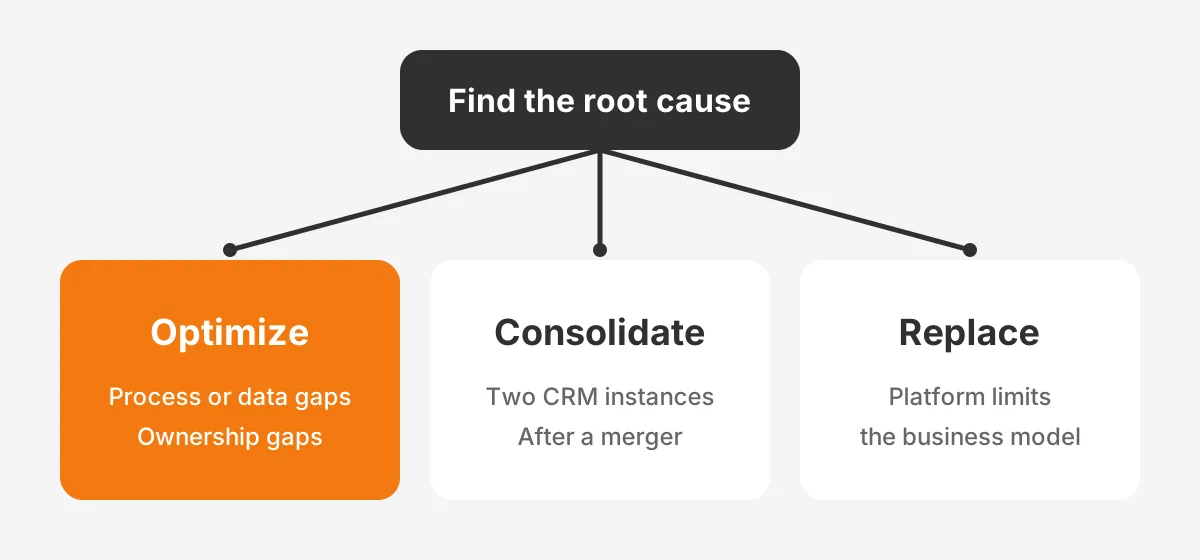
Fix the CRM if the problems come from process, data or ownership. Replace it if the platform cannot support the business model. Most organizations need the fix, not the switch.
The Pedowitz Group's 2026 review argued that the technology is rarely broken and the operating foundation usually is. It cited Harvard Business Review findings of CRM failure rates between 18% and 69%.
Those failures mostly trace to adoption, scope and data problems. A new platform does not solve them on its own.
Use this comparison to decide whether to fix or replace a CRM:
| Factor | Fix and optimize | Replace the platform |
|---|---|---|
| Root cause | Process, data or ownership gaps | Platform limits the business model |
| Data model fit | Objects can be reshaped | Core objects cannot represent the business |
| Customizations | Can be simplified or retired | Technical debt blocks every upgrade |
| Integration | Connectors exist for ERP and billing | Key systems cannot connect at all |
| Cost trend | Stable licenses, rising admin effort | Licensing cost far above value delivered |
| Typical timeline | About 3 to 6 months | About 6 to 12 months or longer |
The timelines in the table are planning ranges from consulting practice, not survey figures. Large data volumes, heavy customizations and strict compliance requirements push both options toward the upper end.
User complaints alone do not answer whether you should replace your CRM. Three questions do:
- Can the current data model represent how the business sells and serves today?
- Would the same process and ownership gaps follow the team to a new platform?
- Does the total cost of ownership of fixing it exceed the cost of CRM platform migration?
When the data model still fits and the gaps would follow the team anyway, fix the current system. Replacing the platform without fixing process moves the same problems to new software. Vendor lock-in also matters, because deep customizations make any later CRM replacement harder.
What does CRM consolidation involve?
Consolidation sits between fixing and replacing. It merges two or more CRM instances, often after an acquisition, into one org or one portal. The platform may stay the same, but the data model, users and processes change.
Consolidation work usually follows four stages:
- Inventory every instance, object, integration and active user.
- Agree on one data model and one set of pipeline stages.
- Deduplicate accounts and contacts before any records move.
- Retire the old instance only after reports match in both systems.
The hardest part is rarely technical. Two sales teams with different habits must agree on shared rules, and that needs a sponsor with authority over both.
For most teams, tuning the current platform is enough. Unboxx's guide to running a scored CRM audit shows how to separate platform limits from setup problems.
What does a failing CRM strategy cost?
A failing CRM strategy costs money in three ways. Licenses return little, staff lose time to manual work and slow follow-up loses revenue. These costs rarely appear on one budget line, so they go unnoticed.
CRM licensing cost is the most visible part. Forrester's 2023 data showed 57% of surveyed organizations expected CRM spending to rise in the next 12 months. Rising spend on a system people avoid widens the gap between cost and value.
A worked example shows the scale. The figures are assumptions, not survey data. Say a company licenses 300 users at $150 per user per month. That is $540,000 a year in licenses alone.
Suppose 40% of those users avoid the CRM and keep shadow spreadsheets. In this example, about $216,000 of yearly license spend supports work that never reaches the system.
The CRM total cost of ownership adds more lines:
- Admin and developer time to maintain custom code and test each vendor release.
- Integration upkeep when the ERP or billing system changes.
- Manual reporting time, where analysts rebuild figures in spreadsheets each month.
- Lost revenue from missed renewals and slow lead follow-up.
Switching has its own costs, and they belong in the same comparison. A move to a new platform adds data migration, integration rebuilds, retraining and a period of lower productivity.
Two systems often run in parallel for weeks. These costs explain why replacement only makes sense when the current platform cannot meet the goals.
The least visible cost is decisions made on bad data. A forecast that misses by a wide margin affects hiring, inventory and cash planning across the company.
A business case for change should put numbers on these lines. Unboxx's guide to calculating and proving CRM ROI gives a formula that fits both the fix and the replace options.
How do you run a CRM strategy review?
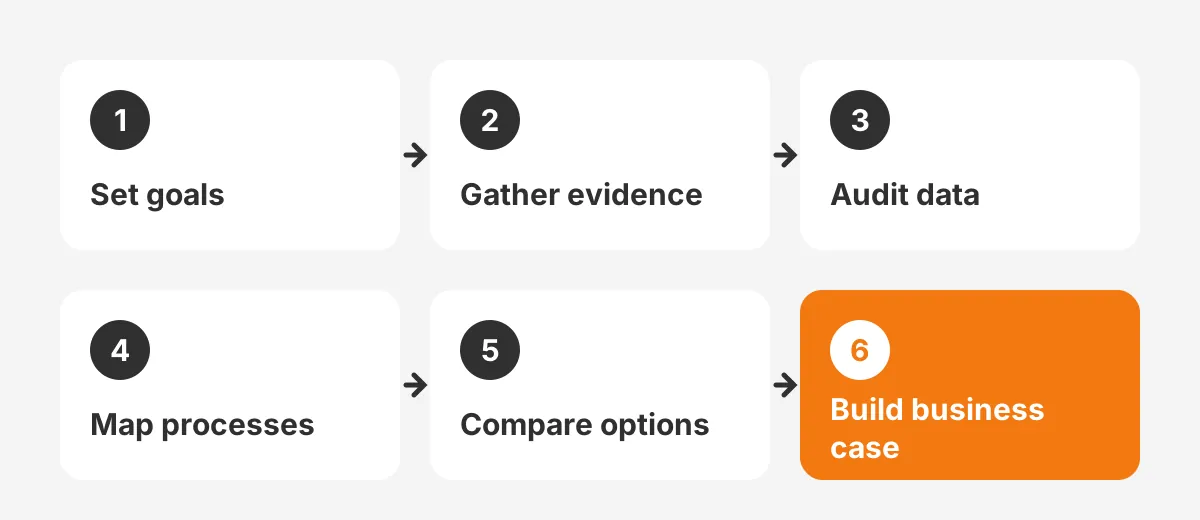
A CRM strategy review moves from goals to evidence to a decision, in six steps. As a planning range, a large organization should allow six to ten weeks. Scope depends on the teams and systems involved.
Each step feeds the next, so the order matters:
- Set the goals. Agree on two or three revenue outcomes the CRM must support, such as forecast accuracy and renewal rate.
- Gather evidence. Run stakeholder interviews with sales, service, marketing, finance and IT users.
- Audit the data. Measure duplicates, empty required fields and record ownership gaps.
- Map the processes. Compare how teams work today with how the CRM records that work.
- Compare the options. Score optimize, consolidate and replace against the goals.
- Build the business case. Put cost, risk and timeline against each option, then decide.
Every step should leave behind something measurable. Goals become target numbers, such as forecast accuracy within 10% of actual results. Evidence becomes a list of pain points ranked by revenue impact.
The data audit becomes a scorecard by object. The process map shows each place where people leave the CRM to finish their work.
A CRM review checklist keeps the work honest. It should cover requirements gathering, data quality scores, integration inventory, customization count and release history. Unboxx's guide to planning a CRM migration lists what to prepare if the review points to a new platform.
Step five is where teams most often slip on how to evaluate a CRM system. CRM vendor evaluation should use real scenarios from the business, not scripted demos. Ask each vendor to show a renewal, a quote and a forecast with sample data.
The finished CRM assessment should be a CRM roadmap, not a slide deck. It names the decision, the owner, the budget and the first 90 days of work. A phased rollout reduces risk whichever option wins.
Unboxx runs these reviews through its CRM consulting services, covering Salesforce, HubSpot, Microsoft Dynamics 365 and Odoo.
Who should own the CRM strategy review?
A senior executive sponsor should own the CRM strategy review, while RevOps or sales operations runs it day to day. IT plays a large part, but a review owned only by IT tends to become a technical project.
The DestinationCRM viewpoint named a lack of sponsorship as one of four barriers to change. Without a sponsor, the review stalls when business units disagree about fields, stages or budget.
A workable split of roles:
- The executive sponsor, often the CRO, COO or CFO, owns the decision and the budget.
- RevOps or sales operations runs the review and owns process design.
- IT owns system integration, security and compliance requirements.
- Business unit leads represent their teams and sign off on process changes.
- A CRM administrator or partner owns CRM governance after the decision.
Ownership also needs a rhythm. A monthly steering meeting reviews adoption, data quality and open change requests. A quarterly session checks progress against the revenue goals. A yearly review asks whether the platform still fits the business, which keeps the next re-evaluation planned rather than forced.
Change management belongs in the plan from the first week. Users who help shape the new process adopt it faster. Training by role works better than one general session for every team.
Organizations without spare internal capacity often bring in a partner for the method and an outside view of the data. The internal sponsor still owns the outcome.
Frequently Asked Questions
How often should a company review its CRM strategy?
A large company should review its CRM strategy once a year, with a lighter check each quarter. Extra reviews make sense after a merger, a leadership change or a major platform release. Regular reviews catch data quality and adoption problems before they become expensive to fix.
How long does a CRM migration take?
Salesmate's 2026 guide puts enterprise CRM implementations at six to twelve months, a fair range for a migration too. The timeline depends on data volume, the number of integrations and how much custom code exists. A phased rollout by region or business unit lowers risk but extends the total schedule.
How is CRM strategy different from CRM implementation?
CRM strategy decides what the CRM must achieve, who owns it and how data and processes should work. CRM implementation is the project that configures the platform to deliver that plan. Why CRM implementations fail usually traces back to a weak or missing strategy, not the software itself.
Is CRM modernization the same as replacing the CRM?
CRM modernization is not always a replacement. It can mean moving legacy CRM customizations to standard features, cleaning data, adding AI readiness or rebuilding integrations. CRM re-platforming is one form of modernization, chosen when the current system cannot support the business model or compliance needs.
How does AI change a CRM strategy review?
AI raises the bar for data quality and system integration in any CRM strategy review. Tools such as Agentforce and HubSpot Breeze depend on complete, connected customer records. A review should test whether data is clean and accessible enough for AI before the company buys new AI licenses.
When should your team start a CRM strategy re-evaluation?
Start a CRM strategy re-evaluation when two or more warning signs appear. Start one before a merger, a new leadership plan or an AI program too.
A review planned early runs on the company's schedule, not the crisis's. Set the goals, data rules and owners first, and the platform choice usually becomes clear.
Unboxx runs CRM strategy reviews for large teams and then delivers the changes they call for. The work covers Salesforce, HubSpot, Microsoft Dynamics 365 and Odoo. Schedule a CRM strategy consultation to review the current setup and agree on a plan.
Let's create something out of this world together.
Have a project in mind? Contact us for expert design and development solutions. Let's discuss how we can help grow your business.
Ready to Unboxx Your Potential?
Build smarter systems. Automate faster. Scale confidently.