
CRM Professional Services Team: Deliverables to Demand
A signed CRM contract often lists hours, roles and a go-live date, but no finished documents. That gap is costly. The PMI Pulse of the Profession 2018 found a 92% project success rate at mature organizations, against 32% at underperformers.
A CRM vendor's professional services team should hand over named, testable deliverables per phase. These include a requirements document, a solution design and a configured system. Migration, test, training and admin documents complete the set. Below is each one, and how to check it before you pay.
Key Takeaways
- Ask the professional services team for named documents and system pieces, each with a written acceptance test.
- Tie every payment milestone in the statement of work to a signed-off deliverable.
- Require a runbook, admin guide and knowledge transfer so your own staff can run the CRM.
What does a CRM vendor's professional services team deliver?
A CRM vendor's professional services team delivers documents, configuration, migrated data and trained users across five phases. The phases are discovery, design, build, test and handover. Together they form the CRM implementation process.
Each phase should end with artifacts your team can open, read and approve. Anyone asking what is CRM implementation will find the answer in these phases. They are the CRM implementation steps every project follows, whatever the platform.
Professional services is the paid consulting arm that sits beside the software license. Salesforce, HubSpot, Microsoft Dynamics 365 and Odoo all sell it directly. Each also works with outside partners.
A CRM implementation partner, a CRM consultancy or an independent CRM consultant sells the same kind of work. Only the contract differs. In every case, the professional services team is selling outputs, and those outputs need names.
A team that bills hours without a deliverables list leaves you paying for activity, with no proof of progress. CRM implementation services that define outputs up front are easier to manage and easier to audit. CRM professional services priced per deliverable are also easier to compare across bidders.
Think of the deliverables in three groups. Planning documents explain what will be built. System deliverables are the configured CRM itself. Handover deliverables let your own staff run it afterwards.
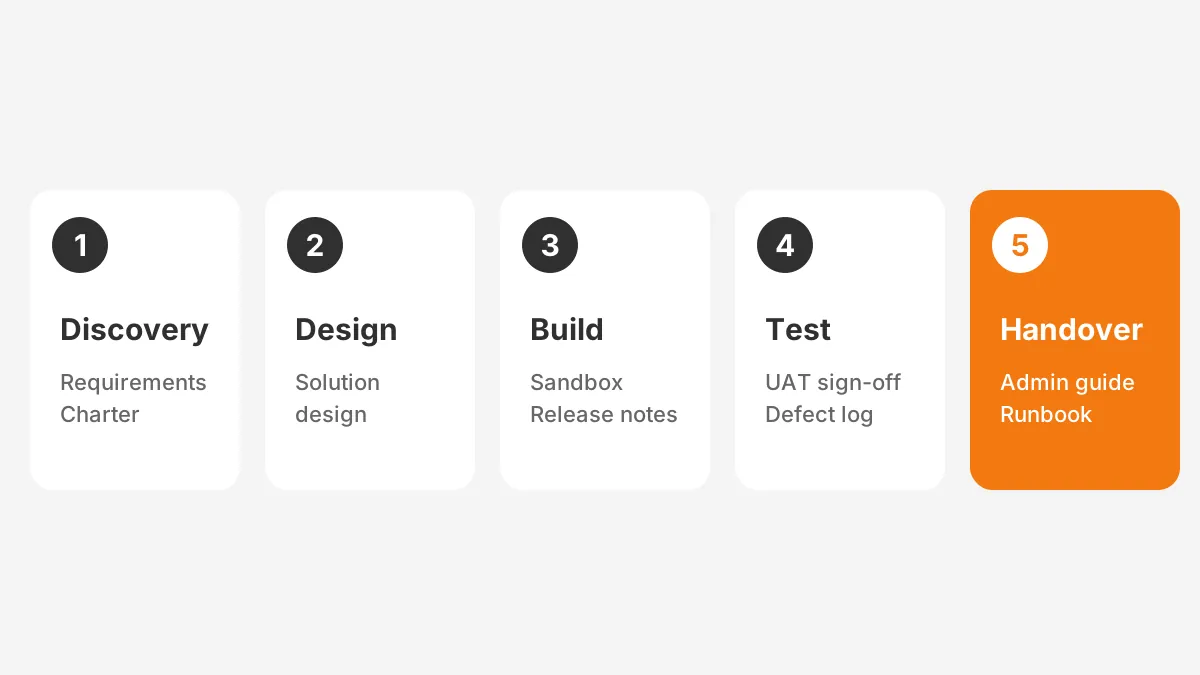
Working this way is how to implement CRM in stages, with one sign-off closing each phase before the next opens. Strong CRM consulting services cover all three groups, not only the build in the middle.
If a phase ends and nothing new exists in writing or in the system, it has not ended. Hold every status meeting with the professional services team to that test.
What should discovery produce before any build starts?
Discovery should end with a project charter, a requirements document and a current-state process map. These three documents fix the scope before anyone touches the system.
Guides on how to implement a CRM system often skip this phase. A CRM system implementation without these documents has nothing to measure later deliverables against. The professional services team should treat them as the first invoice milestone.
The project charter names the sponsor, the goals, the budget and the decision makers. It also records how success will be measured, such as lead response time or pipeline accuracy. It should reach you within the first two weeks.
The requirements document lists each need as a numbered, testable statement. "Sales managers see open opportunities by region" is testable. "Better reporting" is not. For a fuller method, see the Unboxx guide to gathering and scoring CRM requirements.
A requirements traceability matrix belongs in discovery as well. It links every requirement to a design element, a build item and a test case. A requirement that drops out of the matrix shows up at once, before it becomes a missed feature.
A RACI matrix is the last discovery deliverable. It says who is responsible, accountable, consulted and informed for each workstream. CRM implementation companies that skip it tend to find ownership gaps during testing.
Discovery output is also where the CRM implementation project plan begins. A dated plan with owners per task should sit beside the requirements. A CRM implementation roadmap for later phases belongs there too.
The current-state process map shows how leads, deals and service cases move today, step by step. It exposes manual handoffs that the new CRM should remove. Without it, the build tends to copy old habits into new software.
The first invoice then pays for a fixed scope and a fixed schedule. The professional services team should present all of this in one review meeting, with your sponsor present.
What belongs in the solution design document?
The solution design document explains how each requirement will be met in the chosen platform. It covers the data model, automation, security, integrations and reports.
Your team should be able to read it and predict how the finished CRM will behave. Any CRM implementation guide the professional services team shares should match it.
A good solution design document holds these parts:
- An object and field list, with field types and picklist values.
- Automation specs for each Salesforce Flow or HubSpot workflow, with trigger and outcome.
- A security model listing roles, profiles, permission sets and sharing rules.
- An integration design naming each system, sync direction and error handling.
- A report and dashboard list tied to the goals in the charter.
Microsoft builds the same idea into its own method. Its Success by Design framework makes a Solution Blueprint Review mandatory before build. It also makes a Go live Readiness Review mandatory before launch.
Ask any CRM implementation consultant for an equivalent review on Salesforce, HubSpot or Odoo. A professional services team that resists a design review before build is a warning sign.
Sign the design before the build starts. Changes after sign-off should go through a change order with a price and a date. Pricing each change in the open is the most practical defense against scope creep, since nothing new arrives free.
When the CRM connects to an ERP or billing tool, request an integration specification as a separate annex. It should name the middleware, the sync frequency and the owner of each field. Sync choices and field ownership get more detail in the Unboxx CRM implementation plan guide.
How can you confirm the build is finished?
Build deliverables prove the work is done when they exist in a sandbox you can log into. Release notes should match the design line by line.
A status report that says "80% complete" proves nothing. A configured object you can test proves a lot. One of the simplest CRM implementation best practices is to never accept a build you cannot open.
For any CRM software implementation, ask the professional services team for these build outputs:
- A configured sandbox that mirrors the approved solution design.
- Release notes listing every object, field, automation and report built.
- Source control or change set records for each deployment.
- Integration logs showing successful test syncs with each connected system.
- A deployment plan for moving changes to production.
Sandbox access matters because the platforms limit it. On Salesforce, Enterprise Edition includes 25 Developer sandboxes and one Partial Copy sandbox. A Full sandbox is not available in Professional Edition, per Salesforce Help (2026).
HubSpot sandboxes come only with Enterprise subscriptions, according to HubSpot's knowledge base (2026). A HubSpot sandbox copies 5,000 contacts at creation and deploys up to 300 changes at a time.
On a Professional tier, ask the professional services team how it will test without a sandbox. Agree in writing which environment the build happens in.
Here is a worked example with assumed figures. Suppose the design lists 40 custom fields, 12 automations and 8 reports. The release notes should then list the same 60 items, each marked built and unit-tested. Any gap between the two lists is unfinished work, whatever the status report says.
Release management should be a named deliverable too. Each release needs a version number, a list of changes and a rollback step. This makes CRM governance after go-live far easier, since your admin can trace every change.
What should a data migration hand over?
You should demand a data migration plan, a field mapping document, test load results and a final validation report. CRM data migration touches every record you own, so these deliverables need the clearest acceptance tests.
The data migration plan lists every source system, the record counts, the order of loads and the cleansing rules. It should name who decides when two duplicate records conflict. Cleansing rules are set out step by step in the Unboxx CRM data cleansing runbook.
The field mapping document shows each source field, its target field, any transformation and a default value. The professional services team should supply it as a spreadsheet, so your team can review it line by line.
Test loads come next. The professional services team should load a sample into a sandbox and report record counts in and out, plus errors. A Partial Copy sandbox on Salesforce holds 5 GB of data, which suits most sample loads.
The cutover plan is the final migration deliverable. It lists each step for go-live weekend, with times and owners. It also sets a freeze period for the old system and a rollback trigger.
A cutover plan without a rollback trigger is incomplete. Ask the professional services team to rehearse the cutover once in a sandbox before the real weekend.
The validation report closes the work. It compares record counts and spot-checks key records, such as open opportunities and active accounts. Sign it only when the numbers reconcile.
Which tests must pass before go-live?
Testing deliverables protect your go-live date by proving each requirement works before real users depend on it. Ask for a test plan, test scripts, defect logs and signed user acceptance testing results.
Teams implementing a CRM system often compress this phase, so its outputs need names and owners. The professional services team should own the plan, while your users own the results.
System integration testing comes first. It checks that the CRM and every connected system pass data correctly, including error cases. The output is a test log with pass or fail per scenario.
User acceptance testing comes after that. Your own staff run the scripts, using realistic records. The professional services team writes the UAT test plan and the scripts. Each script should map back to a numbered requirement.
Where data volume matters, ask where load testing will happen. Salesforce Help states that only a Full sandbox supports performance testing, load testing and staging. A Full sandbox refreshes every 29 days, so book the window early.
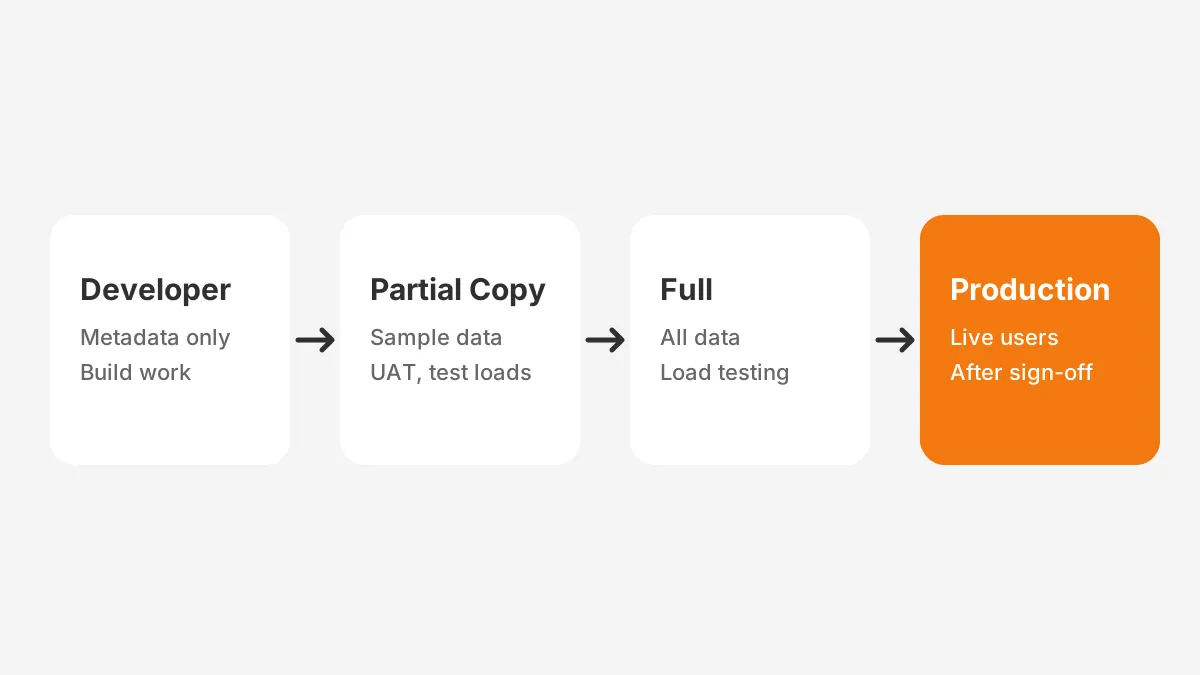
The last testing deliverable is a go live checklist. It confirms that open defects are closed or accepted, users are trained, data has reconciled and support contacts are set.
Approve go-live against this list, never against a calendar date alone. A professional services team with a strong record will welcome that rule.
What must handover include for your team?
The handover deliverables that matter most are the admin guide, the runbook, the training plan and a recorded knowledge transfer. Together they let your team run the CRM without calling the vendor for every change.
The admin guide documents how the system is built: objects, automation, integrations and security. CRM documentation like this should match the final build, not the first design. It should arrive as an editable file.
The runbook covers routine tasks and incidents. It explains how to add a user, change a picklist, restart a failed sync and restore a deleted record. Each task should take one page or less.
CRM training needs its own plan. It should name each user group and the format of each session. It should also list the material left behind, such as short videos or quick-reference sheets.
Role-based sessions for sales, service and managers work better than one session for everyone. It also pays to have the professional services team train your admin as a future trainer.
Knowledge transfer is a set of working sessions where the vendor's CRM consultants walk your admin through the build. Record them. Then agree a hypercare period in writing, with a fixed length, named contacts and response times.
Change management sits across all of this, because training alone does not change habits. An adoption plan should set usage measures, such as weekly logins and records updated per rep. The Unboxx article on measuring and raising CRM adoption lists the measures worth tracking.
How should the statement of work define acceptance?
The statement of work should define acceptance in three parts for each payment milestone. Those parts are a named deliverable, a written test and a sign-off owner. That structure turns a vague promise into a contract you can enforce.
For anyone asking what is a statement of work, the answer is short. It is the contract annex that fixes scope, deliverables, price and acceptance. It is the main tool for holding a professional services team to its promises.
David Taber made the core point in CIO (2013). A specification without a test or a clear go or no-go threshold is a wish list. The same applies to every deliverable in the SOW.
Your legal team will know how to write a statement of work. Your job is to supply the deliverables and tests. A strong statement of work includes:
- A deliverables list with an acceptance test for each item.
- An out-of-scope list, written as plainly as the in-scope list.
- Assumptions behind the estimate, such as data volume and user count.
- A change order process with pricing rules.
- Payment milestones linked to signed deliverables, not dates.
Pricing model affects how acceptance works. A fixed price contract shifts delivery risk to the vendor, so scope must be precise. Time and materials keeps scope flexible but needs weekly reports against the plan.
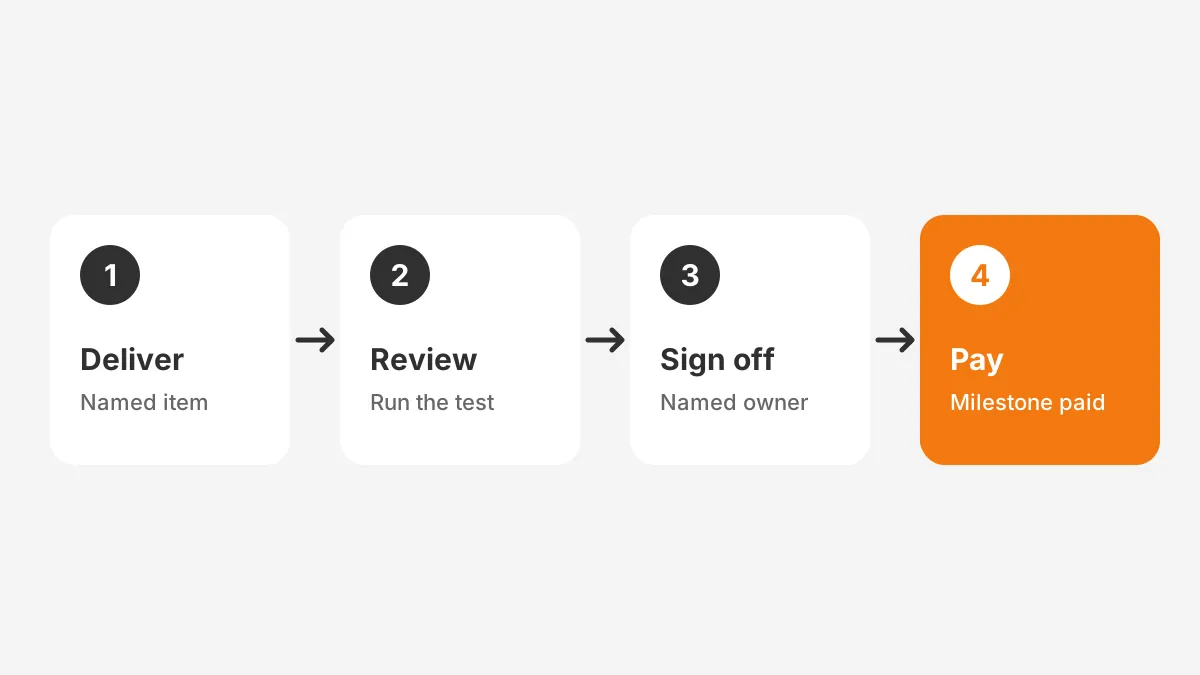
The table below maps each phase to its deliverables and a fair acceptance test. Write these acceptance criteria into the contract word for word.
| Phase | Deliverables | Acceptance test |
|---|---|---|
| Discovery | Project charter, requirements document, RACI matrix | Sponsor signs scope and numbered requirements |
| Design | Solution design document, integration specification | Every requirement traced to a design element |
| Build | Configured sandbox, release notes, deployment plan | Release notes match the sandbox |
| Data | Migration plan, field mapping, validation report | Record counts reconcile with source systems |
| Test | Test scripts, defect log, UAT sign-off | No open critical defects |
| Handover | Admin guide, runbook, training plan, recordings | Your admin completes runbook tasks alone |
Use a statement of work template from your legal team, then add this table as an annex. A statement of work example from a past project helps too. Ask the professional services team to share one with names removed.
Is a CRM vendor's professional services team worth it?
A CRM vendor's professional services team is worth it when you need deep product knowledge on one platform. It is less suited to work that spans two or more vendors or needs heavy integration.
A vendor's professional services team works on one product, so its consultants know the features and limits in depth. It can also route product issues to the vendor's own support teams. That helps with complex features in Salesforce, HubSpot or Dynamics 365.
A certified CRM partner can be more flexible. That might be a Salesforce implementation partner, a HubSpot Solutions Partner or one of the Dynamics CRM implementation partners.
Independent CRM consulting companies also connect the CRM to ERP, finance and marketing tools from other vendors. Unboxx compares these hiring models in its guide on how to hire a Salesforce consultant.
Whichever CRM implementation company you choose, apply the same deliverables list. Ask each professional services team for a sample solution design document and a sample admin guide from past work. Those samples predict project quality better than a sales presentation.
Cost structure differs as well. A vendor's professional services team often prices by role and day rate. A partner may offer fixed-fee packages per phase. Neither model is better by default, so compare them on the same deliverables list and the same acceptance tests.
Check three things before signing. Does the proposal name deliverables, not only hours? Does it include hypercare and knowledge transfer? Does it say who owns each document after go-live?
A "no" to any of these is worth raising before the contract goes out. The answer shows how the professional services team will behave when the project gets hard.
Frequently Asked Questions
Why do CRM implementations fail?
The common reasons why CRM implementations fail are vague scope, unclear ownership and late adoption work. Requirements stay loose, testing is rushed and users are trained too late. Named deliverables, signed acceptance tests and an adoption plan address all three before the build begins.
How long does a CRM implementation take?
Timelines vary with scope, user count and integrations. Projects with data migration and ERP integration run longer than a single-team rollout. The deliverables list sets the real timeline. Ask each vendor to date every deliverable in the plan, then compare those plans across bidders.
How much does a CRM implementation cost?
Cost depends on users, integrations and data volume, and rarely on license price alone. Ask each vendor to price the same deliverables list, so quotes compare like for like. Unboxx breaks down the budget drivers in its CRM implementation cost guide.
Statement of work vs scope of work: what differs?
The statement of work vs scope of work question comes down to breadth. A scope of work describes tasks and boundaries. A statement of work is the wider contract document, holding deliverables, timeline, acceptance criteria, pricing and change rules. For CRM projects, always sign a full statement of work.
Who should own CRM deliverables after go-live?
Your internal CRM admin or operations lead should own every deliverable after go-live. The vendor hands over editable files, logins and recordings at the end of hypercare. Write that transfer into the contract, including where documents will live and who updates them.
How can Unboxx help you check CRM deliverables?
Unboxx reviews proposals and statements of work for CRM projects on Salesforce, HubSpot, Dynamics 365 and Odoo. It checks that a professional services team names every deliverable, with acceptance tests and payment milestones.
Unboxx also delivers this work directly through its CRM implementation services. To review a proposal or plan your next rollout, schedule a consultation with the Unboxx team.
Let's create something out of this world together.
Have a project in mind? Contact us for expert design and development solutions. Let's discuss how we can help grow your business.
Ready to Unboxx Your Potential?
Build smarter systems. Automate faster. Scale confidently.